One contract covers the paint, glass, sign and door work on refurbishments across Chalk Farm and Greater London. That saves you chasing separate trades for a job that has to look like one piece.
It helps if you can be there when we visit Chalk Farm, since five minutes walking the frontage together answers more than a long email.
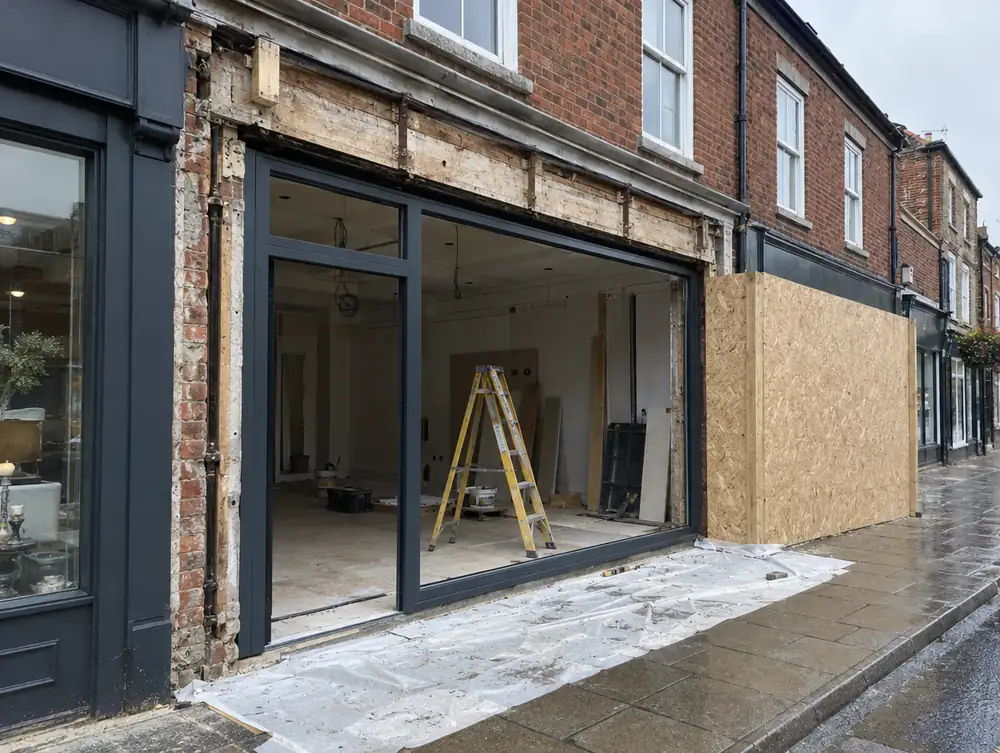
What makes shopfront refurbishment work well on Chalk Farm premises?
Where budget is the limit, we rank the work by what people see first. The fascia, the door and the lower part of the frontage usually matter most, and the rest can follow as a second stage.
Where the frontage is timber, we probe the sills, bottom rails and door jambs before quoting. Rot usually starts low, and a spliced repair in hardwood can save more of the joinery than you might expect.
If the pavement falls across your frontage, let the stallriser take up the slope and keep the glass line dead level. The eye reads the long horizontal, so Chalk Farm premises on a slope look settled once that line is true.
How much should you set aside for shopfront refurbishment in Chalk Farm?
Allow £1,995 to £8,995 plus VAT depending on what is kept. Size and specification set most of that figure for shopfront refurbishment, and the rest depends on what the survey finds on site.
Could shopfront refurbishment in Chalk Farm need planning permission?
Security grilles and shutters are named in England's rules: installing or replacing one on a shopfront sits outside the shop permitted development rights. The frontage itself is treated the same way, so for shopfront refurbishment at premises in the Chalk Farm area, building work that materially affects the appearance needs planning permission. Confirm the position with the council before anything is ordered.
Expect planning and advert applications here to go to London Borough of Camden in the normal way. We check what that means for your building when we survey it in Chalk Farm.
| Town | Chalk Farm |
|---|---|
| Area | Greater London |
| Postcode districts | N1C, NW1, NW3, NW5 |
| Planning authority | London Borough of Camden |
| Building approval | Building Regulations (Approved Documents) |
| Distance from Great Barr | About 102 miles |
| Survey | Free for new work |
Does London Borough of Camden publish shopfront guidance?
Yes, Camden Planning Guidance: Design (Chapter 6: Shopfronts) (2021). It tells applicants what the council expects from new and altered shopfronts. A few of the things it asks for:
- Existing stall risers should be kept, and new ones should be at least 300mm high or reach the top of the pilaster base or door panel.
- Solid shutters are only acceptable in exceptional circumstances, and internal security measures are strongly encouraged.
- Uncoated shutters, galvanised steel, milled finishes and anodised aluminium are not acceptable finishes.
Questions about shopfront refurbishment in Chalk Farm
How do I know if my Chalk Farm shopfront needs replacing?
A measured survey will show you. We check the frame, joints, door and glass, then tell you plainly whether refurbishment will last or whether a new shopfront would be better value.
Will the work match my other premises in Greater London?
Yes, if you can share colour references and sign files from an existing site. We match finishes as closely as the frame allows, and we show you a sample first.
Can my Chalk Farm shopfront be refurbished without closing?
Usually, yes. Work is split into stages around your trading hours, and closed-day or out-of-hours work can be arranged for anything that affects the door.
Does a shop sign in the Chalk Farm area need advertisement consent?
Not always. In England, an unlit sign within Class 5 of the 2007 Advertisement Regulations generally needs no application, and neither does a lit sign within Class 4B. Anything outside those classes needs consent, and Class 4B isn't available in conservation areas, so check before ordering.
Does a new shopfront in the Chalk Farm area need Building Regulations approval?
Assume yes until building control says otherwise. England has no like-for-like exemption, though registered installers can self-certify replacement windows and doors in non-dwellings. That route doesn't cover structural glass, curtain walling or revolving doors.