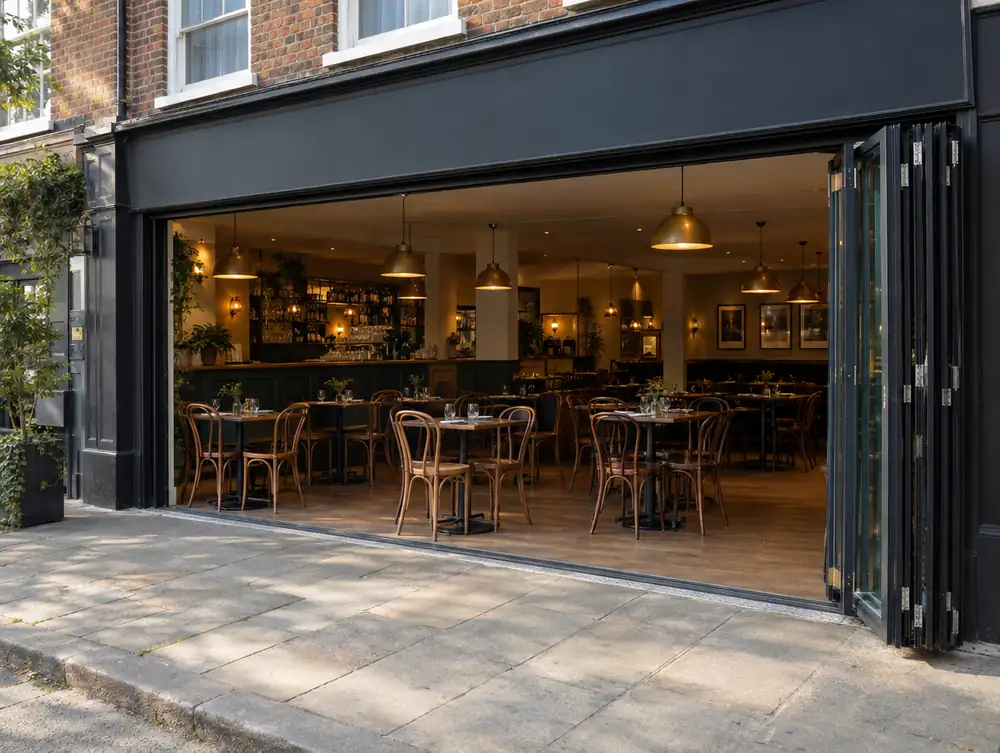
On a warm evening, an open front does more for a cafe or bar in Chalk Farm than any sign. We design the folding set around your seating, so the panels park where they don't cost you a table.
Please have keys to any meter cupboards and shutter housings to hand when we survey in Chalk Farm, because what sits behind them can change the drawing.
What makes bi-folding shopfronts work well on Chalk Farm premises?
Landlords often worry about what a bi-fold does to the structure and the weather line. For a unit in Chalk Farm we'd prepare a drawing of the head, threshold and reinstatement route, so the conversation is about detail rather than doubt.
On a narrow Chalk Farm unit, the stack can swallow the opening. We'd limit the set to three panels, or look at a single sliding leaf, so the opening you gain outweighs the width lost to parked frames.
Where units share one long run of fascia, breaking the height makes you stand out for the wrong reason. If that describes your Chalk Farm parade, keep the line and win attention with lettering, lighting and what's in the window.
Could bi-folding shopfronts in Chalk Farm need planning permission?
England has no permitted development route for changing a shopfront. Part 7 Class A of the General Permitted Development Order 2015 excludes creating, altering or replacing one, and it allows no alterations at all on article 2(3) land. That leaves two outcomes for bi-folding shopfronts at premises in the Chalk Farm area: a planning application, or work that doesn't materially affect the external appearance.
Expect planning and advert applications here to go to London Borough of Camden in the normal way. We check what that means for your building when we survey it in Chalk Farm.
How much should you set aside for bi-folding shopfronts in Chalk Farm?
Allow £5,195 to £13,995 plus VAT for a typical opening. Size and specification set most of that figure for bi-folding shopfronts, and the rest depends on what the survey finds on site.
| Town | Chalk Farm |
|---|---|
| Area | Greater London |
| Postcode districts | N1C, NW1, NW3, NW5 |
| Planning authority | London Borough of Camden |
| Building approval | Building Regulations (Approved Documents) |
| Distance from Great Barr | About 102 miles |
| Survey | Free for new work |
Does London Borough of Camden publish shopfront guidance?
Yes, Camden Planning Guidance: Design (Chapter 6: Shopfronts) (2021). It tells applicants what the council expects from new and altered shopfronts. A few of the things it asks for:
- Existing stall risers should be kept, and new ones should be at least 300mm high or reach the top of the pilaster base or door panel.
- Solid shutters are only acceptable in exceptional circumstances, and internal security measures are strongly encouraged.
- Uncoated shutters, galvanised steel, milled finishes and anodised aluminium are not acceptable finishes.
Questions about bi-folding shopfronts in Chalk Farm
Can the threshold be level at my Chalk Farm premises?
It can be close to level, depending on the floor and drainage. We'd check the levels at survey, because a track sitting flush with the pavement still needs somewhere for water to go.
How many panels would my Chalk Farm opening need?
It depends on the width and how you want the set to open. Most openings divide into leaves under 1m wide, and an odd number gives you a daily door, so we draw the options after the measure-up.
Who do I speak to about a bi-fold in Chalk Farm?
Your named contact stays the same from the first visit to the final adjustment. Fitting is carried out by vetted teams working under S&K Glazing, travelling from Great Barr.
Does the Equality Act apply to a shop entrance in the Chalk Farm area?
Yes. The Equality Act 2010 applies in England, as across Great Britain, and it requires reasonable steps to remove, alter or avoid physical features that disadvantage disabled people. The duty is anticipatory, so it looks at disabled people generally, and a new Services Code replaced the 2011 Code on 5 August 2026.
Do I need listed building consent for a shopfront in the Chalk Farm area?
Usually yes, if the building is listed. In England the local planning authority decides, and Historic England is notified of Grade I and II* works and specified Grade II works. Like-for-like repair may not need consent, so ask the council before work starts.