Panels that fold away should still look right when closed, since that is how a front in Camden Town spends most of the year. We keep the widths even, the rails aligned and the frames slim, so the set reads as a shopfront.
It helps if you can be there when we visit Camden Town, since five minutes walking the frontage together answers more than a long email.
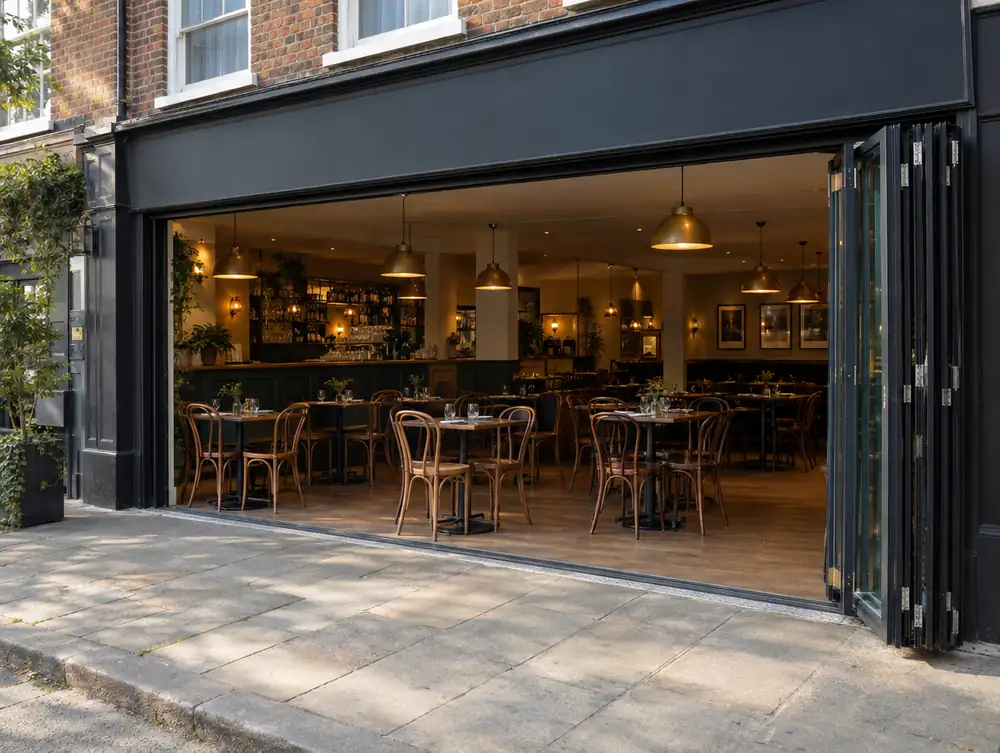
What goes into getting bi-folding shopfronts right in Camden Town?
Bi-folds suit a two-stage fit at Camden Town premises that trade late. We'd take the old front out and fix the frame during closed hours, then hang and adjust the panels the following night, with temporary boarding in between.
If your Camden Town frontage faces the sun, a bi-fold doubles as ventilation. We'd pair it with an awning so the room stays usable at midday, and look at solar control glass for the days the set stays closed.
Where the building has good brick or stone around the opening, set the frame back in the reveal so the masonry can be seen. On Camden Town premises with a flat elevation, that deep reveal throws a shadow line that adds real depth in low sun.
How much could bi-folding shopfronts in Camden Town cost you?
Allow £5,195 to £13,995 plus VAT for a typical opening. Size and specification set most of that figure for bi-folding shopfronts, and the rest depends on what the survey finds on site.
Which applications might bi-folding shopfronts in Camden Town involve?
A true like-for-like replacement usually needs no planning permission in England, because the external appearance isn't materially affected. New materials, a different glass line or altered proportions usually do count as material, so for bi-folding shopfronts at premises in the Camden Town area, an application is then likely. The council confirms which side of that line a job falls on.
Planning and advert applications for Camden Town premises normally go to London Borough of Camden. We check the position for your address at survey.
| Town | Camden Town |
|---|---|
| Area | Greater London |
| Postcode districts | NW1, NW3, NW5, WC1H |
| Planning authority | London Borough of Camden |
| Building approval | Building Regulations (Approved Documents) |
| Distance from Great Barr | About 102 miles |
| Survey | Free for new work |
Does London Borough of Camden publish shopfront guidance?
Yes, Camden Planning Guidance: Design (Chapter 6: Shopfronts) (2021). It tells applicants what the council expects from new and altered shopfronts. A few of the things it asks for:
- Existing stall risers should be kept, and new ones should be at least 300mm high or reach the top of the pilaster base or door panel.
- Solid shutters are only acceptable in exceptional circumstances, and internal security measures are strongly encouraged.
- Uncoated shutters, galvanised steel, milled finishes and anodised aluminium are not acceptable finishes.
Questions about bi-folding shopfronts in Camden Town
Can the threshold be level at my Camden Town premises?
It can be close to level, depending on the floor and drainage. We'd check the levels at survey, because a track sitting flush with the pavement still needs somewhere for water to go.
Who do I speak to about a bi-fold in Camden Town?
Your named contact stays the same from the first visit to the final adjustment. Fitting is carried out by vetted teams working under S&K Glazing, travelling from Great Barr.
Which way should the panels fold at my Camden Town premises?
Inward is the usual answer, since panels folded into the room stay clear of people on the pavement. We'd draw the options where the room allows, and you choose against your seating plan.
Does a shop sign in the Camden Town area need advertisement consent?
Not always. In England, an unlit sign within Class 5 of the 2007 Advertisement Regulations generally needs no application, and neither does a lit sign within Class 4B. Anything outside those classes needs consent, and Class 4B isn't available in conservation areas, so check before ordering.
Do I need listed building consent for a shopfront in the Camden Town area?
Usually yes, if the building is listed. In England the local planning authority decides, and Historic England is notified of Grade I and II* works and specified Grade II works. Like-for-like repair may not need consent, so ask the council before work starts.