Underneath a dated frontage there may be something worth saving. Where Camden Town premises have been overclad, we look behind the panels before anything is ordered.
A survey in Camden Town usually starts outside, looking at the whole elevation before any tape comes out, because the frontage has to answer the building above it.
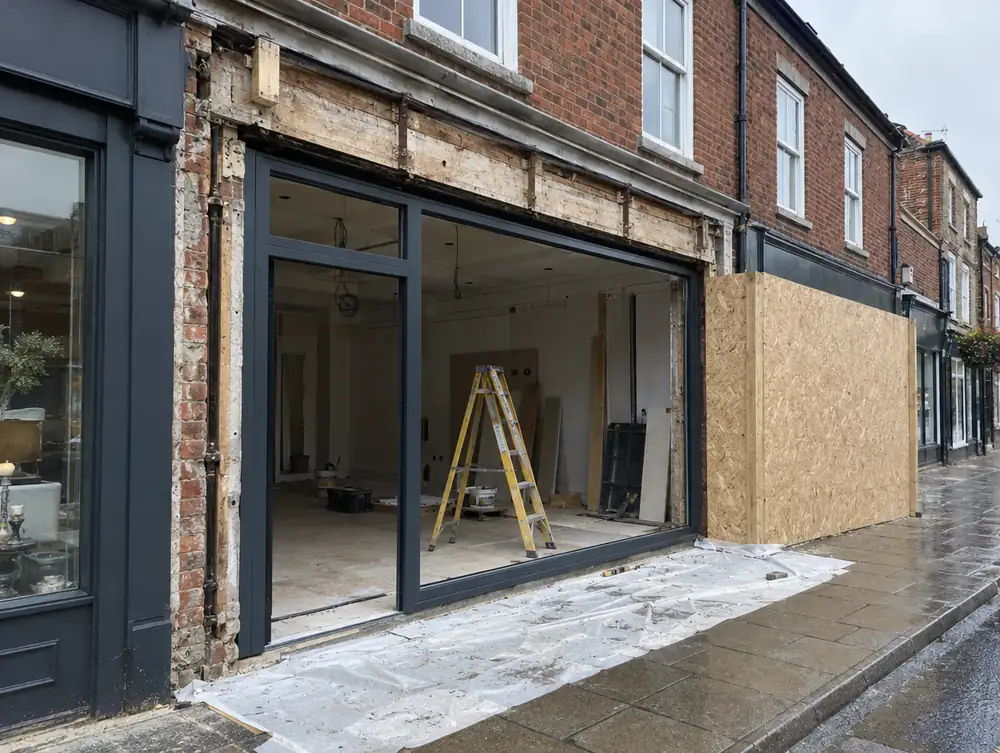
What goes into getting shopfront refurbishment right in Camden Town?
Where the frontage is timber, we probe the sills, bottom rails and door jambs before quoting. Rot usually starts low, and a spliced repair in hardwood can save more of the joinery than you might expect.
Should your Camden Town premises have an older door, we look at the closer, the hinges and the threshold along with the finish. A door that opens easily and closes quietly does more for the frontage than a fresh coat of paint.
Where units share one long run of fascia, breaking the height makes you stand out for the wrong reason. If that describes your Camden Town parade, keep the line and win attention with lettering, lighting and what's in the window.
Which applications might shopfront refurbishment in Camden Town involve?
For shopfront refurbishment at premises in the Camden Town area, the deciding question in England is whether the building work materially affects the external appearance. If it does, planning permission is needed, while a true like-for-like replacement usually needs none. The council confirms the position for each site.
Planning and advert applications for Camden Town premises normally go to London Borough of Camden. We check the position for your address at survey.
How much could shopfront refurbishment in Camden Town cost you?
We would budget £1,995 to £8,995 plus VAT depending on what is kept. Scope sets most of the figure, so a clear brief at the start does more for the budget than any later change of detail.
| Town | Camden Town |
|---|---|
| Area | Greater London |
| Postcode districts | NW1, NW3, NW5, WC1H |
| Planning authority | London Borough of Camden |
| Building approval | Building Regulations (Approved Documents) |
| Distance from Great Barr | About 102 miles |
| Survey | Free for new work |
Does London Borough of Camden publish shopfront guidance?
Yes, Camden Planning Guidance: Design (Chapter 6: Shopfronts) (2021). It tells applicants what the council expects from new and altered shopfronts. A few of the things it asks for:
- Existing stall risers should be kept, and new ones should be at least 300mm high or reach the top of the pilaster base or door panel.
- Solid shutters are only acceptable in exceptional circumstances, and internal security measures are strongly encouraged.
- Uncoated shutters, galvanised steel, milled finishes and anodised aluminium are not acceptable finishes.
Questions about shopfront refurbishment in Camden Town
Will the work match my other premises in Greater London?
Yes, if you can share colour references and sign files from an existing site. We match finishes as closely as the frame allows, and we show you a sample first.
Can you repair a timber shopfront in Camden Town?
Yes. Decayed sections are cut out and spliced with new hardwood, then primed and painted. That keeps the joinery you have, and it usually costs far less than making a new frontage.
Can a refurbishment make my Camden Town premises easier to enter?
Often, yes. Lighter door closers, better handles and a lower threshold can all be added without replacing the frontage. We check the door width and the step at survey.
Do roller shutters need planning permission in the Camden Town area?
Usually yes. Installing or replacing a security grill or shutter on a shopfront is expressly outside England's shop permitted development rights, so the only way to avoid an application is work that doesn't materially affect the appearance. Ask the council before ordering.
Does the Equality Act apply to a shop entrance in the Camden Town area?
Yes. The Equality Act 2010 applies in England, as across Great Britain, and it requires reasonable steps to remove, alter or avoid physical features that disadvantage disabled people. The duty is anticipatory, so it looks at disabled people generally, and a new Services Code replaced the 2011 Code on 5 August 2026.