Across Greater London, a frameless door is often the simplest way to modernise an entrance. For Chalk Farm premises, we look first at the floor, because the spring box needs depth to sit in.
Surveys for Chalk Farm are booked with you directly. Tell us your quieter days and we'll work around them.
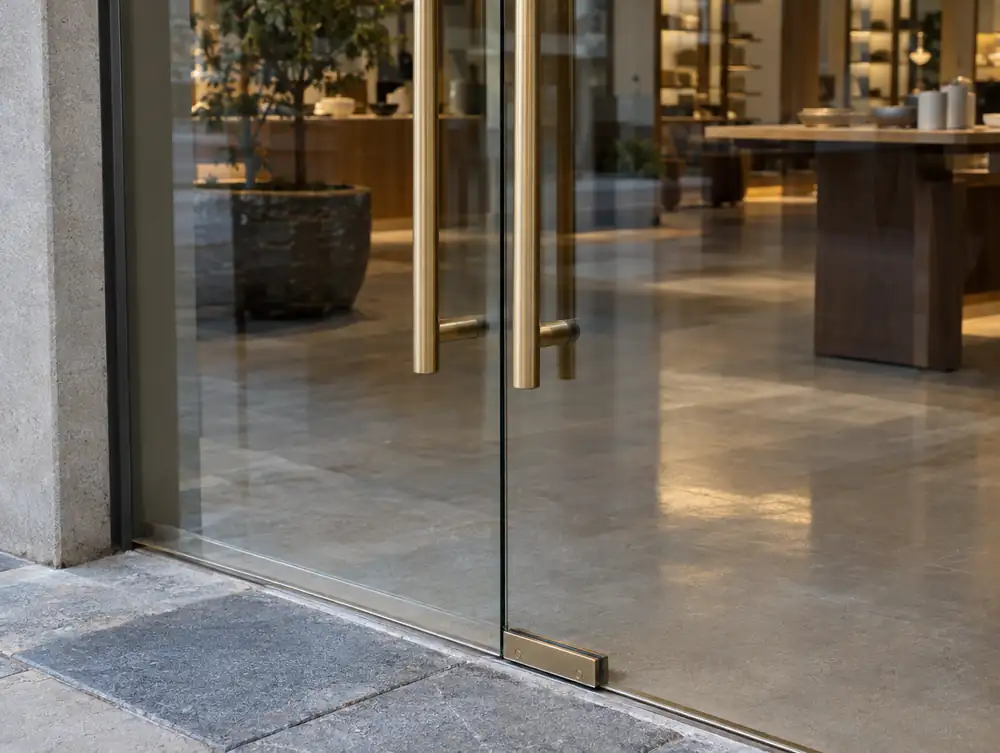
What should you think about before commissioning frameless glass doors in Chalk Farm?
If a landlord in Chalk Farm controls the frontage, a glass door is often an easy approval because so little changes visually. We'd supply a drawing showing the door, the fittings and any markings on the glass.
On a corner plot in Chalk Farm, an entrance set across the angle can catch footfall from both streets. We'd check which way the door swings against the wind on each side before settling the hinge position.
If your premises were once two shops, decide early whether the front should read as one or as two. One continuous fascia with a repeated bay width usually settles the elevation better than two mismatched halves, which is worth testing on any Chalk Farm unit of that kind.
Who approves frameless glass doors in Chalk Farm?
A true like-for-like replacement usually needs no planning permission in England, because the external appearance isn't materially affected. New materials, a different glass line or altered proportions usually do count as material, so for frameless glass doors at premises in the Chalk Farm area, an application is then likely. The council confirms which side of that line a job falls on.
We confirm the position at survey, because a boundary or a special designation can change who handles the file, but applications from Chalk Farm premises normally go to London Borough of Camden.
What is a realistic budget for frameless glass doors in Chalk Farm?
The guide for frameless glass doors is £1,495 to £4,495 plus VAT per door set. Expect the lower end for simple work with clear access, and the upper end where detail, finish or awkward conditions add hours.
| Town | Chalk Farm |
|---|---|
| Area | Greater London |
| Postcode districts | N1C, NW1, NW3, NW5 |
| Planning authority | London Borough of Camden |
| Building approval | Building Regulations (Approved Documents) |
| Distance from Great Barr | About 102 miles |
| Survey | Free for new work |
Does London Borough of Camden publish shopfront guidance?
Yes, Camden Planning Guidance: Design (Chapter 6: Shopfronts) (2021). It tells applicants what the council expects from new and altered shopfronts. A few of the things it asks for:
- Existing stall risers should be kept, and new ones should be at least 300mm high or reach the top of the pilaster base or door panel.
- Solid shutters are only acceptable in exceptional circumstances, and internal security measures are strongly encouraged.
- Uncoated shutters, galvanised steel, milled finishes and anodised aluminium are not acceptable finishes.
Questions about frameless glass doors in Chalk Farm
Can my Chalk Farm premises take a frameless glass door?
Most can, once the floor and opening have been checked. The survey shows whether a floor spring will fit, and if not, a concealed closer in a transom does the same job.
What handle should I choose for a door in Greater London?
Full-height pulls suit tall leaves, while shorter offset handles suit small doors. We'd bring examples to your Chalk Farm premises so you can feel the difference.
Can I have my logo on a glass door in Chalk Farm?
Yes. Etched, frosted or printed logos work well, and they can double as the marking that stops people walking into the glass.
Do I need planning permission to change a shopfront in the Chalk Farm area?
Usually yes, if the work materially affects the building's external appearance. England's shop permitted development rights exclude creating, altering or replacing a shopfront, so there is no shortcut. A true like-for-like replacement usually needs no application, and the council confirms the position.
Does the Equality Act apply to a shop entrance in the Chalk Farm area?
Yes. The Equality Act 2010 applies in England, as across Great Britain, and it requires reasonable steps to remove, alter or avoid physical features that disadvantage disabled people. The duty is anticipatory, so it looks at disabled people generally, and a new Services Code replaced the 2011 Code on 5 August 2026.