Survey, supply and set-up of automatic sliding doors for Roehampton premises all run under one contract, arranged from Great Barr. The usual pattern is 3 to 6 weeks to order after sign-off, then typically 1 to 3 days on site.
Measuring the opening is the easy part of a survey in Roehampton. We also look at the beam above, the pavement fall and any meters or drains nearby.
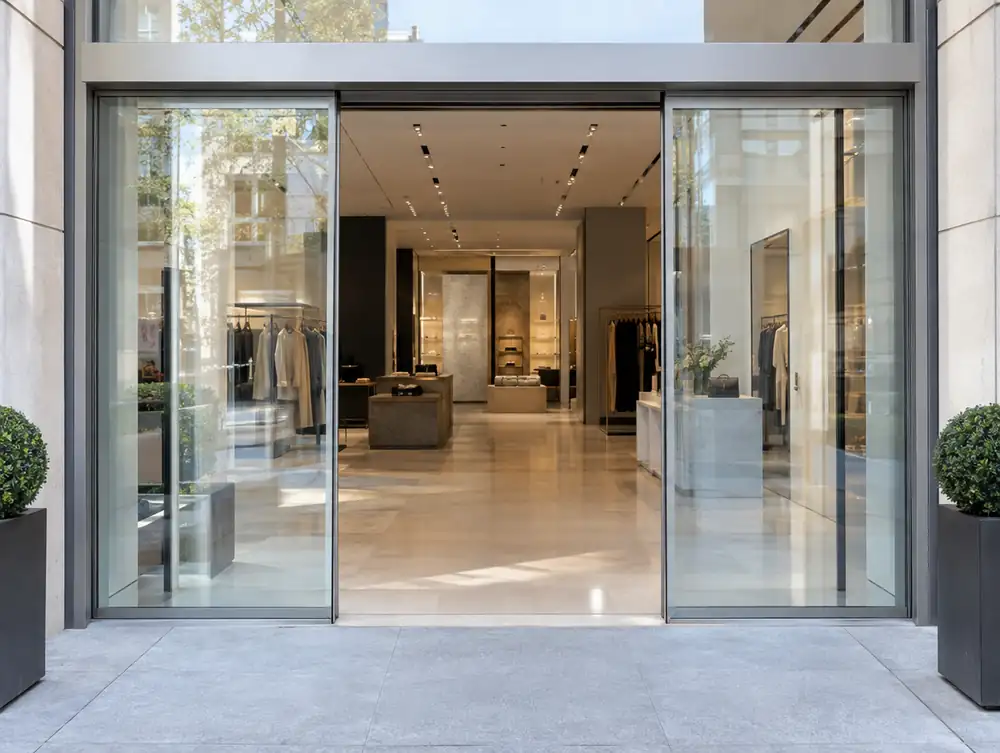
Where should you begin with automatic sliding doors in Roehampton?
If your Roehampton entrance catches low sun, infrared sensors can misread the light on the floor. We'd favour radar with a presence sensor set for those conditions, and consider solar control glass in the leaves.
Where a landlord in Roehampton wants the frontage kept looking the same, a slim slider can sit behind the existing line. We'd draw the operator inside the fascia and give the landlord a clear elevation to approve.
A corner unit has two fronts to think about, and the return elevation often does as much selling as the main one. If that is your layout in Roehampton, carry the fascia and glass line round the corner and treat both faces as one composition.
What price should you expect for automatic sliding doors in Roehampton?
Until the survey is done, plan on £3,895 to £11,995 plus VAT per entrance. Unusual sizes, fine detail and phased working push the figure up, while a simple brief and clear access keep it toward the lower end.
What sign-off might you need for automatic sliding doors in Roehampton?
Security grilles and shutters are named in England's rules: installing or replacing one on a shopfront sits outside the shop permitted development rights. The frontage itself is treated the same way, so for automatic sliding doors at premises in the Roehampton area, building work that materially affects the appearance needs planning permission. Confirm the position with the council before anything is ordered.
At survey we check how things stand for your building, although applications for planning permission or advertisement consent here normally go to London Borough of Wandsworth.
| Town | Roehampton |
|---|---|
| Area | Greater London |
| Postcode districts | SW13, SW14, SW15, SW18 |
| Planning authority | London Borough of Wandsworth |
| Building approval | Building Regulations (Approved Documents) |
| Distance from Great Barr | About 104 miles |
| Survey | Free for new work |
Does Wandsworth Borough Council publish shopfront guidance?
Yes, Shopfronts SPG (1988). It tells applicants what the council expects from new and altered shopfronts. A few of the things it asks for:
- Stallrisers should be retained where possible and be at least 500mm high, or reach the top of the pilaster base.
- Solid external metal shutters are discouraged, with boxes set behind the fascia or recessed flush and guides colour-coated to match.
- Internally lit box fascias and projecting box signs are generally unsuitable in conservation areas and on traditional shopfronts.
Questions about automatic sliding doors in Roehampton
Can you match the door to my existing front in Greater London?
Yes. Frames come in any RAL colour, and we'd line up the leaves with your existing mullions so the door doesn't look like an add-on.
Who installs automatic doors in Roehampton?
Vetted door teams working under S&K Glazing handle the fit and set-up, travelling from Great Barr. Your agreement is with S&K Glazing Limited, and one person stays your point of call.
How noisy would an automatic door be at my Roehampton shop?
A healthy door is very quiet, and you'd normally hear only a soft hum. Noise usually means worn rollers or grit in the guide, which a service will put right.
Do I need planning permission to change a shopfront in the Roehampton area?
Usually yes, if the work materially affects the building's external appearance. England's shop permitted development rights exclude creating, altering or replacing a shopfront, so there is no shortcut. A true like-for-like replacement usually needs no application, and the council confirms the position.
Do I need listed building consent for a shopfront in the Roehampton area?
Usually yes, if the building is listed. In England the local planning authority decides, and Historic England is notified of Grade I and II* works and specified Grade II works. Like-for-like repair may not need consent, so ask the council before work starts.