Every shutter starts with the box, because a box added as an afterthought spoils the frontage. On Roehampton premises we draw its position with the fascia, the glass line and the ceiling.
Please have keys to any meter cupboards and shutter housings to hand when we survey in Roehampton, because what sits behind them can change the drawing.
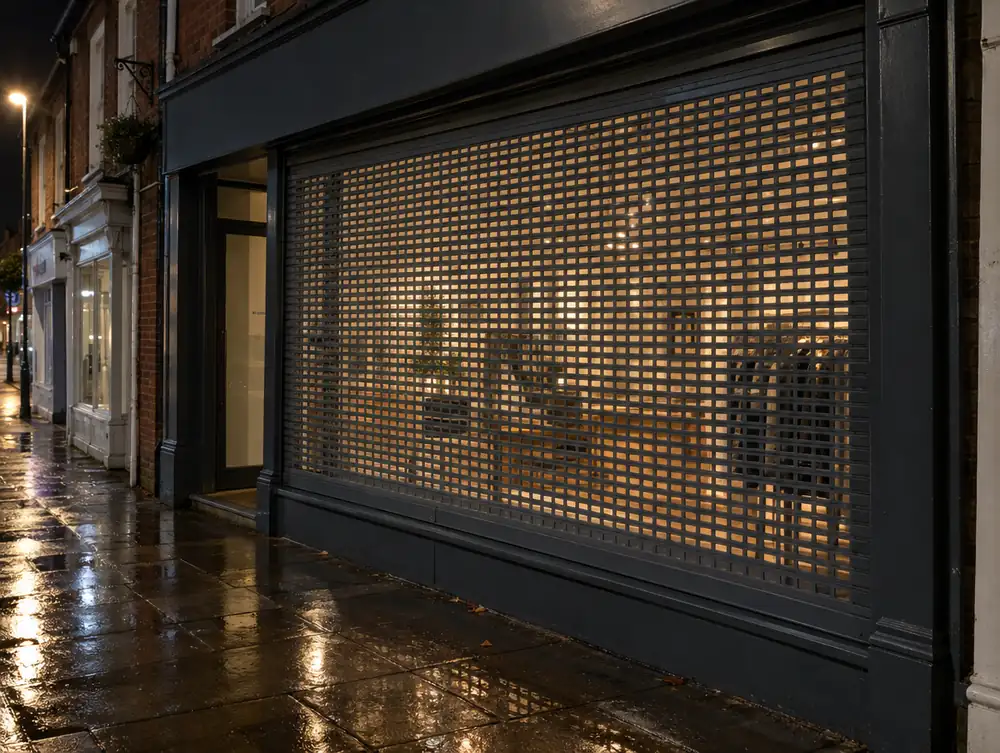
Where should you begin with perforated roller shutters in Roehampton?
Where the frame is slim aluminium, guides need fixing back to something solid. We may add a concealed post or a stiffer jamb, so the lower corners cannot be levered out.
If your Roehampton shopfront has a suspended ceiling behind it, an internal box can often hide above the tiles. Where the ceiling is solid or very low, we would look at a slim box in a painted bulkhead.
Where the footway outside your Roehampton premises is narrow, a recessed entrance earns its keep. It gives people a dry place to pause out of the walkway, and it adds a longer run of display glass either side of the door.
What sign-off might you need for perforated roller shutters in Roehampton?
England has no permitted development route for changing a shopfront. Part 7 Class A of the General Permitted Development Order 2015 excludes creating, altering or replacing one, and it allows no alterations at all on article 2(3) land. That leaves two outcomes for perforated roller shutters at premises in the Roehampton area: a planning application, or work that doesn't materially affect the external appearance.
Expect planning and advert applications here to go to London Borough of Wandsworth in the normal way. We check what that means for your building when we survey it in Roehampton.
What price should you expect for perforated roller shutters in Roehampton?
A sensible starting budget is £1,695 to £4,495 plus VAT per shutter. What shifts the figure is whatever can't be seen yet, such as the condition behind the old frontage or the services running through it.
| Town | Roehampton |
|---|---|
| Area | Greater London |
| Postcode districts | SW13, SW14, SW15, SW18 |
| Planning authority | London Borough of Wandsworth |
| Building approval | Building Regulations (Approved Documents) |
| Distance from Great Barr | About 104 miles |
| Survey | Free for new work |
Does Wandsworth Borough Council publish shopfront guidance?
Yes, Shopfronts SPG (1988). It tells applicants what the council expects from new and altered shopfronts. A few of the things it asks for:
- Stallrisers should be retained where possible and be at least 500mm high, or reach the top of the pilaster base.
- Solid external metal shutters are discouraged, with boxes set behind the fascia or recessed flush and guides colour-coated to match.
- Internally lit box fascias and projecting box signs are generally unsuitable in conservation areas and on traditional shopfronts.
Questions about perforated roller shutters in Roehampton
Can you fit an internal shutter on my Roehampton premises?
Usually, yes. We check for ceiling space, a clear path behind the window and a solid fixing for the guides. Where space is tight, a slim box or a smaller display can make it work.
Can a perforated shutter match my other sites in Greater London?
Yes. Send us the colour reference and curtain type from an existing site, and we match them on the new one. The box and guides may differ, because each frontage has its own structure.
What controls can a shutter have?
A key switch, a wall button or a remote are the usual choices, each with a manual override. Many shops use a key switch at the door, so closing up needs someone present.
Does a shop sign in the Roehampton area need advertisement consent?
Not always. In England, an unlit sign within Class 5 of the 2007 Advertisement Regulations generally needs no application, and neither does a lit sign within Class 4B. Anything outside those classes needs consent, and Class 4B isn't available in conservation areas, so check before ordering.
Does the Equality Act apply to a shop entrance in the Roehampton area?
Yes. The Equality Act 2010 applies in England, as across Great Britain, and it requires reasonable steps to remove, alter or avoid physical features that disadvantage disabled people. The duty is anticipatory, so it looks at disabled people generally, and a new Services Code replaced the 2011 Code on 5 August 2026.