Many tired frontages are closer to good than they look. On Roehampton premises a new sign, fresh colour and better glass can do most of the work of a full replacement.
Nothing gets ordered off the back of a survey in Roehampton, because its job is to give us the numbers to draw and price from.
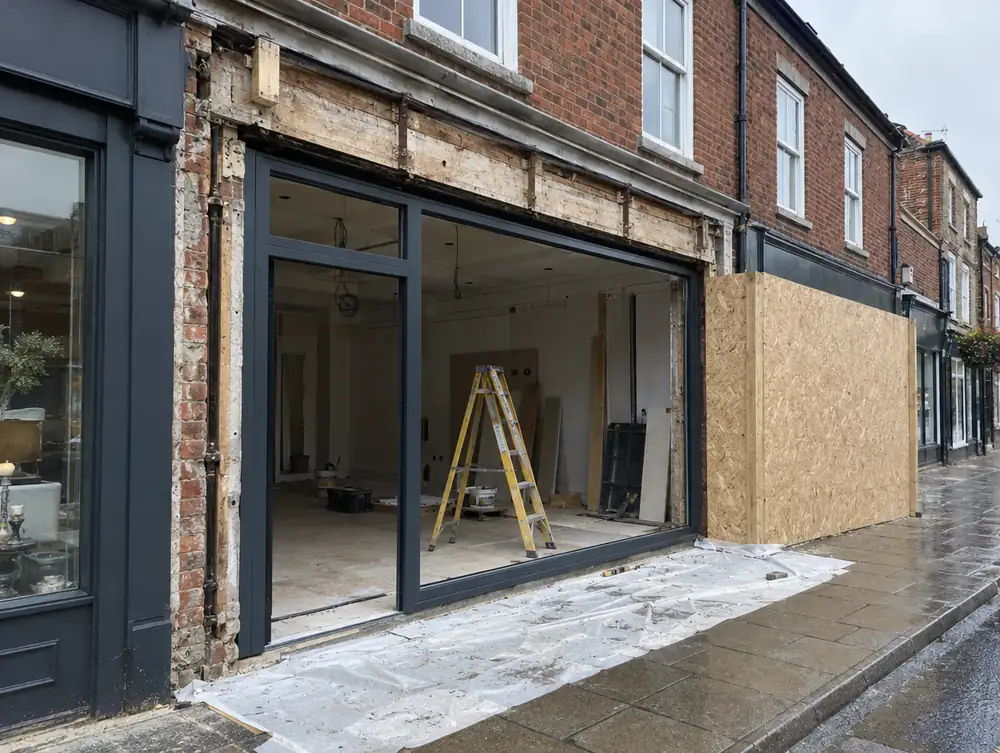
How do you design around the building when planning shopfront refurbishment in Roehampton?
If later panels cover the original fascia, we lift a corner at survey. Surviving cornices, pilasters or tile can change the whole plan, and they cost nothing to keep.
If the glass is old, we look for the etched safety mark in the corner of each pane. Panes without one, in the door or at low level, should be replaced while the frontage is being worked on.
A corner unit has two fronts to think about, and the return elevation often does as much selling as the main one. If that is your layout in Roehampton, carry the fascia and glass line round the corner and treat both faces as one composition.
What might shopfront refurbishment cost in Roehampton?
Our guide band is £1,995 to £8,995 plus VAT depending on what is kept. Scope is the biggest lever, so a tighter brief for shopfront refurbishment brings the figure down faster than any change of detail.
What permissions should you check for shopfront refurbishment in Roehampton?
England has no permitted development route for changing a shopfront. Part 7 Class A of the General Permitted Development Order 2015 excludes creating, altering or replacing one, and it allows no alterations at all on article 2(3) land. That leaves two outcomes for shopfront refurbishment at premises in the Roehampton area: a planning application, or work that doesn't materially affect the external appearance.
We confirm the position at survey, because a boundary or a special designation can change who handles the file, but applications from Roehampton premises normally go to London Borough of Wandsworth.
| Town | Roehampton |
|---|---|
| Area | Greater London |
| Postcode districts | SW13, SW14, SW15, SW18 |
| Planning authority | London Borough of Wandsworth |
| Building approval | Building Regulations (Approved Documents) |
| Distance from Great Barr | About 104 miles |
| Survey | Free for new work |
Does Wandsworth Borough Council publish shopfront guidance?
Yes, Shopfronts SPG (1988). It tells applicants what the council expects from new and altered shopfronts. A few of the things it asks for:
- Stallrisers should be retained where possible and be at least 500mm high, or reach the top of the pilaster base.
- Solid external metal shutters are discouraged, with boxes set behind the fascia or recessed flush and guides colour-coated to match.
- Internally lit box fascias and projecting box signs are generally unsuitable in conservation areas and on traditional shopfronts.
Questions about shopfront refurbishment in Roehampton
Can my Roehampton shopfront be refurbished without closing?
Usually, yes. Work is split into stages around your trading hours, and closed-day or out-of-hours work can be arranged for anything that affects the door.
Can you repair a timber shopfront in Roehampton?
Yes. Decayed sections are cut out and spliced with new hardwood, then primed and painted. That keeps the joinery you have, and it usually costs far less than making a new frontage.
Will the work match my other premises in Greater London?
Yes, if you can share colour references and sign files from an existing site. We match finishes as closely as the frame allows, and we show you a sample first.
Do I need planning permission to change a shopfront in the Roehampton area?
Usually yes, if the work materially affects the building's external appearance. England's shop permitted development rights exclude creating, altering or replacing a shopfront, so there is no shortcut. A true like-for-like replacement usually needs no application, and the council confirms the position.
Does the Equality Act apply to a shop entrance in the Roehampton area?
Yes. The Equality Act 2010 applies in England, as across Great Britain, and it requires reasonable steps to remove, alter or avoid physical features that disadvantage disabled people. The duty is anticipatory, so it looks at disabled people generally, and a new Services Code replaced the 2011 Code on 5 August 2026.