Panels that fold away should still look right when closed, since that is how a front in Hockley spends most of the year. We keep the widths even, the rails aligned and the frames slim, so the set reads as a shopfront.
Surveys for Hockley are booked with you directly. Tell us your quieter days and we'll work around them.
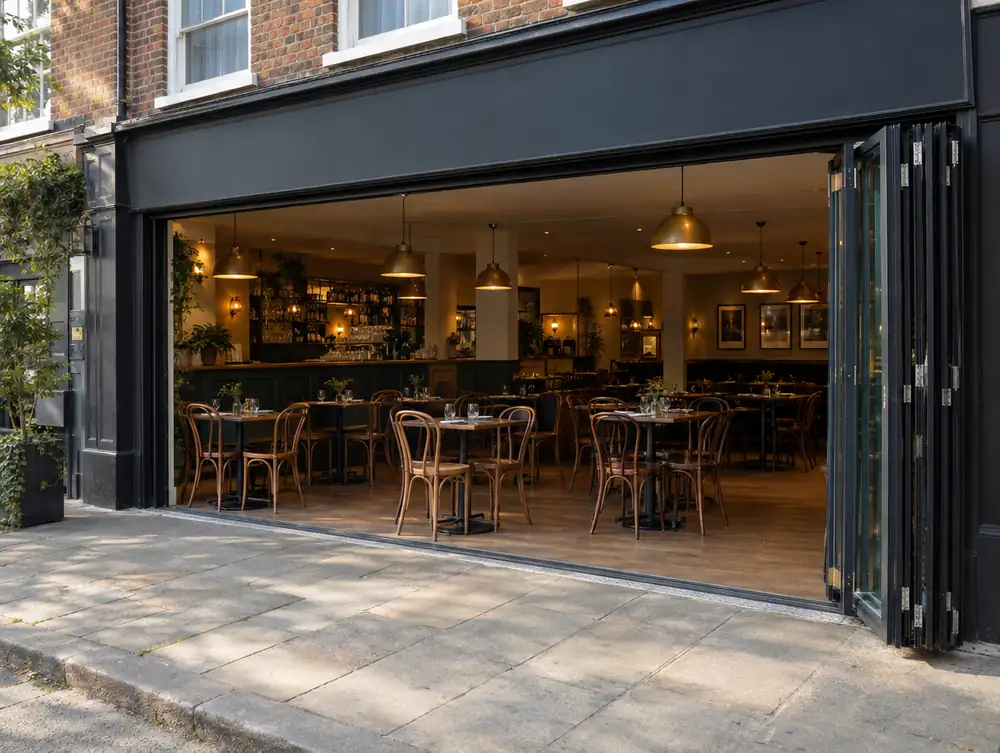
What goes into getting bi-folding shopfronts right in Hockley?
Landlords often worry about what a bi-fold does to the structure and the weather line. For a unit in Hockley we'd prepare a drawing of the head, threshold and reinstatement route, so the conversation is about detail rather than doubt.
If your Hockley frontage faces the sun, a bi-fold doubles as ventilation. We'd pair it with an awning so the room stays usable at midday, and look at solar control glass for the days the set stays closed.
Where the building has good brick or stone around the opening, set the frame back in the reveal so the masonry can be seen. On Hockley premises with a flat elevation, that deep reveal throws a shadow line that adds real depth in low sun.
Which applications might bi-folding shopfronts in Hockley involve?
A true like-for-like replacement usually needs no planning permission in England, because the external appearance isn't materially affected. New materials, a different glass line or altered proportions usually do count as material, so for bi-folding shopfronts at premises in the Hockley area, an application is then likely. The council confirms which side of that line a job falls on.
At survey we check how things stand for your building, although applications for planning permission or advertisement consent here normally go to Birmingham City Council.
How much could bi-folding shopfronts in Hockley cost you?
Guide price: £5,195 to £13,995 plus VAT for a typical opening. Materials, finish and the amount of drawing and coordination involved all move it, and your itemised quotation shows where the money goes on bi-folding shopfronts.
| Town | Hockley |
|---|---|
| Area | West Midlands |
| Postcode districts | B18, B19, B20, B21 |
| Planning authority | Birmingham City Council |
| Building approval | Building Regulations (Approved Documents) |
| Distance from Great Barr | About 3 miles |
| Survey | Free for new work |
Does Birmingham City Council publish shopfront guidance?
Yes, Jewellery Quarter Conservation Area Design Guide (Section 9: Signage, Shopfronts and Lighting) (2005). It covers the Jewellery Quarter Conservation Area only, so it doesn't apply across the whole council area. A few of the things it asks for:
- There is a general presumption against security shutters on listed buildings and in the conservation area.
- Security glazing, internal grilles and demountable external grilles are the accepted alternatives to shutters.
- Internally lit signs are not permitted in a conservation area, and shopfronts and fascias should be externally lit.
Questions about bi-folding shopfronts in Hockley
Will I lose a table to the stack in my Hockley restaurant?
Possibly one, but careful layout usually avoids it. We draw the folded panels on your floor plan, then look at moving the stack to a quieter corner or splitting the set in two.
Can I have a timber bi-fold on my Hockley frontage?
Yes. Painted hardwood sets suit older premises across the West Midlands, though the panels are heavier and need a stiffer head than aluminium.
Which way should the panels fold at my Hockley premises?
Inward is the usual answer, since panels folded into the room stay clear of people on the pavement. We'd draw the options where the room allows, and you choose against your seating plan.
Does a shop sign in the Hockley area need advertisement consent?
Not always. In England, an unlit sign within Class 5 of the 2007 Advertisement Regulations generally needs no application, and neither does a lit sign within Class 4B. Anything outside those classes needs consent, and Class 4B isn't available in conservation areas, so check before ordering.
Do I need planning permission to change a shopfront in the Hockley area?
Usually yes, if the work materially affects the building's external appearance. England's shop permitted development rights exclude creating, altering or replacing a shopfront, so there is no shortcut. A true like-for-like replacement usually needs no application, and the council confirms the position.