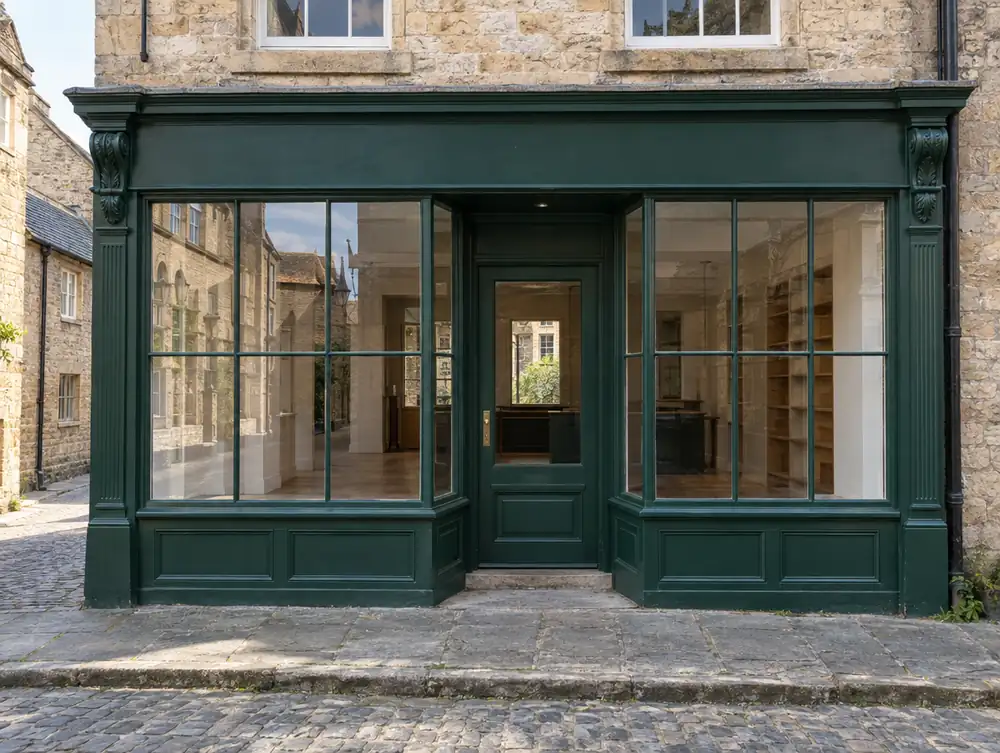
Timber gives a shopfront in Hockley something metal can't: real depth, cast shadows and mouldings you can run your hand along. We draw each front to the measured opening and make it to those signed-off dimensions.
Surveys for Hockley are booked with you directly. Tell us your quieter days and we'll work around them.
What should you think about before commissioning timber shopfronts in Hockley?
A corner plot gives a timber front two faces and one chance to get the turn right. For Hockley premises on a corner, we'd use a pilaster or a canted bay at the angle, so the cornice wraps round without a clumsy mitre.
A south or west-facing Hockley frontage is hard on paint. We'd steer you toward a lighter colour or a more stable timber, and if the brand needs a dark finish, we'd plan a shorter repaint interval from the outset.
On a north-facing frontage the glass stays free of glare, but the interior can look dim from the street, so lighting needs to sit closer to the window. If your Hockley premises face south, the problem flips to reflections by day and fading stock.
What is a realistic budget for timber shopfronts in Hockley?
Guide price: £3,995 to £13,995 plus VAT for a typical frontage. Materials, finish and the amount of drawing and coordination involved all move it, and your itemised quotation shows where the money goes on timber shopfronts.
Who approves timber shopfronts in Hockley?
For timber shopfronts at premises in the Hockley area, the deciding question in England is whether the building work materially affects the external appearance. If it does, planning permission is needed, while a true like-for-like replacement usually needs none. The council confirms the position for each site.
We confirm the position at survey, because a boundary or a special designation can change who handles the file, but applications from Hockley premises normally go to Birmingham City Council.
| Town | Hockley |
|---|---|
| Area | West Midlands |
| Postcode districts | B18, B19, B20, B21 |
| Planning authority | Birmingham City Council |
| Building approval | Building Regulations (Approved Documents) |
| Distance from Great Barr | About 3 miles |
| Survey | Free for new work |
Does Birmingham City Council publish shopfront guidance?
Yes, Jewellery Quarter Conservation Area Design Guide (Section 9: Signage, Shopfronts and Lighting) (2005). It covers the Jewellery Quarter Conservation Area only, so it doesn't apply across the whole council area. A few of the things it asks for:
- There is a general presumption against security shutters on listed buildings and in the conservation area.
- Security glazing, internal grilles and demountable external grilles are the accepted alternatives to shutters.
- Internally lit signs are not permitted in a conservation area, and shopfronts and fascias should be externally lit.
Questions about timber shopfronts in Hockley
How much disruption will a timber front cause in my Hockley shop?
Expect more time on site than an aluminium front, typically 3 to 7 days with the painting. Closed-day or out-of-hours fitting can be arranged, and the opening stays boarded and secure between stages.
Can you copy a timber shopfront I've seen in the West Midlands?
We can work from your photo and borrow what makes it succeed, including proportions, moulding sizes and colour. The front is then drawn to your own Hockley opening.
Can you fit a timber front around existing tiles in Hockley?
Often, yes, and it's usually worth trying. If your stallriser or entrance has good original tile, we'd measure it carefully and scribe the new joinery to it.
Does a new shopfront in the Hockley area need Building Regulations approval?
Assume yes until building control says otherwise. England has no like-for-like exemption, though registered installers can self-certify replacement windows and doors in non-dwellings. That route doesn't cover structural glass, curtain walling or revolving doors.
Does the Equality Act apply to a shop entrance in the Hockley area?
Yes. The Equality Act 2010 applies in England, as across Great Britain, and it requires reasonable steps to remove, alter or avoid physical features that disadvantage disabled people. The duty is anticipatory, so it looks at disabled people generally, and a new Services Code replaced the 2011 Code on 5 August 2026.