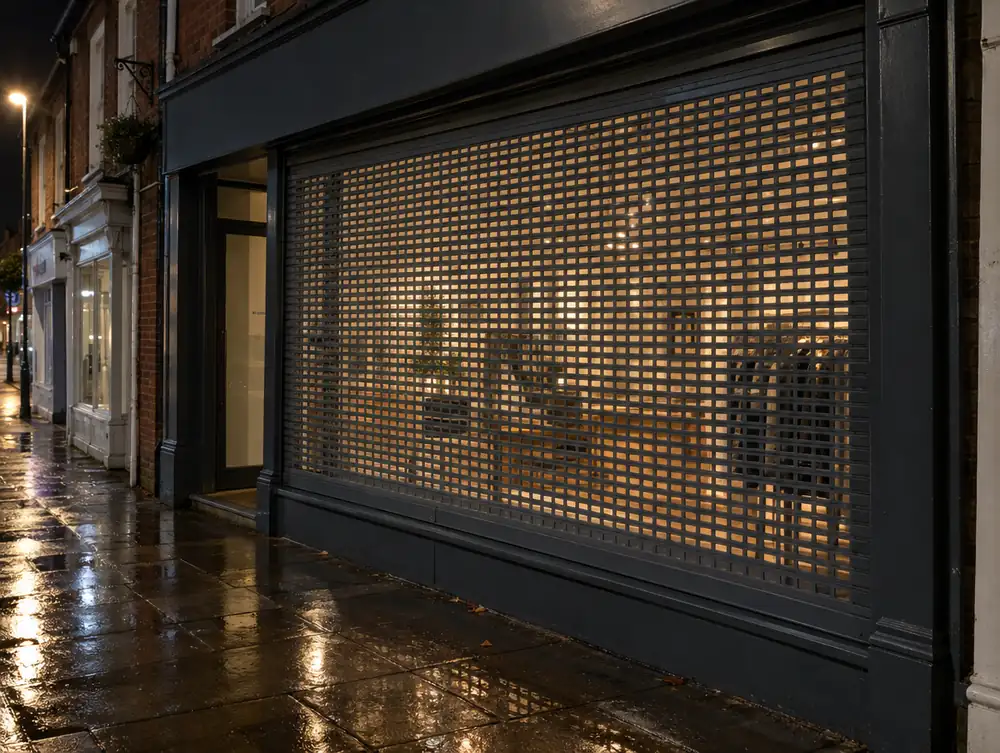
Perforated roller shutters give Hockley premises out-of-hours protection while light and the display still show through. We look first at whether the shutter should sit inside the glass, since that often gives a better frontage.
Your survey is where the price gets real, because widths, heights, levels and access are all taken on site in Hockley.
What should you think about before commissioning perforated roller shutters in Hockley?
For premises that open early or trade late, shutter noise can matter to neighbours. A motor with a soft start and well-set guides runs noticeably more quietly.
If your Hockley shopfront has a suspended ceiling behind it, an internal box can often hide above the tiles. Where the ceiling is solid or very low, we would look at a slim box in a painted bulkhead.
If there are storeys above the shop, the frontage should feel like the base of the building and not a sign stuck on it. Lining up mullions with the windows overhead is a small move that settles the whole elevation at Hockley premises.
Who approves perforated roller shutters in Hockley?
For perforated roller shutters at premises in the Hockley area, the deciding question in England is whether the building work materially affects the external appearance. If it does, planning permission is needed, while a true like-for-like replacement usually needs none. The council confirms the position for each site.
At survey we check how things stand for your building, although applications for planning permission or advertisement consent here normally go to Birmingham City Council.
What is a realistic budget for perforated roller shutters in Hockley?
The guide for perforated roller shutters is £1,695 to £4,495 plus VAT per shutter. Expect the lower end for simple work with clear access, and the upper end where detail, finish or awkward conditions add hours.
| Town | Hockley |
|---|---|
| Area | West Midlands |
| Postcode districts | B18, B19, B20, B21 |
| Planning authority | Birmingham City Council |
| Building approval | Building Regulations (Approved Documents) |
| Distance from Great Barr | About 3 miles |
| Survey | Free for new work |
Does Birmingham City Council publish shopfront guidance?
Yes, Jewellery Quarter Conservation Area Design Guide (Section 9: Signage, Shopfronts and Lighting) (2005). It covers the Jewellery Quarter Conservation Area only, so it doesn't apply across the whole council area. A few of the things it asks for:
- There is a general presumption against security shutters on listed buildings and in the conservation area.
- Security glazing, internal grilles and demountable external grilles are the accepted alternatives to shutters.
- Internally lit signs are not permitted in a conservation area, and shopfronts and fascias should be externally lit.
Questions about perforated roller shutters in Hockley
Can one person open the shutter at my Hockley shop?
Yes. Powered shutters run at the turn of a key or a button press, and a manual override is available if the power fails. We show your staff both at handover.
Can you fit an internal shutter on my Hockley premises?
Usually, yes. We check for ceiling space, a clear path behind the window and a solid fixing for the guides. Where space is tight, a slim box or a smaller display can make it work.
Can a perforated shutter match my other sites in the West Midlands?
Yes. Send us the colour reference and curtain type from an existing site, and we match them on the new one. The box and guides may differ, because each frontage has its own structure.
Does a new shopfront in the Hockley area need Building Regulations approval?
Assume yes until building control says otherwise. England has no like-for-like exemption, though registered installers can self-certify replacement windows and doors in non-dwellings. That route doesn't cover structural glass, curtain walling or revolving doors.
Do I need planning permission to change a shopfront in the Hockley area?
Usually yes, if the work materially affects the building's external appearance. England's shop permitted development rights exclude creating, altering or replacing a shopfront, so there is no shortcut. A true like-for-like replacement usually needs no application, and the council confirms the position.