On a warm evening, an open front does more for a cafe or bar in Rhyl than any sign. We design the folding set around your seating, so the panels park where they don't cost you a table.
Surveys for Rhyl are booked with you directly. Tell us your quieter days and we'll work around them.
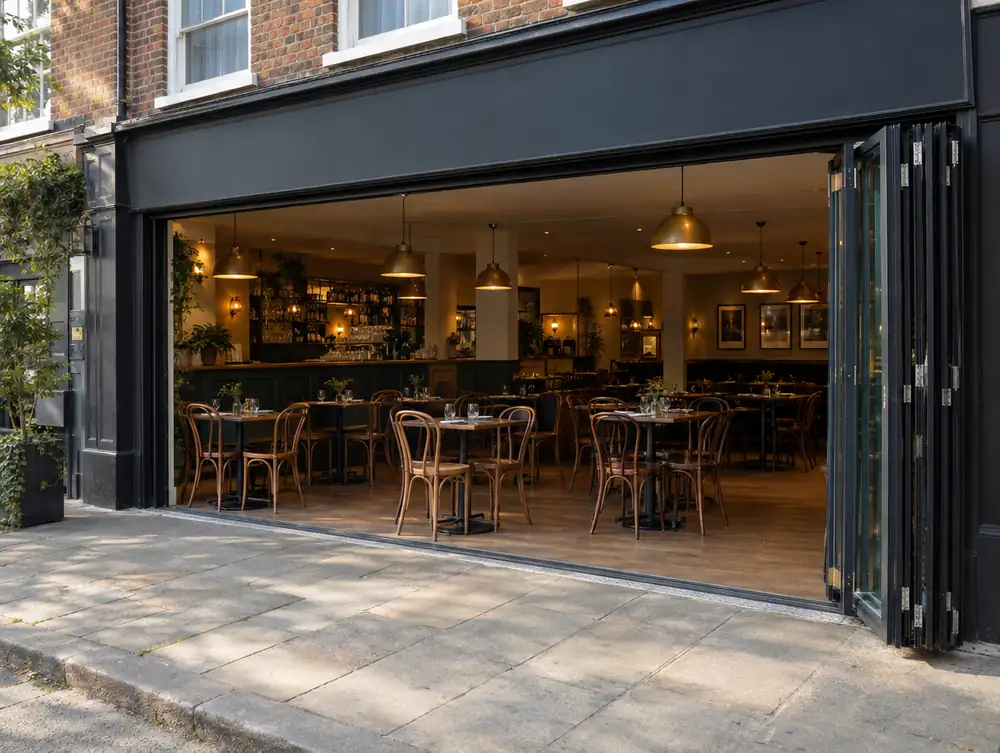
What makes bi-folding shopfronts work well on Rhyl premises?
A deep recess can host a bi-fold set back from the street, which keeps the panels clear of passers-by and creates a sheltered pocket by the door. At Rhyl premises with that depth, it's often the neatest layout.
A corner plot offers something rare: a front that can open on two sides. For Rhyl corner premises, we'd look at two sets meeting with no fixed post, provided the structure above can span it.
A corner unit has two fronts to think about, and the return elevation often does as much selling as the main one. If that is your layout in Rhyl, carry the fascia and glass line round the corner and treat both faces as one composition.
Could bi-folding shopfronts in Rhyl need planning permission?
Section 55 of the Town and Country Planning Act 1990 sets the test in Wales: work that doesn't materially affect the external appearance isn't development. Anything that does needs planning permission, and that goes for bi-folding shopfronts at premises in the Rhyl area as much as for a full new frontage. The council confirms how the test applies to your site.
At survey we check how things stand for your building, although applications for planning permission or advertisement consent here normally go to Denbighshire County Council.
How much should you set aside for bi-folding shopfronts in Rhyl?
Guide price: £5,195 to £13,995 plus VAT for a typical opening. Materials, finish and the amount of drawing and coordination involved all move it, and your itemised quotation shows where the money goes on bi-folding shopfronts.
| Town | Rhyl |
|---|---|
| Area | Clwyd |
| Postcode districts | LL18 |
| Planning authority | Denbighshire County Council |
| Building approval | Building Regulations (Approved Documents for Wales) |
| Distance from Great Barr | About 85 miles |
| Survey | Free for new work |
Does Denbighshire County Council publish shopfront guidance?
Yes, LDP Supplementary Planning Guidance Note 02: Shop Fronts (2013). It tells applicants what the council expects from new and altered shopfronts. A few of the things it asks for:
- As a rule of thumb the fascia should be no more than one-fifth of the distance from its top down to the pavement.
- Internal lattice grilles or shutters are preferred, and solid external roller shutters are the least preferred option.
- External shutters should be perforated, integrated into the design and suitably coloured.
Questions about bi-folding shopfronts in Rhyl
Can the threshold be level at my Rhyl premises?
It can be close to level, depending on the floor and drainage. We'd check the levels at survey, because a track sitting flush with the pavement still needs somewhere for water to go.
Which way should the panels fold at my Rhyl premises?
Inward is the usual answer, since panels folded into the room stay clear of people on the pavement. We'd draw the options where the room allows, and you choose against your seating plan.
Can my Rhyl bi-fold be fitted around service?
Yes. Closed-day or out-of-hours fitting can be arranged to avoid your busiest sittings, and the job typically takes 2 to 4 days on site.
What access duty applies to a shop in the Rhyl area?
The Equality Act 2010 applies, in Wales as across Great Britain, and it requires reasonable steps to remove, alter or avoid physical features that disadvantage disabled people. The duty is anticipatory, so it covers disabled people generally. A feature that meets a design standard is generally protected for 10 years.
Does a replacement shopfront in the Rhyl area need Building Regulations approval?
Assume yes until building control says otherwise, because Wales has no like-for-like exemption. Glazing is judged against Approved Document N, as Wales keeps Part N. A registered installer can self-certify replacement windows and doors in non-dwellings, but not structural glass, curtain walling or revolving doors.