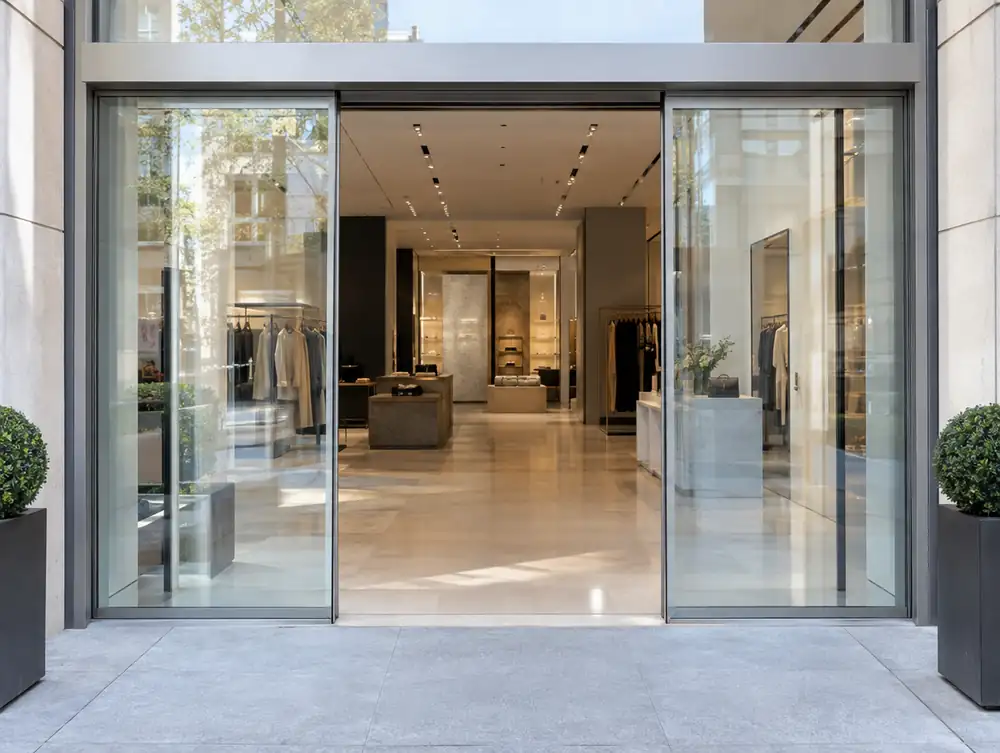
A slim framed slider can sit inside an existing Rhyl frontage with little change to the outside. The drive hides behind the fascia, and the leaves line up with the screens either side.
Bring whatever you have to the survey in Rhyl: brand guidelines, lease plans, old drawings or a photo of a frontage you admire.
Where should you begin with automatic sliding doors in Rhyl?
A corner unit in Rhyl can often move its entrance to the angle, where two directions of footfall meet. We'd look at a curved or canted door set, and check the wind on both streets before fixing the position.
A deep recess is a gift for an automatic door. At Rhyl premises with one, we'd set the door back from the street so the sensors see less of the pavement and the leaves get some shelter from the wind.
If your premises were once two shops, decide early whether the front should read as one or as two. One continuous fascia with a repeated bay width usually settles the elevation better than two mismatched halves, which is worth testing on any Rhyl unit of that kind.
What price should you expect for automatic sliding doors in Rhyl?
Until the survey is done, plan on £3,895 to £11,995 plus VAT per entrance. Unusual sizes, fine detail and phased working push the figure up, while a simple brief and clear access keep it toward the lower end.
What sign-off might you need for automatic sliding doors in Rhyl?
Section 55 of the Town and Country Planning Act 1990 sets the test in Wales: work that doesn't materially affect the external appearance isn't development. Anything that does needs planning permission, and that goes for automatic sliding doors at premises in the Rhyl area as much as for a full new frontage. The council confirms how the test applies to your site.
We confirm the position at survey, because a boundary or a special designation can change who handles the file, but applications from Rhyl premises normally go to Denbighshire County Council.
| Town | Rhyl |
|---|---|
| Area | Clwyd |
| Postcode districts | LL18 |
| Planning authority | Denbighshire County Council |
| Building approval | Building Regulations (Approved Documents for Wales) |
| Distance from Great Barr | About 85 miles |
| Survey | Free for new work |
Does Denbighshire County Council publish shopfront guidance?
Yes, LDP Supplementary Planning Guidance Note 02: Shop Fronts (2013). It tells applicants what the council expects from new and altered shopfronts. A few of the things it asks for:
- As a rule of thumb the fascia should be no more than one-fifth of the distance from its top down to the pavement.
- Internal lattice grilles or shutters are preferred, and solid external roller shutters are the least preferred option.
- External shutters should be perforated, integrated into the design and suitably coloured.
Questions about automatic sliding doors in Rhyl
What will people on the street see at my Rhyl entrance?
Ideally, very little. The drive sits behind the fascia, the leaves line up with the screens beside them, and the frame colour matches the rest of your front.
Can an automatic door work with my Rhyl shop's alarm and locks?
Yes. The door can lock at closing, and it can link to your alarm or access control where the systems allow, with a manual key position as a fallback.
Can you match the door to my existing front in Clwyd?
Yes. Frames come in any RAL colour, and we'd line up the leaves with your existing mullions so the door doesn't look like an add-on.
Can a roller shutter go on a shop in the Rhyl area without planning permission?
Usually not in Wales. Part 42 of the 1995 Order, as inserted in 2014, excludes installing or replacing a security grill or shutter on a shopfront, so the rights for shops don't help. The only way to avoid an application is work that doesn't materially affect the appearance, and the council confirms that.
Can a shop fire exit in the Rhyl area use a sliding door?
No, a dedicated fire exit can't be a sliding or revolving door. In Wales, article 14(2) of the Regulatory Reform (Fire Safety) Order 2005 also says fire exit doors must open in the direction of escape and can't be locked against immediate use. The responsible person holds that duty, normally the employer or whoever controls the premises for a business, otherwise the owner.