Automatic sliding doors for Colwyn Bay premises start with how people reach your entrance. We look at the pavement, the footfall and the space either side of the opening before recommending a door.
Your survey is where the price gets real, because widths, heights, levels and access are all taken on site in Colwyn Bay.
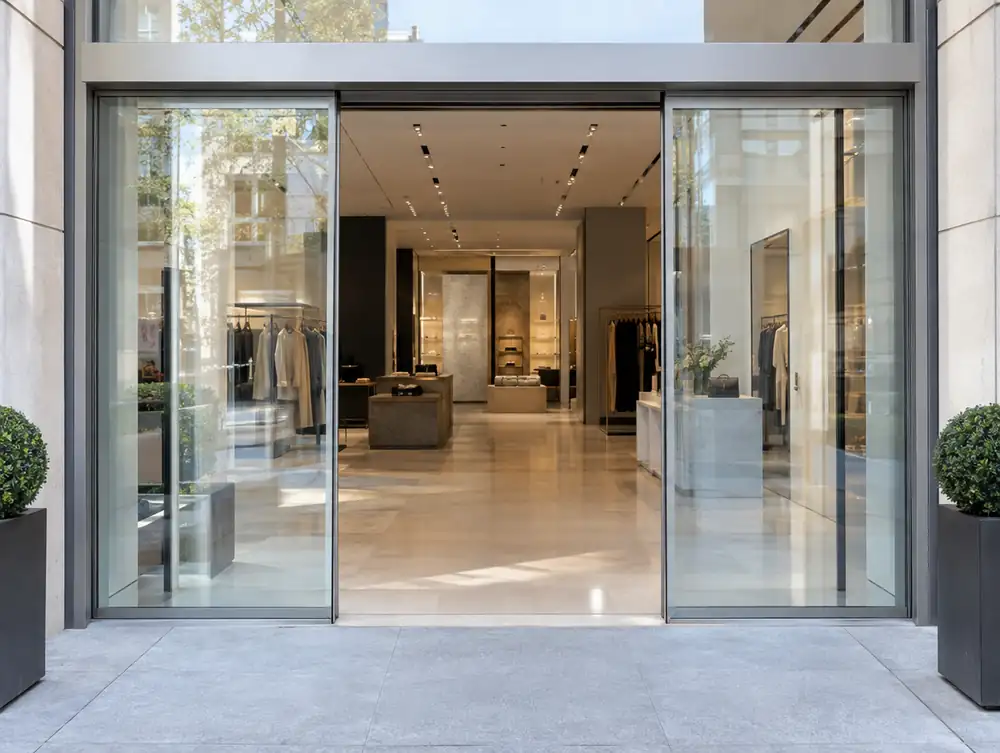
What should you think about before commissioning automatic sliding doors in Colwyn Bay?
In a parade in Colwyn Bay with a narrow pavement, the sensor set-up is the first job. We'd angle the radar so people walking past don't trigger the door, and keep the leaves in line with the neighbouring frontage.
On a narrow Colwyn Bay frontage, parked leaves can leave too little opening. We'd look at a telescopic or single-slide set, and consider moving the door to one side to free up the display.
If your Colwyn Bay unit sits in a Victorian parade, the old pilasters usually set the rhythm, so a new front should land on them and not run past them. Keep that line and even a modern frame looks as though it belongs.
Who approves automatic sliding doors in Colwyn Bay?
The existing rules still apply in Wales, because most of the Planning (Wales) Act 2026 is waiting for a commencement order. For automatic sliding doors at premises in the Colwyn Bay area, building work that materially affects the external appearance needs planning permission, while a true like-for-like replacement usually doesn't. The council confirms the current position.
Colwyn Bay applications for planning permission or advertisement consent are normally handled by Conwy County Borough Council. Our survey includes a check of the position for your address.
What is a realistic budget for automatic sliding doors in Colwyn Bay?
Until the survey is done, plan on £3,895 to £11,995 plus VAT per entrance. Unusual sizes, fine detail and phased working push the figure up, while a simple brief and clear access keep it toward the lower end.
| Town | Colwyn Bay |
|---|---|
| Area | Clwyd |
| Postcode districts | LL28, LL29, LL30, LL31 |
| Planning authority | Conwy County Borough Council |
| Building approval | Building Regulations (Approved Documents for Wales) |
| Distance from Great Barr | About 91 miles |
| Survey | Free for new work |
Does Conwy County Borough Council publish shopfront guidance?
Yes, LDP36: Shop front design (2017). It tells applicants what the council expects from new and altered shopfronts. A few of the things it asks for:
- Stallriser height should not normally exceed 20% of the overall shopfront height.
- Fascia depth is restricted to the depth of the console, or one-fifth of the distance from cornice to pavement where there are no consoles.
- Illuminated box signs and vinyl or acrylic signs are not permitted in conservation areas or on historic buildings, with halo-lit or individually lit letters preferred.
Questions about automatic sliding doors in Colwyn Bay
Can you match the door to my existing front in Clwyd?
Yes. Frames come in any RAL colour, and we'd line up the leaves with your existing mullions so the door doesn't look like an add-on.
Who installs automatic doors in Colwyn Bay?
Vetted door teams working under S&K Glazing handle the fit and set-up, travelling from Great Barr. Your agreement is with S&K Glazing Limited, and one person stays your point of call.
Can an automatic door work with my Colwyn Bay shop's alarm and locks?
Yes. The door can lock at closing, and it can link to your alarm or access control where the systems allow, with a manual key position as a fallback.
When does a shop sign in the Colwyn Bay area need advertisement consent?
A sign needs advertisement consent when it falls outside Class 5 or Class 4B of the 1992 Advertisement Regulations, which still apply in Wales. Within Class 5, an unlit sign sits on a wall containing a shop window and tops out at 4.6m or the first-floor sill if lower. A lit sign in a conservation area needs consent, because Class 4B isn't available there.
Can a shop fire exit in the Colwyn Bay area use a sliding door?
No, a dedicated fire exit can't be a sliding or revolving door. In Wales, article 14(2) of the Regulatory Reform (Fire Safety) Order 2005 also says fire exit doors must open in the direction of escape and can't be locked against immediate use. The responsible person holds that duty, normally the employer or whoever controls the premises for a business, otherwise the owner.