The brief for a bi-fold is simple: an open front in summer and a warm room in winter. For Colwyn Bay premises in Clwyd, that comes down to panel count, thermal section and a threshold that drains properly.
It helps if you can be there when we visit Colwyn Bay, since five minutes walking the frontage together answers more than a long email.
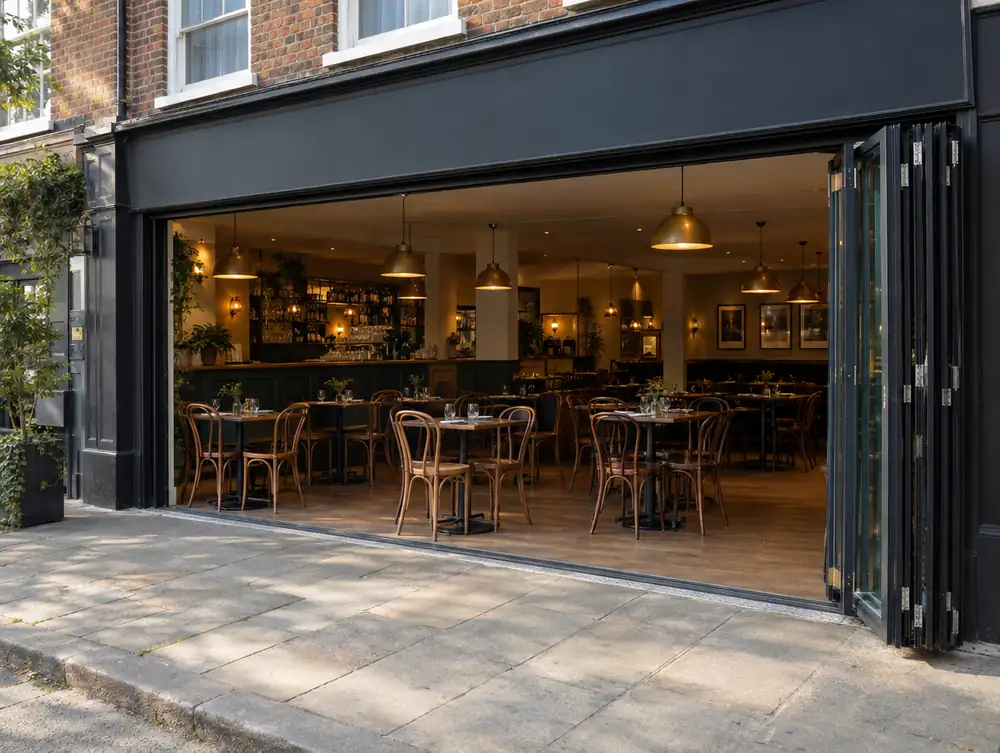
How do you design around the building when planning bi-folding shopfronts in Colwyn Bay?
A corner plot offers something rare: a front that can open on two sides. For Colwyn Bay corner premises, we'd look at two sets meeting with no fixed post, provided the structure above can span it.
Landlords often worry about what a bi-fold does to the structure and the weather line. For a unit in Colwyn Bay we'd prepare a drawing of the head, threshold and reinstatement route, so the conversation is about detail rather than doubt.
Where the footway outside your Colwyn Bay premises is narrow, a recessed entrance earns its keep. It gives people a dry place to pause out of the walkway, and it adds a longer run of display glass either side of the door.
What permissions should you check for bi-folding shopfronts in Colwyn Bay?
Section 55 of the Town and Country Planning Act 1990 sets the test in Wales: work that doesn't materially affect the external appearance isn't development. Anything that does needs planning permission, and that goes for bi-folding shopfronts at premises in the Colwyn Bay area as much as for a full new frontage. The council confirms how the test applies to your site.
For Colwyn Bay, the usual route for planning and advert applications is through Conwy County Borough Council, and we confirm that when we visit.
What might bi-folding shopfronts cost in Colwyn Bay?
As a working budget, use £5,195 to £13,995 plus VAT for a typical opening. Your place inside that range for bi-folding shopfronts depends mostly on how much of the existing frontage can stay and how much has to be put right first.
| Town | Colwyn Bay |
|---|---|
| Area | Clwyd |
| Postcode districts | LL28, LL29, LL30, LL31 |
| Planning authority | Conwy County Borough Council |
| Building approval | Building Regulations (Approved Documents for Wales) |
| Distance from Great Barr | About 91 miles |
| Survey | Free for new work |
Does Conwy County Borough Council publish shopfront guidance?
Yes, LDP36: Shop front design (2017). It tells applicants what the council expects from new and altered shopfronts. A few of the things it asks for:
- Stallriser height should not normally exceed 20% of the overall shopfront height.
- Fascia depth is restricted to the depth of the console, or one-fifth of the distance from cornice to pavement where there are no consoles.
- Illuminated box signs and vinyl or acrylic signs are not permitted in conservation areas or on historic buildings, with halo-lit or individually lit letters preferred.
Questions about bi-folding shopfronts in Colwyn Bay
How secure is a folding front in Colwyn Bay overnight?
Very, if it is specified for the job. Each leaf locks top and bottom with concealed bolts, and laminated glass adds a second line of defence.
Who do I speak to about a bi-fold in Colwyn Bay?
Your named contact stays the same from the first visit to the final adjustment. Fitting is carried out by vetted teams working under S&K Glazing, travelling from Great Barr.
Can the threshold be level at my Colwyn Bay premises?
It can be close to level, depending on the floor and drainage. We'd check the levels at survey, because a track sitting flush with the pavement still needs somewhere for water to go.
Can a shop fire exit in the Colwyn Bay area use a sliding door?
No, a dedicated fire exit can't be a sliding or revolving door. In Wales, article 14(2) of the Regulatory Reform (Fire Safety) Order 2005 also says fire exit doors must open in the direction of escape and can't be locked against immediate use. The responsible person holds that duty, normally the employer or whoever controls the premises for a business, otherwise the owner.
What access duty applies to a shop in the Colwyn Bay area?
The Equality Act 2010 applies, in Wales as across Great Britain, and it requires reasonable steps to remove, alter or avoid physical features that disadvantage disabled people. The duty is anticipatory, so it covers disabled people generally. A feature that meets a design standard is generally protected for 10 years.