If your Colwyn Bay frontage has good glass and a tired door, a new frameless set could lift the whole entrance. We'd line it up with the panes beside it and match the fittings to your brand.
Surveys for Colwyn Bay are booked with you directly. Tell us your quieter days and we'll work around them.
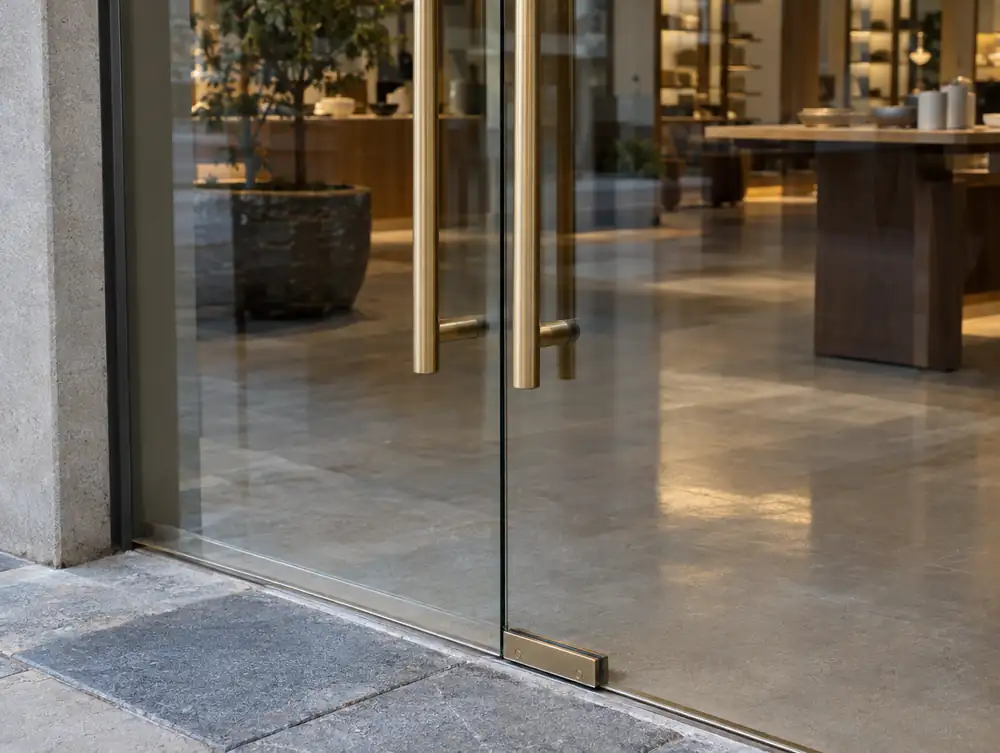
How do you design around the building when planning frameless glass doors in Colwyn Bay?
In a deep recess, a frameless door gets natural shelter and can sit back from the street. At Colwyn Bay premises with that layout, we'd choose glass side returns so the recess stays bright and the door stays obvious.
In a parade in Colwyn Bay, a frameless door can sit within a framed front without looking out of place. We'd match its head height to the neighbouring transoms and keep the fittings in the frame colour.
On a north-facing frontage the glass stays free of glare, but the interior can look dim from the street, so lighting needs to sit closer to the window. If your Colwyn Bay premises face south, the problem flips to reflections by day and fading stock.
What might frameless glass doors cost in Colwyn Bay?
Guide price: £1,495 to £4,495 plus VAT per door set. Materials, finish and the amount of drawing and coordination involved all move it, and your itemised quotation shows where the money goes on frameless glass doors.
What permissions should you check for frameless glass doors in Colwyn Bay?
Section 55 of the Town and Country Planning Act 1990 sets the test in Wales: work that doesn't materially affect the external appearance isn't development. Anything that does needs planning permission, and that goes for frameless glass doors at premises in the Colwyn Bay area as much as for a full new frontage. The council confirms how the test applies to your site.
We confirm the position at survey, because a boundary or a special designation can change who handles the file, but applications from Colwyn Bay premises normally go to Conwy County Borough Council.
| Town | Colwyn Bay |
|---|---|
| Area | Clwyd |
| Postcode districts | LL28, LL29, LL30, LL31 |
| Planning authority | Conwy County Borough Council |
| Building approval | Building Regulations (Approved Documents for Wales) |
| Distance from Great Barr | About 91 miles |
| Survey | Free for new work |
Does Conwy County Borough Council publish shopfront guidance?
Yes, LDP36: Shop front design (2017). It tells applicants what the council expects from new and altered shopfronts. A few of the things it asks for:
- Stallriser height should not normally exceed 20% of the overall shopfront height.
- Fascia depth is restricted to the depth of the console, or one-fifth of the distance from cornice to pavement where there are no consoles.
- Illuminated box signs and vinyl or acrylic signs are not permitted in conservation areas or on historic buildings, with halo-lit or individually lit letters preferred.
Questions about frameless glass doors in Colwyn Bay
How long will my Colwyn Bay entrance be out of use?
Usually only a few hours, if the floor needs no work. Doors are often fitted outside trading hours, so you can open as normal.
Who fits glass doors in Colwyn Bay?
Vetted glazing teams working under S&K Glazing fit them, and you have a single named contact. They travel to Colwyn Bay from Great Barr.
Can I have my logo on a glass door in Colwyn Bay?
Yes. Etched, frosted or printed logos work well, and they can double as the marking that stops people walking into the glass.
When does a shop sign in the Colwyn Bay area need advertisement consent?
A sign needs advertisement consent when it falls outside Class 5 or Class 4B of the 1992 Advertisement Regulations, which still apply in Wales. Within Class 5, an unlit sign sits on a wall containing a shop window and tops out at 4.6m or the first-floor sill if lower. A lit sign in a conservation area needs consent, because Class 4B isn't available there.
What access duty applies to a shop in the Colwyn Bay area?
The Equality Act 2010 applies, in Wales as across Great Britain, and it requires reasonable steps to remove, alter or avoid physical features that disadvantage disabled people. The duty is anticipatory, so it covers disabled people generally. A feature that meets a design standard is generally protected for 10 years.