Each frameless door for Llandudno premises is made to a final check measure, never to a rough size. We travel from Great Barr to fit it, and you'll have one named contact from start to finish.
It helps if you can be there when we visit Llandudno, since five minutes walking the frontage together answers more than a long email.
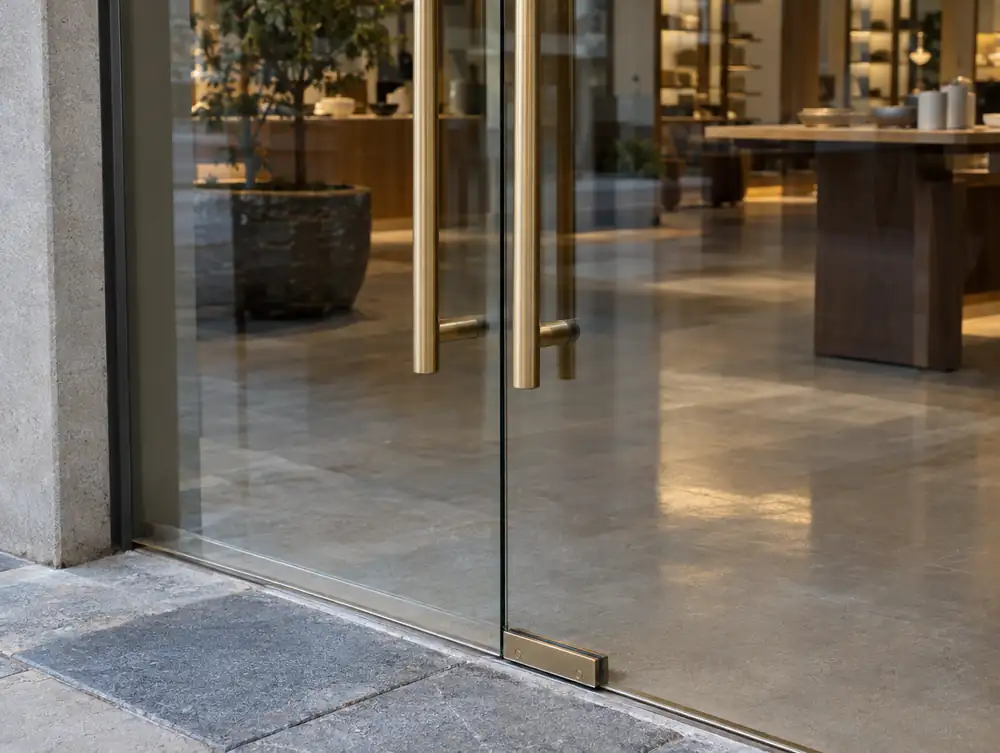
What makes frameless glass doors work well on Llandudno premises?
A narrow Llandudno unit benefits from a door that takes up no visual width. We'd use a single glass leaf hung beside one clear pane, so the entrance and the display read as one view into the shop.
In a parade in Llandudno, a frameless door can sit within a framed front without looking out of place. We'd match its head height to the neighbouring transoms and keep the fittings in the frame colour.
A corner unit has two fronts to think about, and the return elevation often does as much selling as the main one. If that is your layout in Llandudno, carry the fascia and glass line round the corner and treat both faces as one composition.
Could frameless glass doors in Llandudno need planning permission?
Like-for-like replacement usually needs no planning permission in Wales, because the external appearance isn't materially affected. Matching the existing materials, proportions and glass line is what keeps a job in that position. For frameless glass doors at premises in the Llandudno area, changing any of those usually means an application, which the council can confirm.
Planning and advert applications for Llandudno premises normally go to Conwy County Borough Council. We check the position for your address at survey.
How much should you set aside for frameless glass doors in Llandudno?
As a working budget, use £1,495 to £4,495 plus VAT per door set. Your place inside that range for frameless glass doors depends mostly on how much of the existing frontage can stay and how much has to be put right first.
| Town | Llandudno |
|---|---|
| Area | Clwyd |
| Postcode districts | LL30 |
| Planning authority | Conwy County Borough Council |
| Building approval | Building Regulations (Approved Documents for Wales) |
| Distance from Great Barr | About 96 miles |
| Survey | Free for new work |
Does Conwy County Borough Council publish shopfront guidance?
Yes, LDP36: Shop front design (2017). It tells applicants what the council expects from new and altered shopfronts. A few of the things it asks for:
- Stallriser height should not normally exceed 20% of the overall shopfront height.
- Fascia depth is restricted to the depth of the console, or one-fifth of the distance from cornice to pavement where there are no consoles.
- Illuminated box signs and vinyl or acrylic signs are not permitted in conservation areas or on historic buildings, with halo-lit or individually lit letters preferred.
Questions about frameless glass doors in Llandudno
Can I have my logo on a glass door in Llandudno?
Yes. Etched, frosted or printed logos work well, and they can double as the marking that stops people walking into the glass.
Can my Llandudno premises take a frameless glass door?
Most can, once the floor and opening have been checked. The survey shows whether a floor spring will fit, and if not, a concealed closer in a transom does the same job.
Will a glass door be safe with children around in my Llandudno shop?
Toughened glass is strong and breaks into small pieces, so it is a good choice for a family-facing shop. The main risks are finger traps at the hinge side, which careful spring settings and guards can reduce.
Can a roller shutter go on a shop in the Llandudno area without planning permission?
Usually not in Wales. Part 42 of the 1995 Order, as inserted in 2014, excludes installing or replacing a security grill or shutter on a shopfront, so the rights for shops don't help. The only way to avoid an application is work that doesn't materially affect the appearance, and the council confirms that.
Can a shop fire exit in the Llandudno area use a sliding door?
No, a dedicated fire exit can't be a sliding or revolving door. In Wales, article 14(2) of the Regulatory Reform (Fire Safety) Order 2005 also says fire exit doors must open in the direction of escape and can't be locked against immediate use. The responsible person holds that duty, normally the employer or whoever controls the premises for a business, otherwise the owner.