One contract covers the paint, glass, sign and door work on refurbishments across Llandudno and Clwyd. That saves you chasing separate trades for a job that has to look like one piece.
It helps if you can be there when we visit Llandudno, since five minutes walking the frontage together answers more than a long email.
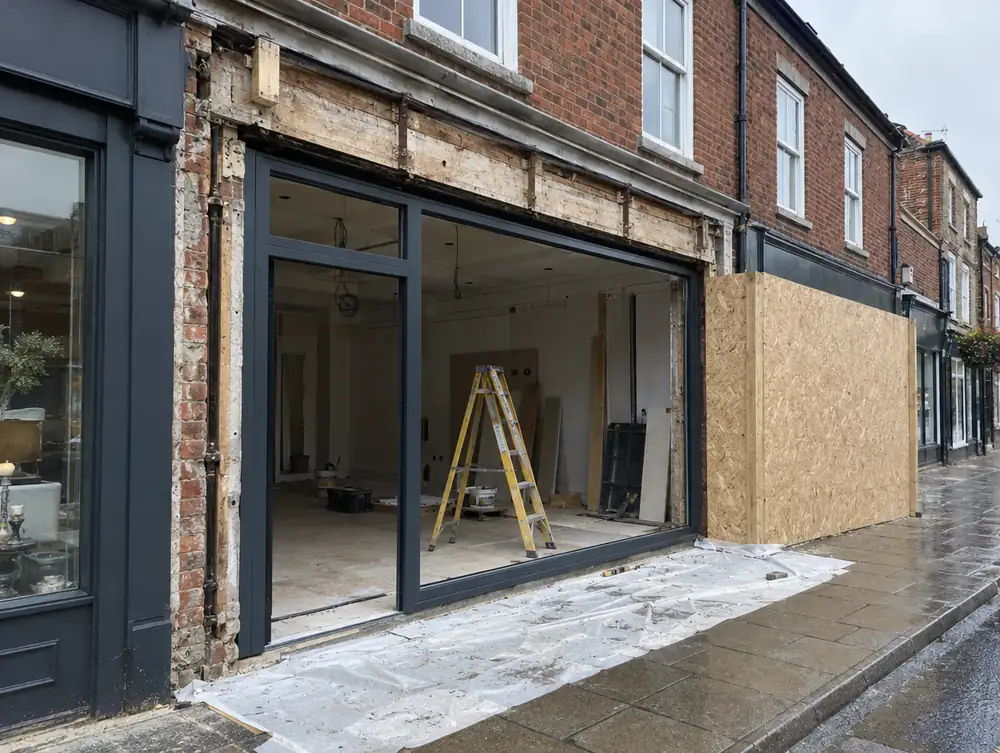
Where should you begin with shopfront refurbishment in Llandudno?
Should your Llandudno premises have an older door, we look at the closer, the hinges and the threshold along with the finish. A door that opens easily and closes quietly does more for the frontage than a fresh coat of paint.
If your Llandudno shopfront is aluminium and the frame is sound, a recoat can change the whole look. We check for corrosion and old sealant first, because paint will not hide either for long.
Where the footway outside your Llandudno premises is narrow, a recessed entrance earns its keep. It gives people a dry place to pause out of the walkway, and it adds a longer run of display glass either side of the door.
What sign-off might you need for shopfront refurbishment in Llandudno?
Like-for-like replacement usually needs no planning permission in Wales, because the external appearance isn't materially affected. Matching the existing materials, proportions and glass line is what keeps a job in that position. For shopfront refurbishment at premises in the Llandudno area, changing any of those usually means an application, which the council can confirm.
Planning and advert applications for Llandudno premises normally go to Conwy County Borough Council. We check the position for your address at survey.
What price should you expect for shopfront refurbishment in Llandudno?
As a working budget, use £1,995 to £8,995 plus VAT depending on what is kept. Your place inside that range for shopfront refurbishment depends mostly on how much of the existing frontage can stay and how much has to be put right first.
| Town | Llandudno |
|---|---|
| Area | Clwyd |
| Postcode districts | LL30 |
| Planning authority | Conwy County Borough Council |
| Building approval | Building Regulations (Approved Documents for Wales) |
| Distance from Great Barr | About 96 miles |
| Survey | Free for new work |
Does Conwy County Borough Council publish shopfront guidance?
Yes, LDP36: Shop front design (2017). It tells applicants what the council expects from new and altered shopfronts. A few of the things it asks for:
- Stallriser height should not normally exceed 20% of the overall shopfront height.
- Fascia depth is restricted to the depth of the console, or one-fifth of the distance from cornice to pavement where there are no consoles.
- Illuminated box signs and vinyl or acrylic signs are not permitted in conservation areas or on historic buildings, with halo-lit or individually lit letters preferred.
Questions about shopfront refurbishment in Llandudno
How do I know if my Llandudno shopfront needs replacing?
A measured survey will show you. We check the frame, joints, door and glass, then tell you plainly whether refurbishment will last or whether a new shopfront would be better value.
Can my Llandudno shopfront be refurbished without closing?
Usually, yes. Work is split into stages around your trading hours, and closed-day or out-of-hours work can be arranged for anything that affects the door.
Will the work match my other premises in Clwyd?
Yes, if you can share colour references and sign files from an existing site. We match finishes as closely as the frame allows, and we show you a sample first.
Is planning permission needed for a new shopfront in the Llandudno area?
Usually yes, if the work materially affects the external appearance, because Wales has no permitted development route for changing a shopfront. Most of the Planning (Wales) Act 2026 hasn't been commenced yet, so the existing rules apply. A true like-for-like replacement usually avoids an application, and the council confirms the position.
Does a replacement shopfront in the Llandudno area need Building Regulations approval?
Assume yes until building control says otherwise, because Wales has no like-for-like exemption. Glazing is judged against Approved Document N, as Wales keeps Part N. A registered installer can self-certify replacement windows and doors in non-dwellings, but not structural glass, curtain walling or revolving doors.