Many tired frontages are closer to good than they look. On Abergele premises a new sign, fresh colour and better glass can do most of the work of a full replacement.
A survey in Abergele usually starts outside, looking at the whole elevation before any tape comes out, because the frontage has to answer the building above it.
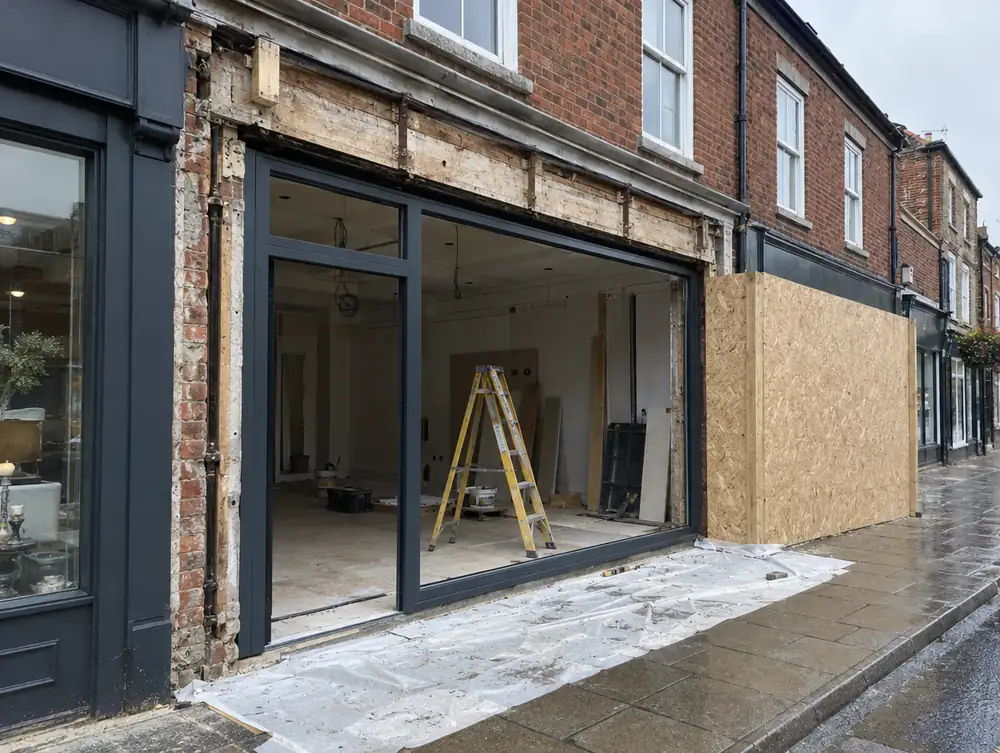
What makes shopfront refurbishment work well on Abergele premises?
If your Abergele shopfront is aluminium and the frame is sound, a recoat can change the whole look. We check for corrosion and old sealant first, because paint will not hide either for long.
Where the frontage is timber, we probe the sills, bottom rails and door jambs before quoting. Rot usually starts low, and a spliced repair in hardwood can save more of the joinery than you might expect.
On a north-facing frontage the glass stays free of glare, but the interior can look dim from the street, so lighting needs to sit closer to the window. If your Abergele premises face south, the problem flips to reflections by day and fading stock.
How much should you set aside for shopfront refurbishment in Abergele?
Allow £1,995 to £8,995 plus VAT depending on what is kept. Size and specification set most of that figure for shopfront refurbishment, and the rest depends on what the survey finds on site.
Could shopfront refurbishment in Abergele need planning permission?
Section 55 of the Town and Country Planning Act 1990 sets the test in Wales: work that doesn't materially affect the external appearance isn't development. Anything that does needs planning permission, and that goes for shopfront refurbishment at premises in the Abergele area as much as for a full new frontage. The council confirms how the test applies to your site.
Planning and advert applications for Abergele premises normally go to Conwy County Borough Council. We check the position for your address at survey.
| Town | Abergele |
|---|---|
| Area | Clwyd |
| Postcode districts | LL22 |
| Planning authority | Conwy County Borough Council |
| Building approval | Building Regulations (Approved Documents for Wales) |
| Distance from Great Barr | About 86 miles |
| Survey | Free for new work |
Does Conwy County Borough Council publish shopfront guidance?
Yes, LDP36: Shop front design (2017). It tells applicants what the council expects from new and altered shopfronts. A few of the things it asks for:
- Stallriser height should not normally exceed 20% of the overall shopfront height.
- Fascia depth is restricted to the depth of the console, or one-fifth of the distance from cornice to pavement where there are no consoles.
- Illuminated box signs and vinyl or acrylic signs are not permitted in conservation areas or on historic buildings, with halo-lit or individually lit letters preferred.
Questions about shopfront refurbishment in Abergele
Will the work match my other premises in Clwyd?
Yes, if you can share colour references and sign files from an existing site. We match finishes as closely as the frame allows, and we show you a sample first.
Can you refurbish just the sign and door on my Abergele frontage?
Yes. A new sign and door gear can make a big difference on their own. We would look at how they sit with the frame and suggest a colour to tie them together.
How do I know if my Abergele shopfront needs replacing?
A measured survey will show you. We check the frame, joints, door and glass, then tell you plainly whether refurbishment will last or whether a new shopfront would be better value.
What access duty applies to a shop in the Abergele area?
The Equality Act 2010 applies, in Wales as across Great Britain, and it requires reasonable steps to remove, alter or avoid physical features that disadvantage disabled people. The duty is anticipatory, so it covers disabled people generally. A feature that meets a design standard is generally protected for 10 years.
Does a replacement shopfront in the Abergele area need Building Regulations approval?
Assume yes until building control says otherwise, because Wales has no like-for-like exemption. Glazing is judged against Approved Document N, as Wales keeps Part N. A registered installer can self-certify replacement windows and doors in non-dwellings, but not structural glass, curtain walling or revolving doors.