Internal shutters have become the sensible first option for many premises. They keep the frontage clean by day and protect stock at night.
Bring whatever you have to the survey in Abergele: brand guidelines, lease plans, old drawings or a photo of a frontage you admire.
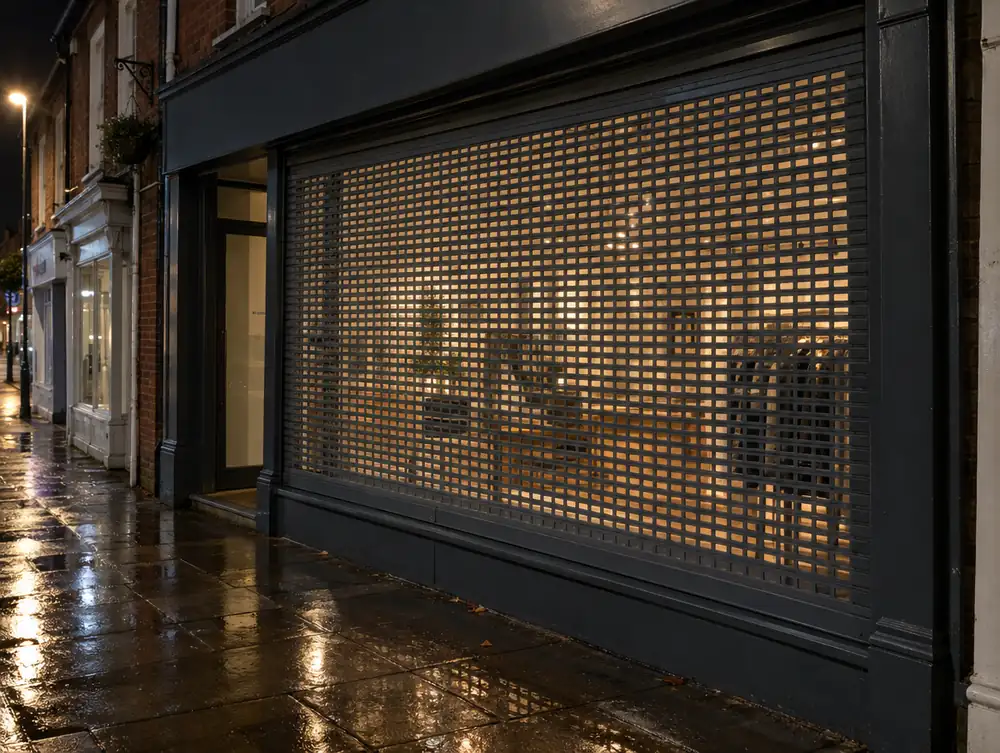
What makes perforated roller shutters work well on Abergele premises?
If your Abergele shopfront has a suspended ceiling behind it, an internal box can often hide above the tiles. Where the ceiling is solid or very low, we would look at a slim box in a painted bulkhead.
If the display goes dark overnight, the shutter will read as plain metal from the street. A low-level timer on the window lighting costs very little and keeps your Abergele frontage looking open.
A corner unit has two fronts to think about, and the return elevation often does as much selling as the main one. If that is your layout in Abergele, carry the fascia and glass line round the corner and treat both faces as one composition.
How much should you set aside for perforated roller shutters in Abergele?
The guide for perforated roller shutters is £1,695 to £4,495 plus VAT per shutter. Expect the lower end for simple work with clear access, and the upper end where detail, finish or awkward conditions add hours.
Could perforated roller shutters in Abergele need planning permission?
Like-for-like replacement usually needs no planning permission in Wales, because the external appearance isn't materially affected. Matching the existing materials, proportions and glass line is what keeps a job in that position. For perforated roller shutters at premises in the Abergele area, changing any of those usually means an application, which the council can confirm.
We confirm the position at survey, because a boundary or a special designation can change who handles the file, but applications from Abergele premises normally go to Conwy County Borough Council.
| Town | Abergele |
|---|---|
| Area | Clwyd |
| Postcode districts | LL22 |
| Planning authority | Conwy County Borough Council |
| Building approval | Building Regulations (Approved Documents for Wales) |
| Distance from Great Barr | About 86 miles |
| Survey | Free for new work |
Does Conwy County Borough Council publish shopfront guidance?
Yes, LDP36: Shop front design (2017). It tells applicants what the council expects from new and altered shopfronts. A few of the things it asks for:
- Stallriser height should not normally exceed 20% of the overall shopfront height.
- Fascia depth is restricted to the depth of the console, or one-fifth of the distance from cornice to pavement where there are no consoles.
- Illuminated box signs and vinyl or acrylic signs are not permitted in conservation areas or on historic buildings, with halo-lit or individually lit letters preferred.
Questions about perforated roller shutters in Abergele
How noisy is a shutter in Abergele premises?
A modern tubular motor is fairly quiet, and a well-set curtain only makes a low rumble. Heavier steel shutters and worn guides make more noise, which matters if there are flats above.
Can a perforated shutter match my other sites in Clwyd?
Yes. Send us the colour reference and curtain type from an existing site, and we match them on the new one. The box and guides may differ, because each frontage has its own structure.
Do you remove old shutters in Abergele?
Yes. Taking out the old curtain, box and guides, then making good the frontage, is shown as its own line in the itemised quotation.
Does a replacement shopfront in the Abergele area need Building Regulations approval?
Assume yes until building control says otherwise, because Wales has no like-for-like exemption. Glazing is judged against Approved Document N, as Wales keeps Part N. A registered installer can self-certify replacement windows and doors in non-dwellings, but not structural glass, curtain walling or revolving doors.
What access duty applies to a shop in the Abergele area?
The Equality Act 2010 applies, in Wales as across Great Britain, and it requires reasonable steps to remove, alter or avoid physical features that disadvantage disabled people. The duty is anticipatory, so it covers disabled people generally. A feature that meets a design standard is generally protected for 10 years.