Keys, remotes and manual overrides all matter at closing time. We set the controls to suit how your Rhyl staff lock up, then show them how everything works.
Bring whatever you have to the survey in Rhyl: brand guidelines, lease plans, old drawings or a photo of a frontage you admire.
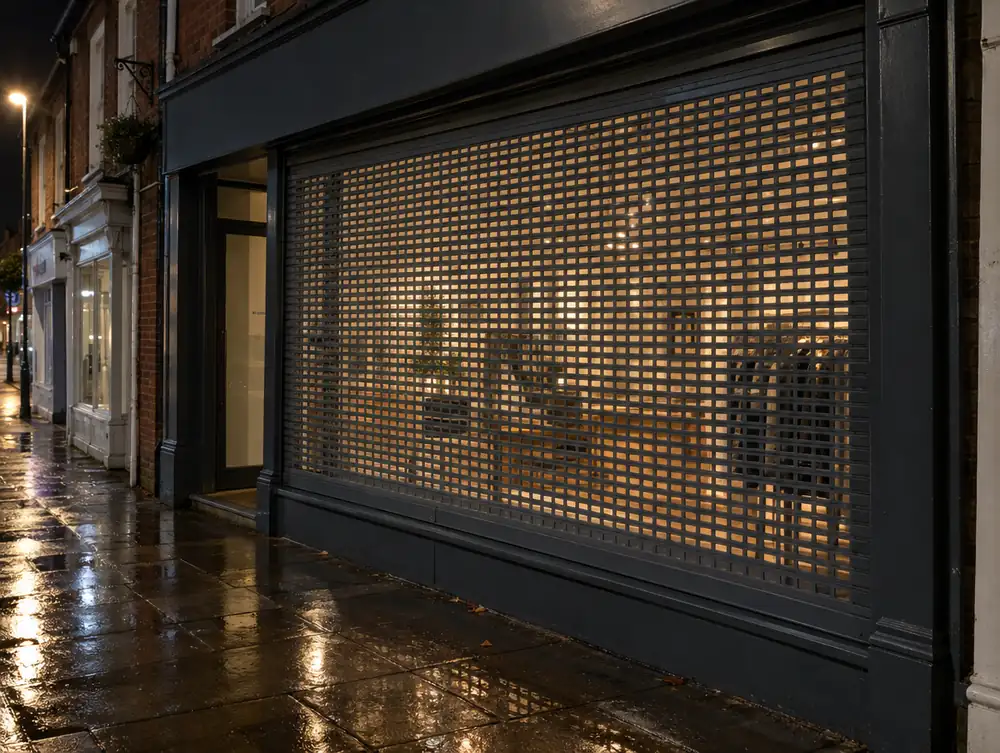
What should you think about before commissioning perforated roller shutters in Rhyl?
Where the frame is slim aluminium, guides need fixing back to something solid. We may add a concealed post or a stiffer jamb, so the lower corners cannot be levered out.
If the shutter has to run past a door or a side window, we check how the curtain lands on the threshold. A neat bottom rail and floor lock keep the entrance flush when the shutter is up.
If the pavement falls across your frontage, let the stallriser take up the slope and keep the glass line dead level. The eye reads the long horizontal, so Rhyl premises on a slope look settled once that line is true.
Who approves perforated roller shutters in Rhyl?
Going by Part 42 of the 1995 Order as inserted in 2014, Wales has no permitted development route for changing a shopfront. The right covers A1 and A2 premises, but it excludes creating, altering or replacing a shopfront, or fitting or replacing a security grill or shutter on one, and it doesn't apply on Article 1(5) land. For perforated roller shutters at premises in the Rhyl area, that leaves a planning application, or work that leaves the appearance materially unchanged.
At survey we check how things stand for your building, although applications for planning permission or advertisement consent here normally go to Denbighshire County Council.
What is a realistic budget for perforated roller shutters in Rhyl?
The guide for perforated roller shutters is £1,695 to £4,495 plus VAT per shutter. Expect the lower end for simple work with clear access, and the upper end where detail, finish or awkward conditions add hours.
| Town | Rhyl |
|---|---|
| Area | Clwyd |
| Postcode districts | LL18 |
| Planning authority | Denbighshire County Council |
| Building approval | Building Regulations (Approved Documents for Wales) |
| Distance from Great Barr | About 85 miles |
| Survey | Free for new work |
Does Denbighshire County Council publish shopfront guidance?
Yes, LDP Supplementary Planning Guidance Note 02: Shop Fronts (2013). It tells applicants what the council expects from new and altered shopfronts. A few of the things it asks for:
- As a rule of thumb the fascia should be no more than one-fifth of the distance from its top down to the pavement.
- Internal lattice grilles or shutters are preferred, and solid external roller shutters are the least preferred option.
- External shutters should be perforated, integrated into the design and suitably coloured.
Questions about perforated roller shutters in Rhyl
What controls can a shutter have?
A key switch, a wall button or a remote are the usual choices, each with a manual override. Many shops use a key switch at the door, so closing up needs someone present.
Can I keep my window display lit behind a shutter in Rhyl?
Yes, and we recommend it. A low-level light on a timer costs very little and lets the display read through the perforations overnight.
Can a perforated shutter match my other sites in Clwyd?
Yes. Send us the colour reference and curtain type from an existing site, and we match them on the new one. The box and guides may differ, because each frontage has its own structure.
When does a shop sign in the Rhyl area need advertisement consent?
A sign needs advertisement consent when it falls outside Class 5 or Class 4B of the 1992 Advertisement Regulations, which still apply in Wales. Within Class 5, an unlit sign sits on a wall containing a shop window and tops out at 4.6m or the first-floor sill if lower. A lit sign in a conservation area needs consent, because Class 4B isn't available there.
What access duty applies to a shop in the Rhyl area?
The Equality Act 2010 applies, in Wales as across Great Britain, and it requires reasonable steps to remove, alter or avoid physical features that disadvantage disabled people. The duty is anticipatory, so it covers disabled people generally. A feature that meets a design standard is generally protected for 10 years.