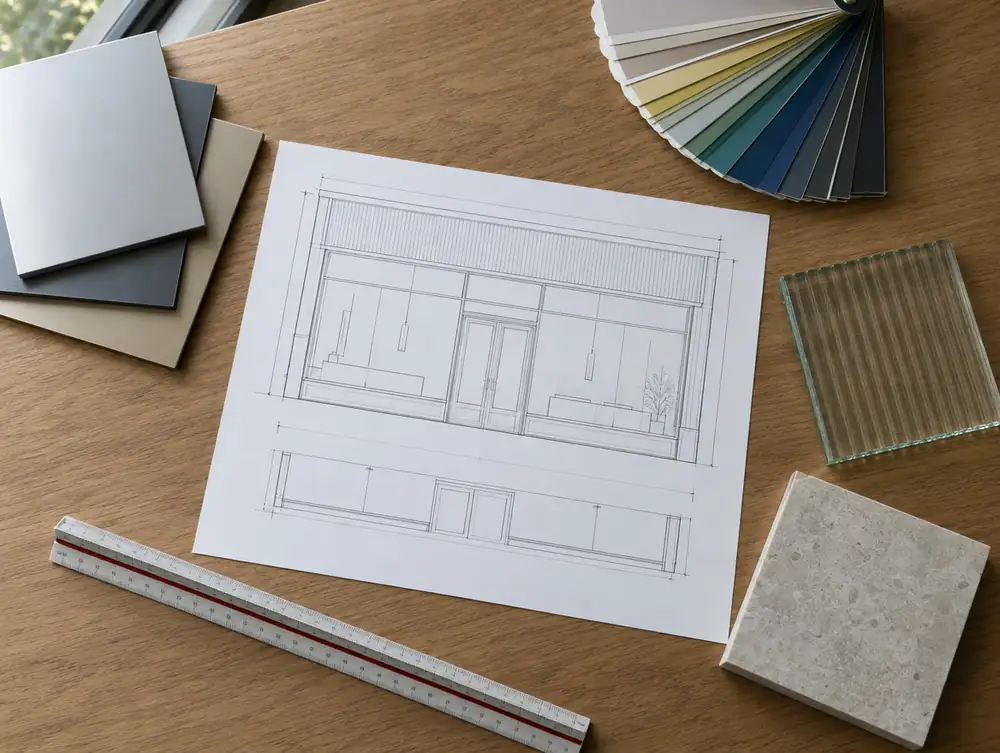
Seeing the frontage before it is built changes the conversation. You get scale drawings and a rendered view of your Abergele premises, so you can judge it properly before committing.
Expect us to measure the opening, photograph the existing front and check how materials will reach it on the day, at a time you have agreed.
What makes shopfront design work well on Abergele premises?
If your Abergele unit sits in a terrace, we draw the neighbouring frontages on the elevation too. Your design then has to work in context, which is how people will actually see it.
Where the building above has strong vertical lines, we carry them down through pilasters and mullions. If it is plain, the shopfront can take a calmer, wider treatment.
If your Abergele unit sits in a Victorian parade, the old pilasters usually set the rhythm, so a new front should land on them and not run past them. Keep that line and even a modern frame looks as though it belongs.
Could shopfront design in Abergele need planning permission?
Like-for-like replacement usually needs no planning permission in Wales, because the external appearance isn't materially affected. Matching the existing materials, proportions and glass line is what keeps a job in that position. For shopfront work at premises in the Abergele area, changing any of those usually means an application, which the council can confirm.
Expect planning and advert applications here to go to Conwy County Borough Council in the normal way. We check what that means for your building when we survey it in Abergele.
How much should you set aside for shopfront design in Abergele?
As a working budget, use £495 to £2,495 plus VAT per frontage. Your place inside that range for shopfront design depends mostly on how much of the existing frontage can stay and how much has to be put right first.
| Town | Abergele |
|---|---|
| Area | Clwyd |
| Postcode districts | LL22 |
| Planning authority | Conwy County Borough Council |
| Building approval | Building Regulations (Approved Documents for Wales) |
| Distance from Great Barr | About 86 miles |
| Survey | Free for new work |
Does Conwy County Borough Council publish shopfront guidance?
Yes, LDP36: Shop front design (2017). It tells applicants what the council expects from new and altered shopfronts. A few of the things it asks for:
- Stallriser height should not normally exceed 20% of the overall shopfront height.
- Fascia depth is restricted to the depth of the console, or one-fifth of the distance from cornice to pavement where there are no consoles.
- Illuminated box signs and vinyl or acrylic signs are not permitted in conservation areas or on historic buildings, with halo-lit or individually lit letters preferred.
Questions about shopfront design in Abergele
What do you need from me before designing for my Abergele premises?
The address, brand files and a few frontages you admire are a good start. Tell us your rough budget too, because it helps us focus on what can be built.
Do I need a design service for a simple Abergele shopfront?
Not always. Every job gets a measured survey and scale drawings anyway. The design service adds options, visuals and a full specification, which pay off when the look matters most.
Can you show the design to my landlord in Clwyd?
Yes. The drawings and visuals are prepared so a landlord or agent can review them easily. We can answer their questions directly if that helps.
Can a shop fire exit in the Abergele area use a sliding door?
No, a dedicated fire exit can't be a sliding or revolving door. In Wales, article 14(2) of the Regulatory Reform (Fire Safety) Order 2005 also says fire exit doors must open in the direction of escape and can't be locked against immediate use. The responsible person holds that duty, normally the employer or whoever controls the premises for a business, otherwise the owner.
Does a replacement shopfront in the Abergele area need Building Regulations approval?
Assume yes until building control says otherwise, because Wales has no like-for-like exemption. Glazing is judged against Approved Document N, as Wales keeps Part N. A registered installer can self-certify replacement windows and doors in non-dwellings, but not structural glass, curtain walling or revolving doors.