Fixed canopies give Dalgety Bay entrances year-round shelter, in steel, fabric or glass. We design the frame around the structure behind it, so it looks part of the frontage.
Expect us to measure the opening, photograph the existing front and check how materials will reach it on the day, at a time you have agreed.
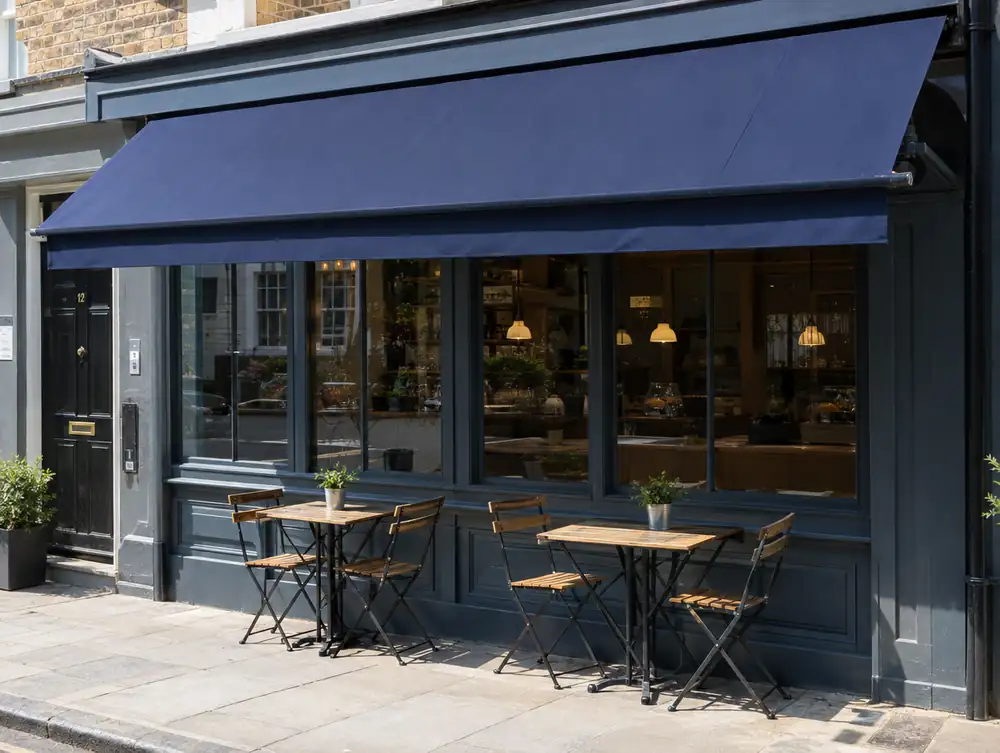
How do you design around the building when planning canopies and awnings in Dalgety Bay?
Should your frontage still have an old blind box, we open it up at survey. A sound box can take a new roller and cover, and it keeps a detail worth having.
If you only need cover at the door, a small fixed canopy or Dutch canopy over the entrance may do the job at a fraction of the cost of a full-width awning. We would draw both, so you can compare them on your elevation.
If your Dalgety Bay unit is narrow, a central door can split a small window into two weak ones. Moving the door to one side gives you a single confident pane, provided the layout inside still works.
What permissions should you check for canopies and awnings in Dalgety Bay?
Shutters aren't named in Class 9A, so in Scotland they usually fall to the appearance test. The same goes for canopies and awnings at premises in the Dalgety Bay area: building work that materially affects the external appearance needs planning permission, and a true like-for-like usually doesn't. Ask the council to confirm the position for your site.
The 0.25m projection limit in Class VI means most lit projecting signs in Scotland fall outside it. One at premises in the Dalgety Bay area will usually need advertisement consent, so allow for an application in the programme.
Expect planning and advert applications here to go to Fife Council in the normal way. We check what that means for your building when we survey it in Dalgety Bay.
What might canopies and awnings cost in Dalgety Bay?
A sensible starting budget is £1,495 to £9,995 plus VAT per canopy or awning. What shifts the figure is whatever can't be seen yet, such as the condition behind the old frontage or the services running through it.
| Town | Dalgety Bay |
|---|---|
| Area | Fife |
| Postcode districts | EH30, KY11 |
| Planning authority | Fife Council |
| Building approval | Building warrant (Technical Handbook) |
| Distance from Great Barr | About 248 miles |
| Survey | Free for new work |
Does Fife Council publish shopfront guidance?
Yes, Shop Front Design Guidelines (2016). It tells applicants what the council expects from new and altered shopfronts. A few of the things it asks for:
- Solid security shutters are discouraged, and shutter boxes may not project in front of the shop front.
- Internal lattice shutters and reinforced laminated glass are encouraged in town centres, with demountable mesh grilles preferred on traditional shop fronts.
- Each shop normally gets one fascia sign and one projecting sign, and only one of them may be lit.
Questions about canopies and awnings in Dalgety Bay
Can an awning in Dalgety Bay be motorised?
Yes, most can. A tubular motor sits inside the roller, with a remote or wall switch, and a wind sensor can be added. You will need a power supply near the box, which we check at survey.
Can you fit a canopy over a single door in Dalgety Bay?
Yes. A small fixed canopy or Dutch canopy works well over one entrance. We design the fixings around the wall, and the size around the door and any sign above it.
How long will an awning last on Dalgety Bay premises?
A good frame typically lasts 15 years or more, and acrylic canvas typically lasts 7 to 10 years. Regular cleaning and retracting in high wind make the biggest difference.
Do I need a building warrant for a shopfront in the Dalgety Bay area?
Usually yes in Scotland, if the work alters a wall or structure. Schedule 3 of the Building (Scotland) Regulations 2004 lists some work that needs no warrant, such as replacing a door or window with its frame, but the standards still apply. Shopfronts aren't named there, so ask the council before relying on it.
Does the Equality Act cover a shop entrance in the Dalgety Bay area?
Yes. The Equality Act 2010 applies in Scotland as part of Great Britain, and its anticipatory duty expects reasonable steps to remove, alter or avoid physical features that disadvantage disabled people generally. BS 8300-2:2018 is the current British Standard for accessible buildings.