Colour and craft do the work on a timber front in Dalgety Bay. We test paint on your actual frontage, draw any moulding that matters at full size, and keep every dimension on paper for you to sign off.
Surveys for Dalgety Bay are booked with you directly. Tell us your quieter days and we'll work around them.
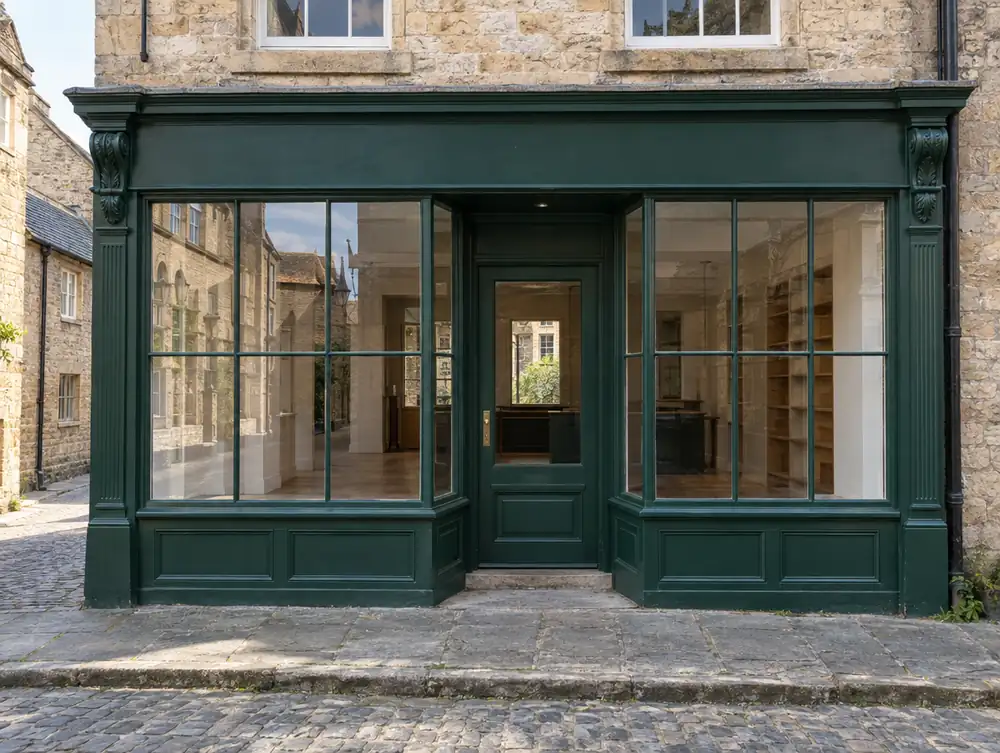
How would we approach timber shopfronts for your Dalgety Bay premises?
Narrow units suit timber well, because mouldings add interest where there's little width to work with. On a slim Dalgety Bay frontage we'd keep one strong pane, a panelled door and a fascia that doesn't crowd them.
Timber fits a night programme better than you'd think, since most of the joinery is made elsewhere. For a unit in Dalgety Bay that can't close by day, we'd fit the frame in stages at night and leave painting until the end, once the dust has gone.
A corner unit has two fronts to think about, and the return elevation often does as much selling as the main one. If that is your layout in Dalgety Bay, carry the fascia and glass line round the corner and treat both faces as one composition.
What should you budget for timber shopfronts in Dalgety Bay?
The guide for timber shopfronts is £3,995 to £13,995 plus VAT for a typical frontage. Expect the lower end for simple work with clear access, and the upper end where detail, finish or awkward conditions add hours.
What consents could affect timber shopfronts in Dalgety Bay?
Scottish guidance says like-for-like windows need no permission, and a true like-for-like frontage replacement usually follows the same logic. Class 7A covers altering or replacing an existing window, but it doesn't mention shopfronts, so ask before relying on it for a display window. For timber shopfronts at premises in the Dalgety Bay area, a material effect on the external appearance means planning permission, and the council confirms the position.
At survey we check how things stand for your building, although applications for planning permission or advertisement consent here normally go to Fife Council.
| Town | Dalgety Bay |
|---|---|
| Area | Fife |
| Postcode districts | EH30, KY11 |
| Planning authority | Fife Council |
| Building approval | Building warrant (Technical Handbook) |
| Distance from Great Barr | About 248 miles |
| Survey | Free for new work |
Does Fife Council publish shopfront guidance?
Yes, Shop Front Design Guidelines (2016). It tells applicants what the council expects from new and altered shopfronts. A few of the things it asks for:
- Solid security shutters are discouraged, and shutter boxes may not project in front of the shop front.
- Internal lattice shutters and reinforced laminated glass are encouraged in town centres, with demountable mesh grilles preferred on traditional shop fronts.
- Each shop normally gets one fascia sign and one projecting sign, and only one of them may be lit.
Questions about timber shopfronts in Dalgety Bay
Will timber suffer on my Dalgety Bay frontage if it gets a lot of rain?
Not if the details are right. Sloped cills, sealed end grain and plinth blocks keep water moving, and the paint system then only has to deal with the weather, not trapped damp.
Do you make the joinery for Dalgety Bay shops to order?
Yes. Every length is made to the signed-off drawings for your opening, then brought to Dalgety Bay from Great Barr by vetted teams working under S&K Glazing.
Can a timber front take a modern sign in Dalgety Bay?
Yes. Hand-painted letters suit a timber fascia well, and raised letters or a concealed trough light work too. We draw the sign and the joinery together, so the fixings don't cut through a moulding.
Do I need a building warrant for a shopfront in the Dalgety Bay area?
Usually yes in Scotland, if the work alters a wall or structure. Schedule 3 of the Building (Scotland) Regulations 2004 lists some work that needs no warrant, such as replacing a door or window with its frame, but the standards still apply. Shopfronts aren't named there, so ask the council before relying on it.
Do I need listed building consent for a shopfront in the Dalgety Bay area?
Almost certainly, if the building is listed and windows or doors are changing, according to Historic Environment Scotland. The planning authority decides, and Historic Environment Scotland is consulted on some applications. Scottish Ministers are notified if it objects.