Looking for a front with more character on your Cowdenbeath premises? A painted timber frontage, built up in layers and proportioned to the building, has a warmth that reads from across the street.
It helps if you can be there when we visit Cowdenbeath, since five minutes walking the frontage together answers more than a long email.
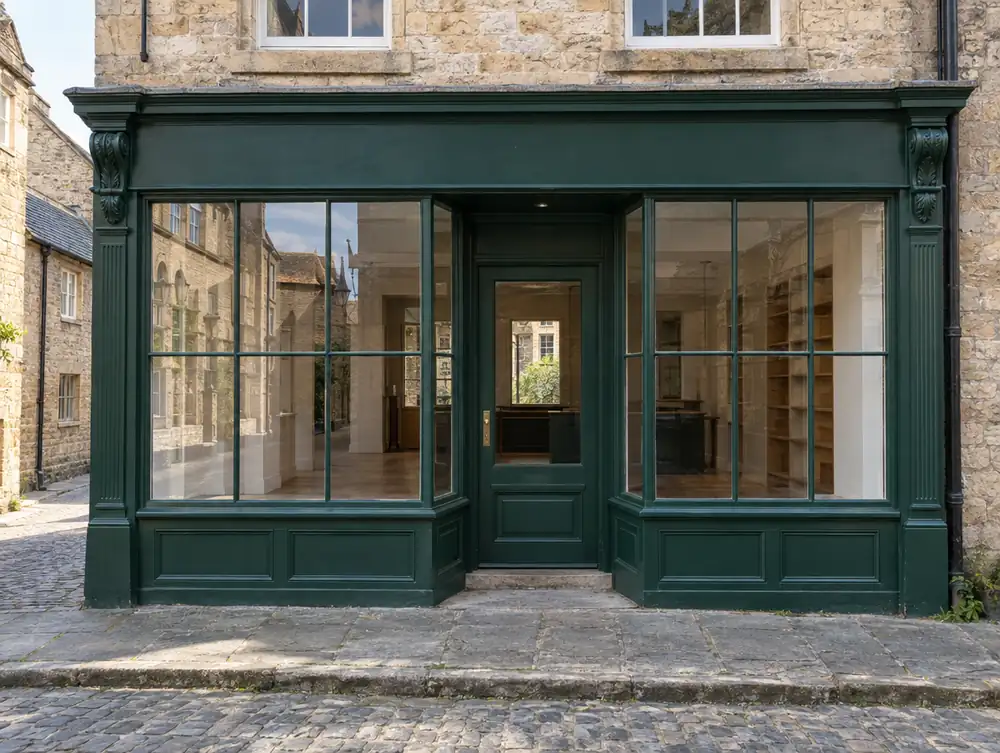
What makes timber shopfronts work well on Cowdenbeath premises?
In a parade of mixed fronts in Cowdenbeath, painted timber can lift a unit without shouting. We'd take the height of the neighbouring cills and fascias, then let the depth of the mouldings and a considered colour do the talking.
If your Cowdenbeath premises have a deep recessed entrance, timber can make it feel like a welcome. We'd panel the returns, add a lit soffit and lay a hard-wearing threshold, keeping the end grain of every post clear of the wet.
If the pavement falls across your frontage, let the stallriser take up the slope and keep the glass line dead level. The eye reads the long horizontal, so Cowdenbeath premises on a slope look settled once that line is true.
Could timber shopfronts in Cowdenbeath need planning permission?
Class 9A, Scotland's shop permitted development right, gives no route for a shopfront change. It covers Class 1A premises, but not work that alters or extends beyond the existing front, and it doesn't apply in conservation areas, National Parks or World Heritage Sites. For timber shopfronts at premises in the Cowdenbeath area, that generally means a planning application unless the external appearance isn't materially affected.
For Cowdenbeath, the usual route for planning and advert applications is through Fife Council, and we confirm that when we visit.
How much should you set aside for timber shopfronts in Cowdenbeath?
Allow £3,995 to £13,995 plus VAT for a typical frontage. Size and specification set most of that figure for timber shopfronts, and the rest depends on what the survey finds on site.
| Town | Cowdenbeath |
|---|---|
| Area | Fife |
| Postcode districts | KY4, KY5 |
| Planning authority | Fife Council |
| Building approval | Building warrant (Technical Handbook) |
| Distance from Great Barr | About 253 miles |
| Survey | Free for new work |
Does Fife Council publish shopfront guidance?
Yes, Shop Front Design Guidelines (2016). It tells applicants what the council expects from new and altered shopfronts. A few of the things it asks for:
- Solid security shutters are discouraged, and shutter boxes may not project in front of the shop front.
- Internal lattice shutters and reinforced laminated glass are encouraged in town centres, with demountable mesh grilles preferred on traditional shop fronts.
- Each shop normally gets one fascia sign and one projecting sign, and only one of them may be lit.
Questions about timber shopfronts in Cowdenbeath
Will timber suffer on my Cowdenbeath frontage if it gets a lot of rain?
Not if the details are right. Sloped cills, sealed end grain and plinth blocks keep water moving, and the paint system then only has to deal with the weather, not trapped damp.
Is timber a sensible choice for my Cowdenbeath frontage?
Usually, if you're happy with a repaint every 5 to 7 years. A survey shows how exposed the front is and whether the structure behind it is sound, and we'll tell you if aluminium would serve you better.
How much disruption will a timber front cause in my Cowdenbeath shop?
Expect more time on site than an aluminium front, typically 3 to 7 days with the painting. Closed-day or out-of-hours fitting can be arranged, and the opening stays boarded and secure between stages.
Do roller shutters need planning permission in the Cowdenbeath area?
Usually yes, if they materially affect the external appearance. Class 9A doesn't name shutters, so in Scotland treat them as falling to the appearance test rather than assuming a permitted development route. Ask the council before ordering, as this is a reading of the rules and not an official statement.
Do I need listed building consent for a shopfront in the Cowdenbeath area?
Almost certainly, if the building is listed and windows or doors are changing, according to Historic Environment Scotland. The planning authority decides, and Historic Environment Scotland is consulted on some applications. Scottish Ministers are notified if it objects.