Colour and craft do the work on a timber front in Glenrothes. We test paint on your actual frontage, draw any moulding that matters at full size, and keep every dimension on paper for you to sign off.
Bring whatever you have to the survey in Glenrothes: brand guidelines, lease plans, old drawings or a photo of a frontage you admire.
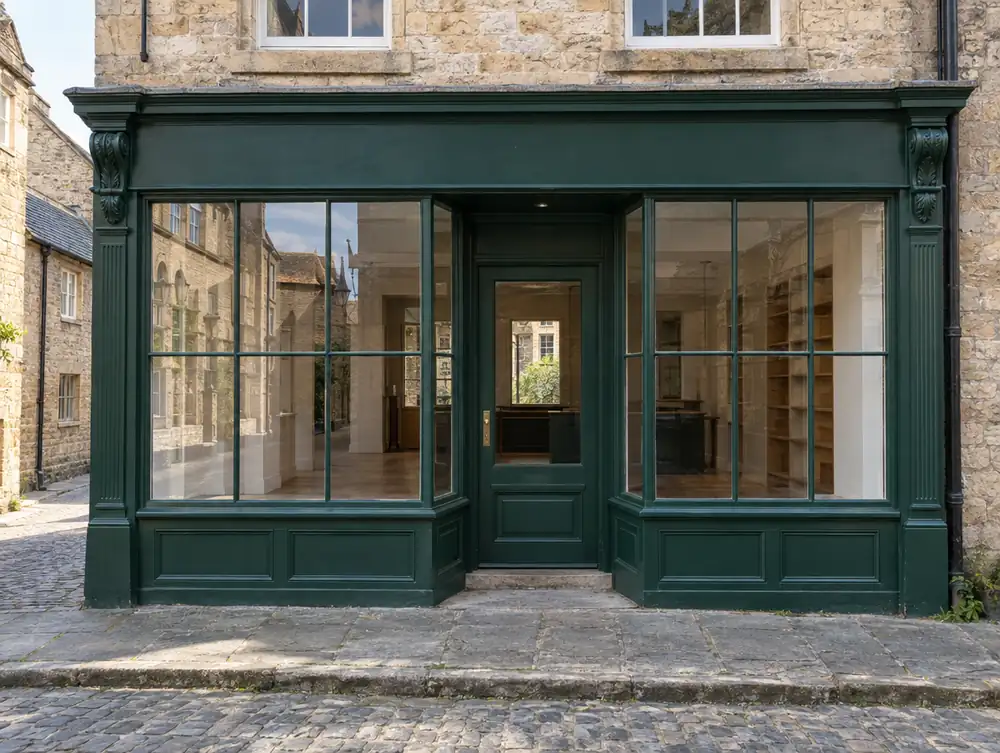
What goes into getting timber shopfronts right in Glenrothes?
A corner plot gives a timber front two faces and one chance to get the turn right. For Glenrothes premises on a corner, we'd use a pilaster or a canted bay at the angle, so the cornice wraps round without a clumsy mitre.
A south or west-facing Glenrothes frontage is hard on paint. We'd steer you toward a lighter colour or a more stable timber, and if the brand needs a dark finish, we'd plan a shorter repaint interval from the outset.
Where units share one long run of fascia, breaking the height makes you stand out for the wrong reason. If that describes your Glenrothes parade, keep the line and win attention with lettering, lighting and what's in the window.
How much could timber shopfronts in Glenrothes cost you?
The guide for timber shopfronts is £3,995 to £13,995 plus VAT for a typical frontage. Expect the lower end for simple work with clear access, and the upper end where detail, finish or awkward conditions add hours.
Which applications might timber shopfronts in Glenrothes involve?
Scottish guidance says like-for-like windows need no permission, and a true like-for-like frontage replacement usually follows the same logic. Class 7A covers altering or replacing an existing window, but it doesn't mention shopfronts, so ask before relying on it for a display window. For timber shopfronts at premises in the Glenrothes area, a material effect on the external appearance means planning permission, and the council confirms the position.
At survey we check how things stand for your building, although applications for planning permission or advertisement consent here normally go to Fife Council.
| Town | Glenrothes |
|---|---|
| Area | Fife |
| Postcode districts | KY6, KY7 |
| Planning authority | Fife Council |
| Building approval | Building warrant (Technical Handbook) |
| Distance from Great Barr | About 257 miles |
| Survey | Free for new work |
Does Fife Council publish shopfront guidance?
Yes, Shop Front Design Guidelines (2016). It tells applicants what the council expects from new and altered shopfronts. A few of the things it asks for:
- Solid security shutters are discouraged, and shutter boxes may not project in front of the shop front.
- Internal lattice shutters and reinforced laminated glass are encouraged in town centres, with demountable mesh grilles preferred on traditional shop fronts.
- Each shop normally gets one fascia sign and one projecting sign, and only one of them may be lit.
Questions about timber shopfronts in Glenrothes
How much disruption will a timber front cause in my Glenrothes shop?
Expect more time on site than an aluminium front, typically 3 to 7 days with the painting. Closed-day or out-of-hours fitting can be arranged, and the opening stays boarded and secure between stages.
What should I budget for looking after a timber front in Glenrothes?
A repaint every 5 to 7 years, plus a yearly wash and touch-up of the cills. Door gear needs checking too, since seasonal movement can throw a door out of line.
Can you fit a timber front around existing tiles in Glenrothes?
Often, yes, and it's usually worth trying. If your stallriser or entrance has good original tile, we'd measure it carefully and scribe the new joinery to it.
Do I need planning permission to alter a shopfront in the Glenrothes area?
Usually yes, if the work materially affects the external appearance. Class 9A, Scotland's shop permitted development right, doesn't cover work that alters or extends beyond the existing front. A true like-for-like replacement usually needs no permission, and the council confirms the position.
Do roller shutters need planning permission in the Glenrothes area?
Usually yes, if they materially affect the external appearance. Class 9A doesn't name shutters, so in Scotland treat them as falling to the appearance test rather than assuming a permitted development route. Ask the council before ordering, as this is a reading of the rules and not an official statement.