A well-made timber front should still look good in Kirkcaldy long after the first coat of paint has gone. That comes from choosing a durable timber, sealing the end grain and keeping water away from the bottom of every member.
A survey in Kirkcaldy usually starts outside, looking at the whole elevation before any tape comes out, because the frontage has to answer the building above it.
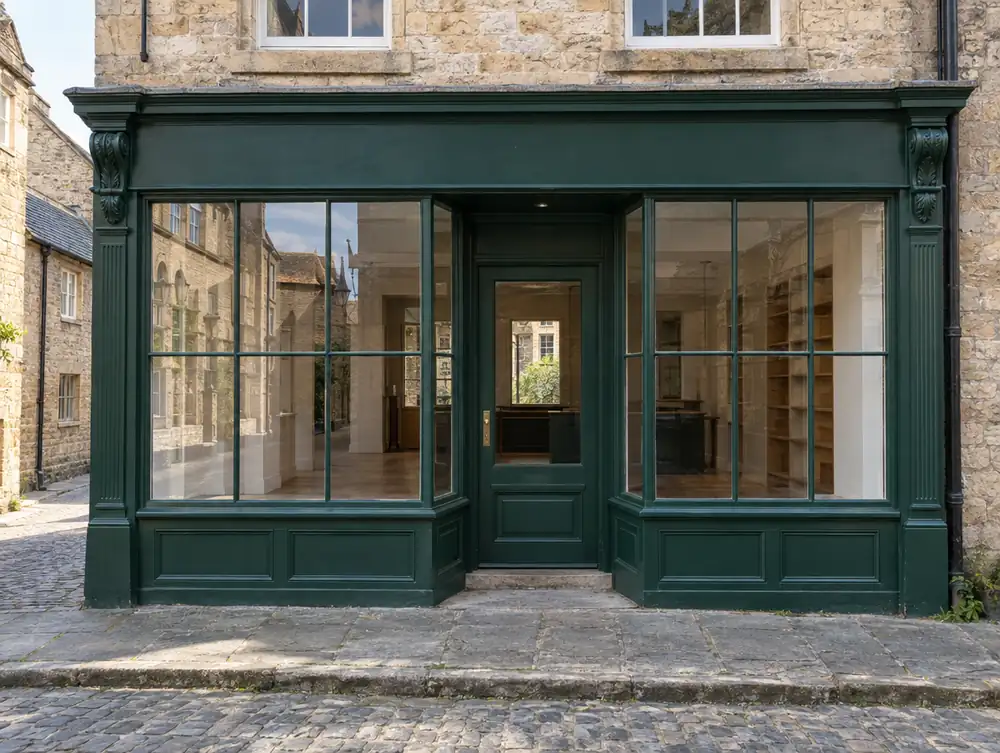
What should you think about before commissioning timber shopfronts in Kirkcaldy?
Timber fits a night programme better than you'd think, since most of the joinery is made elsewhere. For a unit in Kirkcaldy that can't close by day, we'd fit the frame in stages at night and leave painting until the end, once the dust has gone.
Narrow units suit timber well, because mouldings add interest where there's little width to work with. On a slim Kirkcaldy frontage we'd keep one strong pane, a panelled door and a fascia that doesn't crowd them.
A corner unit has two fronts to think about, and the return elevation often does as much selling as the main one. If that is your layout in Kirkcaldy, carry the fascia and glass line round the corner and treat both faces as one composition.
Who approves timber shopfronts in Kirkcaldy?
Section 26 of the Town and Country Planning (Scotland) Act 1997 sets the test: work that doesn't materially affect the external appearance isn't development. For timber shopfronts at premises in the Kirkcaldy area, anything that does needs planning permission, and a true like-for-like replacement usually doesn't. The council confirms how that applies to each site.
For Kirkcaldy, the usual route for planning and advert applications is through Fife Council, and we confirm that when we visit.
What is a realistic budget for timber shopfronts in Kirkcaldy?
As a working budget, use £3,995 to £13,995 plus VAT for a typical frontage. Your place inside that range for timber shopfronts depends mostly on how much of the existing frontage can stay and how much has to be put right first.
| Town | Kirkcaldy |
|---|---|
| Area | Fife |
| Postcode districts | KY1, KY2 |
| Planning authority | Fife Council |
| Building approval | Building warrant (Technical Handbook) |
| Distance from Great Barr | About 252 miles |
| Survey | Free for new work |
Does Fife Council publish shopfront guidance?
Yes, Shop Front Design Guidelines (2016). It tells applicants what the council expects from new and altered shopfronts. A few of the things it asks for:
- Solid security shutters are discouraged, and shutter boxes may not project in front of the shop front.
- Internal lattice shutters and reinforced laminated glass are encouraged in town centres, with demountable mesh grilles preferred on traditional shop fronts.
- Each shop normally gets one fascia sign and one projecting sign, and only one of them may be lit.
Questions about timber shopfronts in Kirkcaldy
Is timber a sensible choice for my Kirkcaldy frontage?
Usually, if you're happy with a repaint every 5 to 7 years. A survey shows how exposed the front is and whether the structure behind it is sound, and we'll tell you if aluminium would serve you better.
Can you fit a timber front around existing tiles in Kirkcaldy?
Often, yes, and it's usually worth trying. If your stallriser or entrance has good original tile, we'd measure it carefully and scribe the new joinery to it.
Can you copy a timber shopfront I've seen in Fife?
We can work from your photo and borrow what makes it succeed, including proportions, moulding sizes and colour. The front is then drawn to your own Kirkcaldy opening.
Which way must a fire exit door open on a shop in the Kirkcaldy area?
In the direction of escape. Regulation 13(2) of the Fire Safety (Scotland) Regulations 2006 also rules out sliding and revolving doors on a dedicated fire exit and says fire exit doors can't be locked against immediate use. Duties sit with dutyholders under Part 3 of the Fire (Scotland) Act 2005, meaning the employer and any person with control of the premises.
Do roller shutters need planning permission in the Kirkcaldy area?
Usually yes, if they materially affect the external appearance. Class 9A doesn't name shutters, so in Scotland treat them as falling to the appearance test rather than assuming a permitted development route. Ask the council before ordering, as this is a reading of the rules and not an official statement.