One contract covers the paint, glass, sign and door work on refurbishments across Dalgety Bay and Fife. That saves you chasing separate trades for a job that has to look like one piece.
Please have keys to any meter cupboards and shutter housings to hand when we survey in Dalgety Bay, because what sits behind them can change the drawing.
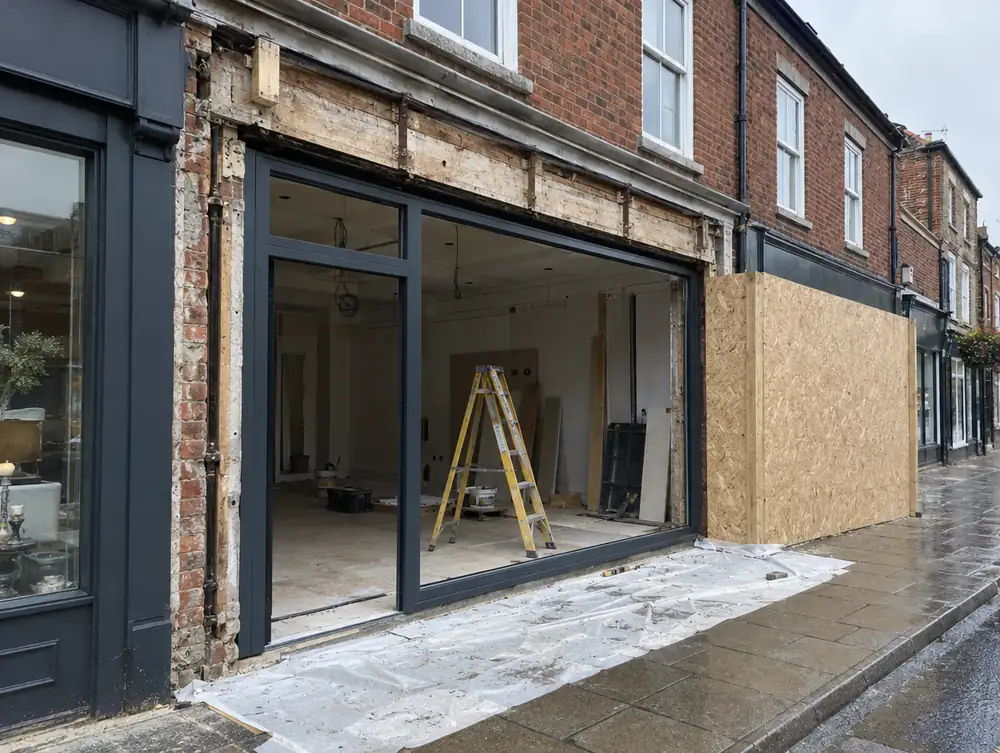
What makes shopfront refurbishment work well on Dalgety Bay premises?
If the glass is old, we look for the etched safety mark in the corner of each pane. Panes without one, in the door or at low level, should be replaced while the frontage is being worked on.
If your Dalgety Bay shopfront is aluminium and the frame is sound, a recoat can change the whole look. We check for corrosion and old sealant first, because paint will not hide either for long.
On a north-facing frontage the glass stays free of glare, but the interior can look dim from the street, so lighting needs to sit closer to the window. If your Dalgety Bay premises face south, the problem flips to reflections by day and fading stock.
Could shopfront refurbishment in Dalgety Bay need planning permission?
Shutters aren't named in Class 9A, so in Scotland they usually fall to the appearance test. The same goes for shopfront refurbishment at premises in the Dalgety Bay area: building work that materially affects the external appearance needs planning permission, and a true like-for-like usually doesn't. Ask the council to confirm the position for your site.
Planning and advert applications for Dalgety Bay premises normally go to Fife Council. We check the position for your address at survey.
How much should you set aside for shopfront refurbishment in Dalgety Bay?
Allow £1,995 to £8,995 plus VAT depending on what is kept. Size and specification set most of that figure for shopfront refurbishment, and the rest depends on what the survey finds on site.
| Town | Dalgety Bay |
|---|---|
| Area | Fife |
| Postcode districts | EH30, KY11 |
| Planning authority | Fife Council |
| Building approval | Building warrant (Technical Handbook) |
| Distance from Great Barr | About 248 miles |
| Survey | Free for new work |
Does Fife Council publish shopfront guidance?
Yes, Shop Front Design Guidelines (2016). It tells applicants what the council expects from new and altered shopfronts. A few of the things it asks for:
- Solid security shutters are discouraged, and shutter boxes may not project in front of the shop front.
- Internal lattice shutters and reinforced laminated glass are encouraged in town centres, with demountable mesh grilles preferred on traditional shop fronts.
- Each shop normally gets one fascia sign and one projecting sign, and only one of them may be lit.
Questions about shopfront refurbishment in Dalgety Bay
Can my Dalgety Bay shopfront be refurbished without closing?
Usually, yes. Work is split into stages around your trading hours, and closed-day or out-of-hours work can be arranged for anything that affects the door.
Is it worth refurbishing an old aluminium shopfront in Dalgety Bay?
Often, yes, if the frame is straight and the corners are tight. Recoating, new gaskets and better glass can add years of life. If the frame is corroded or the door has worn out its fixings, replacement may make more sense.
Can a refurbishment make my Dalgety Bay premises easier to enter?
Often, yes. Lighter door closers, better handles and a lower threshold can all be added without replacing the frontage. We check the door width and the step at survey.
Do I need a building warrant for a shopfront in the Dalgety Bay area?
Usually yes in Scotland, if the work alters a wall or structure. Schedule 3 of the Building (Scotland) Regulations 2004 lists some work that needs no warrant, such as replacing a door or window with its frame, but the standards still apply. Shopfronts aren't named there, so ask the council before relying on it.
Does a shop sign in the Dalgety Bay area need advertisement consent?
Not always. Scotland's 1984 Regulations let an unlit sign within Class IV(1) go up without an application, and Class VI does the same for a lit sign with each character lit from within. Class VI isn't available in conservation areas, and one council says lit signs always need express consent, so ask first.