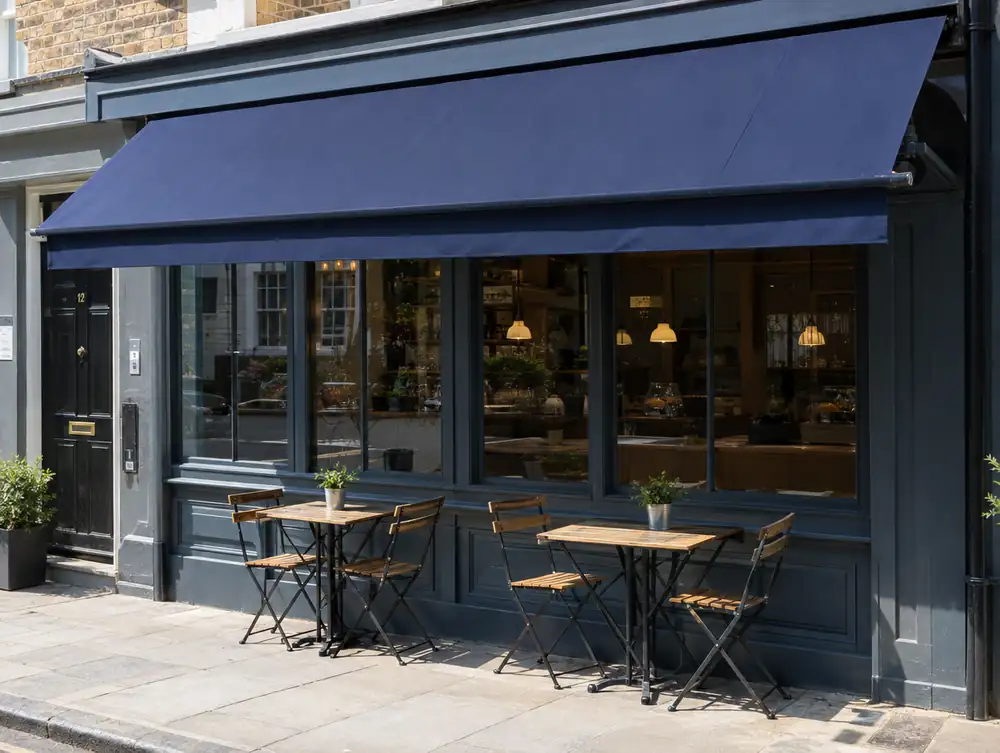
Shade over a window display protects stock as well as customers. For frontages in Limehouse that catch the afternoon sun, a folding arm awning or shop blind can slow fading and make the interior easier to see.
It helps if you can be there when we visit Limehouse, since five minutes walking the frontage together answers more than a long email.
What goes into getting canopies and awnings right in Limehouse?
If the wall is rendered or cavity-built, we check what lies behind it before designing brackets. Long anchors or a spreader plate can take the load where a standard fixing would pull out.
Where your sign sits on the fascia, the awning box goes above or below it without covering the name. If that cannot be done, we letter the valance so people can still read who you are.
If there are storeys above the shop, the frontage should feel like the base of the building and not a sign stuck on it. Lining up mullions with the windows overhead is a small move that settles the whole elevation at Limehouse premises.
Which applications might canopies and awnings in Limehouse involve?
A true like-for-like replacement usually needs no planning permission in England, because the external appearance isn't materially affected. New materials, a different glass line or altered proportions usually do count as material, so for canopies and awnings at premises in the Limehouse area, an application is then likely. The council confirms which side of that line a job falls on.
In England, signs at premises in the Limehouse area come under the 2007 Advertisement Regulations. An unlit fascia sign generally needs no application under Class 5 of Schedule 3 if it sits on a wall containing a shop window, tops out at 4.6m or the first-floor sill if that is lower, and keeps letters to 0.75m high. Displaying a sign without the consent it needs is a criminal offence, so check before it goes up.
Planning and advert applications for Limehouse premises normally go to London Borough of Tower Hamlets. We check the position for your address at survey.
How much could canopies and awnings in Limehouse cost you?
Allow £1,495 to £9,995 plus VAT per canopy or awning. Size and specification set most of that figure for canopies and awnings, and the rest depends on what the survey finds on site.
| Town | Limehouse |
|---|---|
| Area | Greater London |
| Postcode districts | E1, E14, E1W, E3 |
| Planning authority | London Borough of Tower Hamlets |
| Building approval | Building Regulations (Approved Documents) |
| Distance from Great Barr | About 107 miles |
| Survey | Free for new work |
Does London Borough of Tower Hamlets publish shopfront guidance?
Yes, Shopfronts and Roller Shutter Grilles. It tells applicants what the council expects from new and altered shopfronts. A few of the things it asks for:
- Stallrisers are always required on traditional shopfronts.
- Fascias should normally be no more than 500mm deep and no higher than ground floor level.
- External roller shutter boxes will not be permitted, and shutters should wherever possible be an integral feature of the shopfront.
Questions about canopies and awnings in Limehouse
Do you replace awning fabric in Limehouse?
Yes, provided the frame is sound. We measure the frame, check the arms and roller, then make a new cover in your chosen canvas and colour.
Will an awning hide the sign on my Limehouse premises?
It should not, if it is designed properly. We place the box and valance so the name reads with the cover out, or we add lettering to the valance.
How long will an awning last on Limehouse premises?
A good frame typically lasts 15 years or more, and acrylic canvas typically lasts 7 to 10 years. Regular cleaning and retracting in high wind make the biggest difference.
Does a shop sign in the Limehouse area need advertisement consent?
Not always. In England, an unlit sign within Class 5 of the 2007 Advertisement Regulations generally needs no application, and neither does a lit sign within Class 4B. Anything outside those classes needs consent, and Class 4B isn't available in conservation areas, so check before ordering.
Do I need planning permission to change a shopfront in the Limehouse area?
Usually yes, if the work materially affects the building's external appearance. England's shop permitted development rights exclude creating, altering or replacing a shopfront, so there is no shortcut. A true like-for-like replacement usually needs no application, and the council confirms the position.