Aluminium shopfronts for Limehouse premises start with a measured survey of your opening, because the neat lines of the metal will expose any lean in the building. We draw the frame to scale and you sign off every dimension before anything is made.
Nothing gets ordered off the back of a survey in Limehouse, because its job is to give us the numbers to draw and price from.
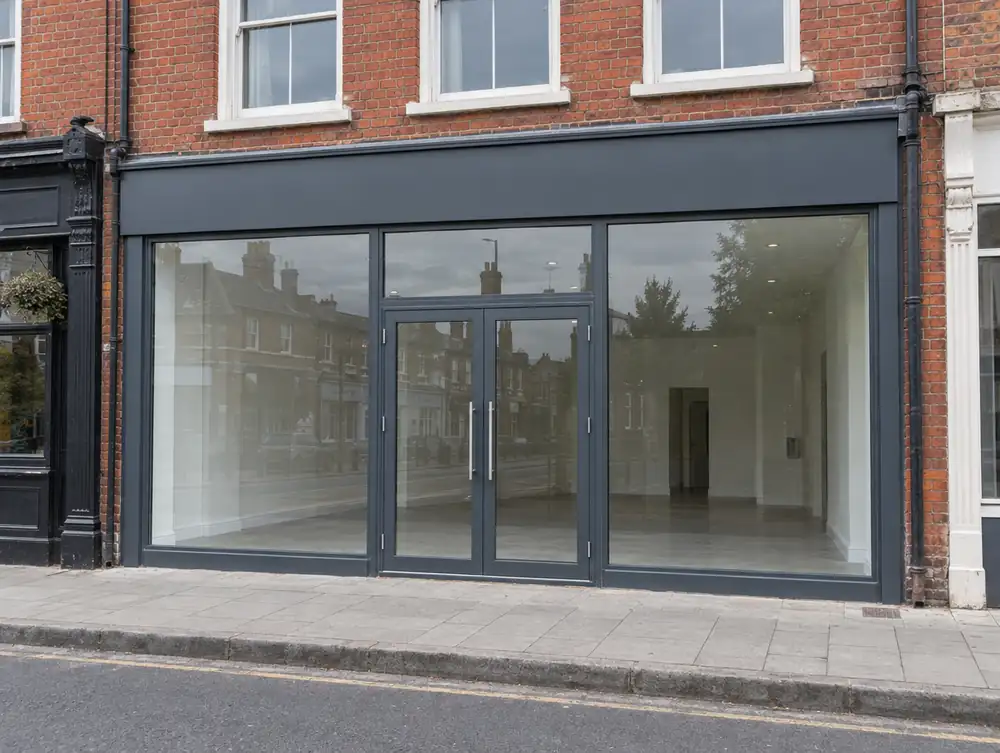
What goes into getting aluminium shopfronts right in Limehouse?
On a corner plot, the side elevation does as much selling as the front. We'd run the stallriser and fascia round at one height and use a slim corner post in the frame colour, so anyone approaching your Limehouse premises from either direction sees one continuous shopfront.
If your unit sits in a parade in Limehouse, we'd start with the neighbours: the fascia line, cill height and pier rhythm of the row. Holding those lines lets a slimmer section stand out for the right reasons, rather than fighting everything beside it.
Where the building has good brick or stone around the opening, set the frame back in the reveal so the masonry can be seen. On Limehouse premises with a flat elevation, that deep reveal throws a shadow line that adds real depth in low sun.
Which applications might aluminium shopfronts in Limehouse involve?
For aluminium shopfronts at premises in the Limehouse area, the deciding question in England is whether the building work materially affects the external appearance. If it does, planning permission is needed, while a true like-for-like replacement usually needs none. The council confirms the position for each site.
We confirm the position at survey, because a boundary or a special designation can change who handles the file, but applications from Limehouse premises normally go to London Borough of Tower Hamlets.
How much could aluminium shopfronts in Limehouse cost you?
The guide for aluminium shopfronts is £2,495 to £11,995 plus VAT for a typical 3 to 7 m frontage. Expect the lower end for simple work with clear access, and the upper end where detail, finish or awkward conditions add hours.
| Town | Limehouse |
|---|---|
| Area | Greater London |
| Postcode districts | E1, E14, E1W, E3 |
| Planning authority | London Borough of Tower Hamlets |
| Building approval | Building Regulations (Approved Documents) |
| Distance from Great Barr | About 107 miles |
| Survey | Free for new work |
Does London Borough of Tower Hamlets publish shopfront guidance?
Yes, Shopfronts and Roller Shutter Grilles. It tells applicants what the council expects from new and altered shopfronts. A few of the things it asks for:
- Stallrisers are always required on traditional shopfronts.
- Fascias should normally be no more than 500mm deep and no higher than ground floor level.
- External roller shutter boxes will not be permitted, and shutters should wherever possible be an integral feature of the shopfront.
Questions about aluminium shopfronts in Limehouse
What do you need before surveying a unit in Limehouse?
An address, a few photos and a rough idea of what you have in mind are enough to book the survey. If you have a lease, a landlord's specification or brand guidelines, send those too, because they shape the drawing.
Will an aluminium front make my Limehouse shop warmer?
It can, though the glass matters more than the frame. A thermally broken section with double-glazed units loses less heat than single glazing, and a well-sealed door is often the change you notice most on a cold day.
Who carries out the work in Limehouse?
Vetted teams working under S&K Glazing carry it out, with one named contact from survey to handover. The contract is with S&K Glazing Limited, and we travel to Limehouse from Great Barr.
Do I need listed building consent for a shopfront in the Limehouse area?
Usually yes, if the building is listed. In England the local planning authority decides, and Historic England is notified of Grade I and II* works and specified Grade II works. Like-for-like repair may not need consent, so ask the council before work starts.
What rules apply to a fire exit door through a shopfront in the Limehouse area?
It must open in the direction of escape and can't be locked against immediate use, and a dedicated fire exit can't be a sliding or revolving door. In England that comes from article 14(2) of the Regulatory Reform (Fire Safety) Order 2005, and the duty sits with the responsible person, normally the employer or whoever controls the premises for a business, otherwise the owner. An outward door can clash with section 153 of the Highways Act 1980 where it opens onto the footway, so raise it early.