Internal shutters have become the sensible first option for many premises. They keep the frontage clean by day and protect stock at night.
Bring whatever you have to the survey in Aberdare: brand guidelines, lease plans, old drawings or a photo of a frontage you admire.
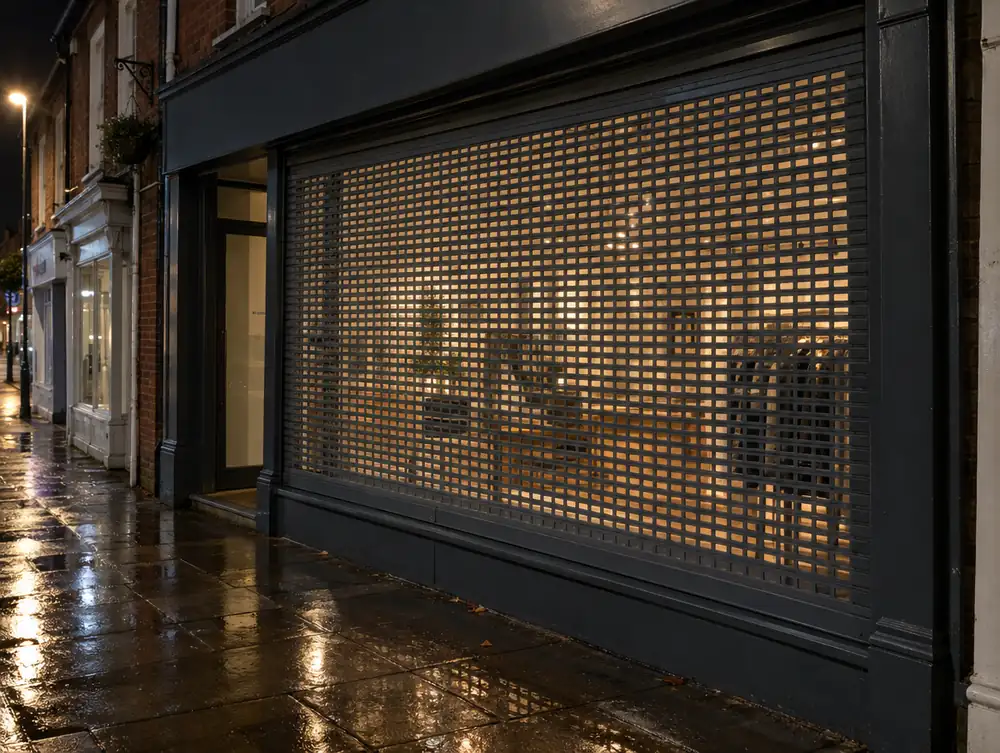
What makes perforated roller shutters work well on Aberdare premises?
Where the frame is slim aluminium, guides need fixing back to something solid. We may add a concealed post or a stiffer jamb, so the lower corners cannot be levered out.
On premises with a recessed entrance, the shutter line needs careful thought. We usually bring it forward to the building line, or close the recess separately, so the doorway does not become a hiding place.
On a north-facing frontage the glass stays free of glare, but the interior can look dim from the street, so lighting needs to sit closer to the window. If your Aberdare premises face south, the problem flips to reflections by day and fading stock.
Could perforated roller shutters in Aberdare need planning permission?
Like-for-like replacement usually needs no planning permission in Wales, because the external appearance isn't materially affected. Matching the existing materials, proportions and glass line is what keeps a job in that position. For perforated roller shutters at premises in the Aberdare area, changing any of those usually means an application, which the council can confirm.
Aberdare applications for planning permission or advertisement consent are normally handled by Rhondda Cynon Taf County Borough Council. Our survey includes a check of the position for your address.
How much should you set aside for perforated roller shutters in Aberdare?
Until the survey is done, plan on £1,695 to £4,495 plus VAT per shutter. Unusual sizes, fine detail and phased working push the figure up, while a simple brief and clear access keep it toward the lower end.
| Town | Aberdare |
|---|---|
| Area | Mid Glamorgan |
| Postcode districts | CF44 |
| Planning authority | Rhondda Cynon Taf County Borough Council |
| Building approval | Building Regulations (Approved Documents for Wales) |
| Distance from Great Barr | About 87 miles |
| Survey | Free for new work |
Does Rhondda Cynon Taf County Borough Council publish shopfront guidance?
Yes, Shopfront Design. It tells applicants what the council expects from new and altered shopfronts. A few of the things it asks for:
- External roller shutters are a last resort after other security options are shown to be unsuitable.
- Solid metal shutters are unlikely to be acceptable, while lattice or brick-bond grille shutters may be considered.
- Individual shutters covering only the glazing are one option, and powder coating is generally preferred to paint.
Questions about perforated roller shutters in Aberdare
What happens if the shutter jams at closing time in Aberdare?
Do not force it, because that can damage the curtain and motor. Use the manual override if it is safe, then call us. Repairs are charged call-outs, and the fixed price is shown on our site.
Can one person open the shutter at my Aberdare shop?
Yes. Powered shutters run at the turn of a key or a button press, and a manual override is available if the power fails. We show your staff both at handover.
Do you remove old shutters in Aberdare?
Yes. Taking out the old curtain, box and guides, then making good the frontage, is shown as its own line in the itemised quotation.
Does a replacement shopfront in the Aberdare area need Building Regulations approval?
Assume yes until building control says otherwise, because Wales has no like-for-like exemption. Glazing is judged against Approved Document N, as Wales keeps Part N. A registered installer can self-certify replacement windows and doors in non-dwellings, but not structural glass, curtain walling or revolving doors.
Can a shop fire exit in the Aberdare area use a sliding door?
No, a dedicated fire exit can't be a sliding or revolving door. In Wales, article 14(2) of the Regulatory Reform (Fire Safety) Order 2005 also says fire exit doors must open in the direction of escape and can't be locked against immediate use. The responsible person holds that duty, normally the employer or whoever controls the premises for a business, otherwise the owner.