Across Mid Glamorgan, timber is the material we suggest when a building has proportions worth respecting. For Aberdare premises, we set the stallriser, pilasters and fascia from the elevation above, then detail the joinery to match.
We measure your Aberdare opening in person, at a time agreed with you first, so the visit fits around your trading.
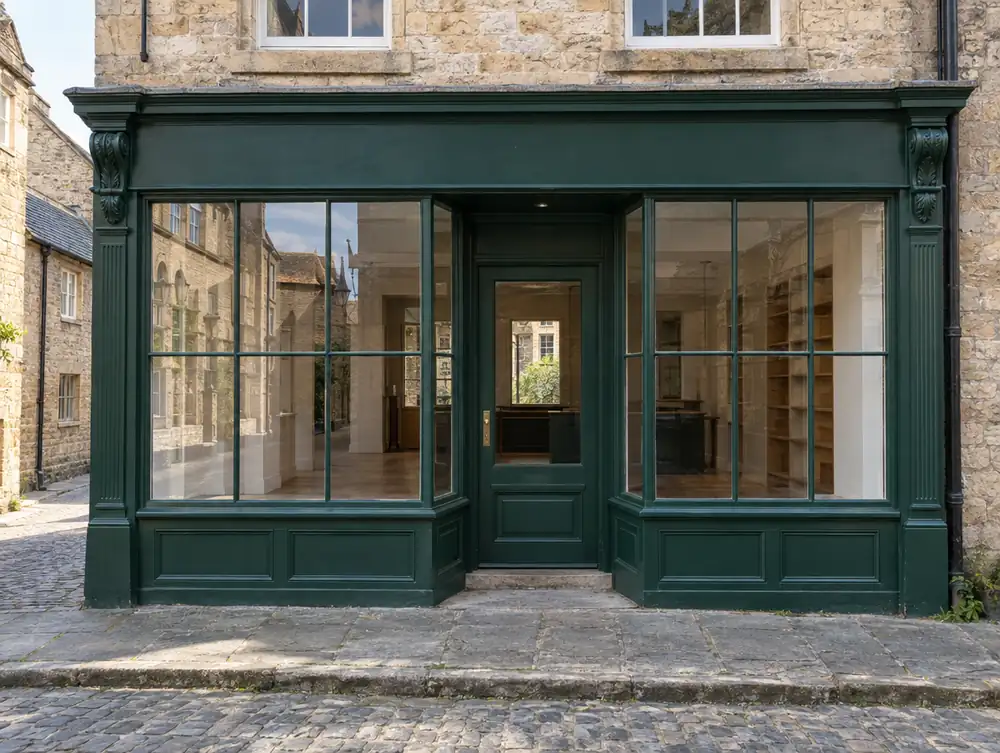
How do you design around the building when planning timber shopfronts in Aberdare?
Timber fits a night programme better than you'd think, since most of the joinery is made elsewhere. For a unit in Aberdare that can't close by day, we'd fit the frame in stages at night and leave painting until the end, once the dust has gone.
If your Aberdare premises have a deep recessed entrance, timber can make it feel like a welcome. We'd panel the returns, add a lit soffit and lay a hard-wearing threshold, keeping the end grain of every post clear of the wet.
Where a fascia has crept down over the years, lifting it back to its original line can add real height to the glass. Check what sits behind it first at Aberdare premises, since a shutter box or old beam may set the limit.
What might timber shopfronts cost in Aberdare?
We would budget £3,995 to £13,995 plus VAT for a typical frontage. Scope sets most of the figure, so a clear brief at the start does more for the budget than any later change of detail.
What permissions should you check for timber shopfronts in Aberdare?
Section 55 of the Town and Country Planning Act 1990 sets the test in Wales: work that doesn't materially affect the external appearance isn't development. Anything that does needs planning permission, and that goes for timber shopfronts at premises in the Aberdare area as much as for a full new frontage. The council confirms how the test applies to your site.
Expect planning and advert applications here to go to Rhondda Cynon Taf County Borough Council in the normal way. We check what that means for your building when we survey it in Aberdare.
| Town | Aberdare |
|---|---|
| Area | Mid Glamorgan |
| Postcode districts | CF44 |
| Planning authority | Rhondda Cynon Taf County Borough Council |
| Building approval | Building Regulations (Approved Documents for Wales) |
| Distance from Great Barr | About 87 miles |
| Survey | Free for new work |
Does Rhondda Cynon Taf County Borough Council publish shopfront guidance?
Yes, Shopfront Design. It tells applicants what the council expects from new and altered shopfronts. A few of the things it asks for:
- External roller shutters are a last resort after other security options are shown to be unsuitable.
- Solid metal shutters are unlikely to be acceptable, while lattice or brick-bond grille shutters may be considered.
- Individual shutters covering only the glazing are one option, and powder coating is generally preferred to paint.
Questions about timber shopfronts in Aberdare
Is timber a sensible choice for my Aberdare frontage?
Usually, if you're happy with a repaint every 5 to 7 years. A survey shows how exposed the front is and whether the structure behind it is sound, and we'll tell you if aluminium would serve you better.
What should I budget for looking after a timber front in Aberdare?
A repaint every 5 to 7 years, plus a yearly wash and touch-up of the cills. Door gear needs checking too, since seasonal movement can throw a door out of line.
Can you copy a timber shopfront I've seen in Mid Glamorgan?
We can work from your photo and borrow what makes it succeed, including proportions, moulding sizes and colour. The front is then drawn to your own Aberdare opening.
Can a roller shutter go on a shop in the Aberdare area without planning permission?
Usually not in Wales. Part 42 of the 1995 Order, as inserted in 2014, excludes installing or replacing a security grill or shutter on a shopfront, so the rights for shops don't help. The only way to avoid an application is work that doesn't materially affect the appearance, and the council confirms that.
What access duty applies to a shop in the Aberdare area?
The Equality Act 2010 applies, in Wales as across Great Britain, and it requires reasonable steps to remove, alter or avoid physical features that disadvantage disabled people. The duty is anticipatory, so it covers disabled people generally. A feature that meets a design standard is generally protected for 10 years.