Perforated roller shutters give Covent Garden premises out-of-hours protection while light and the display still show through. We look first at whether the shutter should sit inside the glass, since that often gives a better frontage.
Your survey is where the price gets real, because widths, heights, levels and access are all taken on site in Covent Garden.
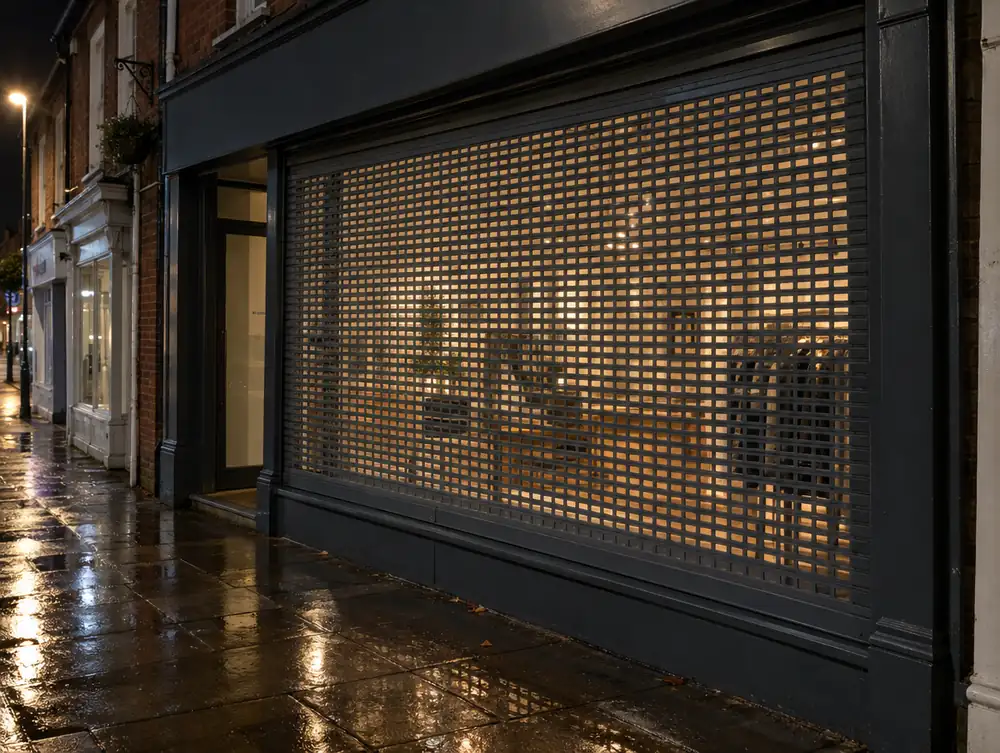
How would we approach perforated roller shutters for your Covent Garden premises?
If your Covent Garden unit has an old external shutter, we check whether the box can come off and leave a clean fascia. That single change can lift a frontage more than a new sign.
Where stock is high in value, a perforated shutter alone may not be enough. We would look at laminated glass in front, a rated curtain, and what your insurer expects, then specify the three together.
If your premises were once two shops, decide early whether the front should read as one or as two. One continuous fascia with a repeated bay width usually settles the elevation better than two mismatched halves, which is worth testing on any Covent Garden unit of that kind.
What should you budget for perforated roller shutters in Covent Garden?
The guide for perforated roller shutters is £1,695 to £4,495 plus VAT per shutter. Expect the lower end for simple work with clear access, and the upper end where detail, finish or awkward conditions add hours.
What consents could affect perforated roller shutters in Covent Garden?
For perforated roller shutters at premises in the Covent Garden area, the deciding question in England is whether the building work materially affects the external appearance. If it does, planning permission is needed, while a true like-for-like replacement usually needs none. The council confirms the position for each site.
We confirm the position at survey, because a boundary or a special designation can change who handles the file, but applications from Covent Garden premises normally go to Westminster City Council.
| Town | Covent Garden |
|---|---|
| Area | Greater London |
| Postcode districts | WC2 |
| Planning authority | Westminster City Council |
| Building approval | Building Regulations (Approved Documents) |
| Distance from Great Barr | About 104 miles |
| Survey | Free for new work |
Does Westminster City Council publish shopfront guidance?
Yes, Shopfronts, Blinds and Signs - A Guide to their Design (1993). It tells applicants what the council expects from new and altered shopfronts. A few of the things it asks for:
- Roller shutters will not normally be given consent, and internally fitted brick-bond grilles are the preferred solution.
- Large internally lit box signs are generally inappropriate, while externally lit fascias and back-lit or halo-lit letters are accepted.
- Projecting signs need at least 2.6m clearance above the pavement and should sit at fascia level, centred on a pilaster.
Questions about perforated roller shutters in Covent Garden
Can one person open the shutter at my Covent Garden shop?
Yes. Powered shutters run at the turn of a key or a button press, and a manual override is available if the power fails. We show your staff both at handover.
How noisy is a shutter in Covent Garden premises?
A modern tubular motor is fairly quiet, and a well-set curtain only makes a low rumble. Heavier steel shutters and worn guides make more noise, which matters if there are flats above.
Can I keep my window display lit behind a shutter in Covent Garden?
Yes, and we recommend it. A low-level light on a timer costs very little and lets the display read through the perforations overnight.
Do roller shutters need planning permission in the Covent Garden area?
Usually yes. Installing or replacing a security grill or shutter on a shopfront is expressly outside England's shop permitted development rights, so the only way to avoid an application is work that doesn't materially affect the appearance. Ask the council before ordering.
Does the Equality Act apply to a shop entrance in the Covent Garden area?
Yes. The Equality Act 2010 applies in England, as across Great Britain, and it requires reasonable steps to remove, alter or avoid physical features that disadvantage disabled people. The duty is anticipatory, so it looks at disabled people generally, and a new Services Code replaced the 2011 Code on 5 August 2026.