Underneath a dated frontage there may be something worth saving. Where Huyton premises have been overclad, we look behind the panels before anything is ordered.
It helps if you can be there when we visit Huyton, since five minutes walking the frontage together answers more than a long email.
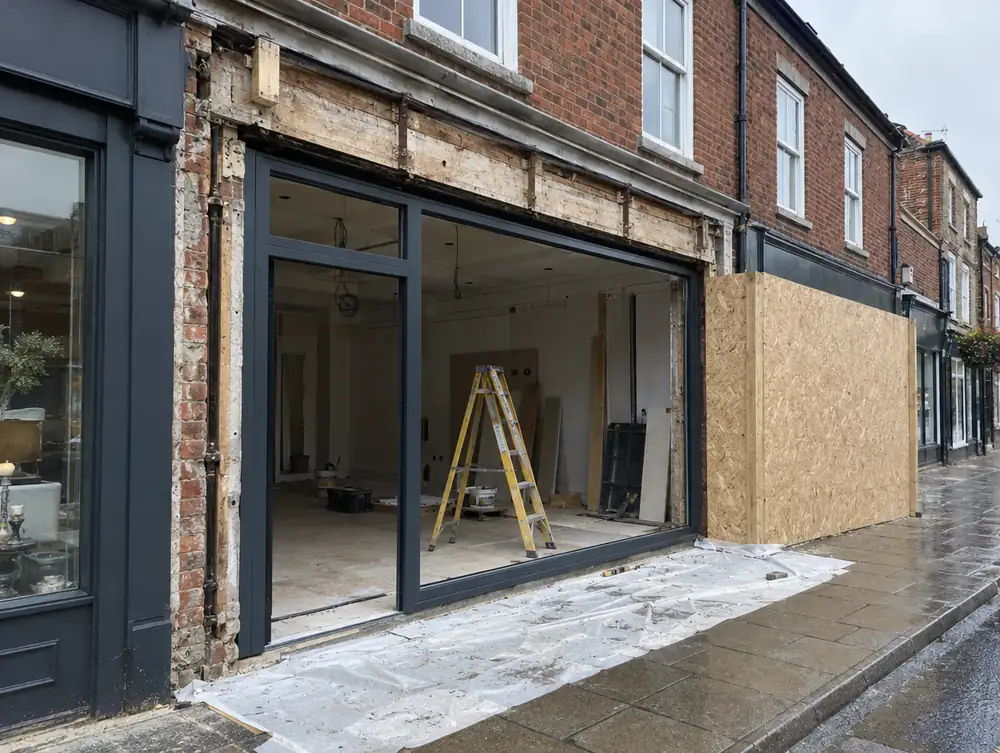
How would we approach shopfront refurbishment for your Huyton premises?
If later panels cover the original fascia, we lift a corner at survey. Surviving cornices, pilasters or tile can change the whole plan, and they cost nothing to keep.
Should your Huyton premises have an older door, we look at the closer, the hinges and the threshold along with the finish. A door that opens easily and closes quietly does more for the frontage than a fresh coat of paint.
If there are storeys above the shop, the frontage should feel like the base of the building and not a sign stuck on it. Lining up mullions with the windows overhead is a small move that settles the whole elevation at Huyton premises.
What should you budget for shopfront refurbishment in Huyton?
As a working budget, use £1,995 to £8,995 plus VAT depending on what is kept. Your place inside that range for shopfront refurbishment depends mostly on how much of the existing frontage can stay and how much has to be put right first.
What consents could affect shopfront refurbishment in Huyton?
For shopfront refurbishment at premises in the Huyton area, the deciding question in England is whether the building work materially affects the external appearance. If it does, planning permission is needed, while a true like-for-like replacement usually needs none. The council confirms the position for each site.
For Huyton, the usual route for planning and advert applications is through Knowsley Metropolitan Borough Council, and we confirm that when we visit.
| Town | Huyton |
|---|---|
| Area | Merseyside |
| Postcode districts | L14, L27, L28, L36 |
| Planning authority | Knowsley Metropolitan Borough Council |
| Building approval | Building Regulations (Approved Documents) |
| Distance from Great Barr | About 71 miles |
| Survey | Free for new work |
Does Knowsley Metropolitan Borough Council publish shopfront guidance?
Yes, Shopfront and Signage Design Supplementary Planning Document (2023). It tells applicants what the council expects from new and altered shopfronts. A few of the things it asks for:
- The stallriser should generally be no more than 20% of the shopfront's overall height.
- The fascia should be no more than 20% of the shopfront's height and generally no deeper than 400mm.
- Solid external roller shutters are unacceptable, and internal grilles or shutters are preferred.
Questions about shopfront refurbishment in Huyton
Can you refurbish just the sign and door on my Huyton frontage?
Yes. A new sign and door gear can make a big difference on their own. We would look at how they sit with the frame and suggest a colour to tie them together.
Can a refurbishment make my Huyton premises easier to enter?
Often, yes. Lighter door closers, better handles and a lower threshold can all be added without replacing the frontage. We check the door width and the step at survey.
Can my Huyton shopfront be refurbished without closing?
Usually, yes. Work is split into stages around your trading hours, and closed-day or out-of-hours work can be arranged for anything that affects the door.
What rules apply to a fire exit door through a shopfront in the Huyton area?
It must open in the direction of escape and can't be locked against immediate use, and a dedicated fire exit can't be a sliding or revolving door. In England that comes from article 14(2) of the Regulatory Reform (Fire Safety) Order 2005, and the duty sits with the responsible person, normally the employer or whoever controls the premises for a business, otherwise the owner. An outward door can clash with section 153 of the Highways Act 1980 where it opens onto the footway, so raise it early.
Do I need listed building consent for a shopfront in the Huyton area?
Usually yes, if the building is listed. In England the local planning authority decides, and Historic England is notified of Grade I and II* works and specified Grade II works. Like-for-like repair may not need consent, so ask the council before work starts.