Few businesses can shut for a week, so any time on site for stallrisers and cladding in County Fermanagh is planned around the hours you trade. Closed-day or out-of-hours installation can be arranged.
What sits behind the existing fascia often decides the job. Old beams, abandoned cable runs and earlier frames are common finds, which is why our visit to County Fermanagh premises looks past the surface before anything is drawn or priced for stallrisers and cladding.
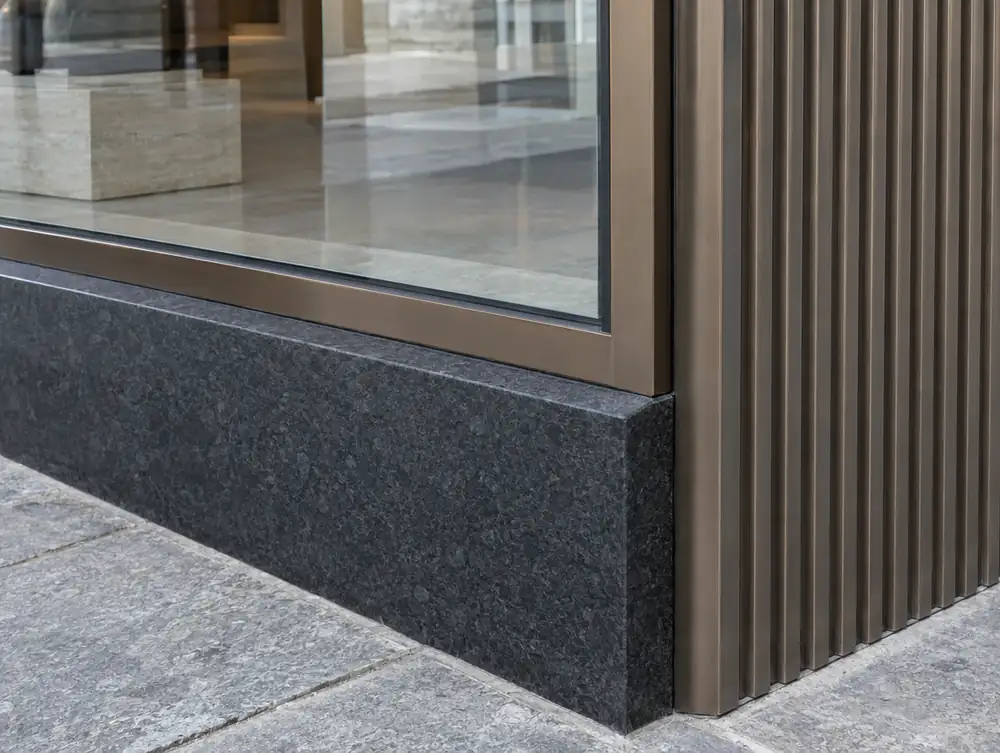
How should you approach stallrisers and cladding in County Fermanagh?
Stone and tile need a clean, dry surface and time to set. If your unit around Enniskillen opens straight onto the pavement, we cut off site and keep the working area small so the entrance stays usable.
Stripping an old facing can reveal what the building had first. If original tile or timber turns up on your premises in County Fermanagh, we stop and talk to you, since repairing it may cost less than cladding over it.
What consents apply to stallrisers and cladding in County Fermanagh?
Section 23 of the Planning Act (Northern Ireland) 2011 sets the test: work that doesn't materially affect the external appearance isn't development. That makes appearance the deciding point for stallrisers and cladding at premises in the County Fermanagh area, so planning permission is needed if it is materially affected and usually not for a true like-for-like replacement. The council confirms the position for the particular premises.
How much do stallrisers and cladding cost in County Fermanagh?
We would budget £195 to £495 plus VAT per m². Scope sets most of the figure, so a clear brief at the start does more for the budget than any later change of detail.
| Area | County Fermanagh |
|---|---|
| Nation | Northern Ireland |
| Towns covered | 1 |
| Main town | Enniskillen |
| Planning regime | Northern Ireland: Planning Act 2011 and the 2015 Advertisement Regulations |
| Building approval | Building Control (Technical Booklets) |
| Survey | Free for new work, from our Great Barr base |
Does Fermanagh and Omagh District Council publish shopfront guidance?
Yes, Shop Front Design, Supplementary Planning Guidance. It tells applicants what the council expects from new and altered shopfronts. A few of the things it asks for:
- Stallrisers should not exceed the pilaster base or fascia depth, whichever is less, with depths up to 600mm generally acceptable.
- Fascia depths up to 600mm are generally acceptable, one fascia should not span two buildings, and box fascia signs should be avoided.
- External solid roller shutters are not acceptable, with security glass, internal lattice shutters or demountable mesh grilles preferred.
Questions about stallrisers and cladding in County Fermanagh
Do you fit natural stone stallrisers across County Fermanagh?
Yes. Stone is templated from the measured survey, then fixed with mechanical restraints and a ventilated cavity. Heavier stone may need a check of the wall behind before we confirm the thickness.
Can you reclad only the stallriser on my premises in County Fermanagh?
Yes. It is one of the simplest ways to lift a tired frontage, provided the frame above is sound. We check the sill detail first, because a new facing must not trap water beneath it.
Can you match an existing tiled stallriser on premises in County Fermanagh?
Often, yes, though an exact glaze match can be difficult. We take a sample tile, compare it with what is available, and suggest a specialist tile or a change at a natural break if the colour cannot be found.
What building approval does a shopfront in the County Fermanagh area need?
Usually a full plans application to Building Control in Northern Ireland, because building notices are for single dwellings. The Technical Booklets set the detail, with Booklet V for glass and Booklet R for access. Only dwelling windows and doors are exempt, so ask Building Control before assuming a like-for-like job falls outside the rules.
Does a shop sign in the County Fermanagh area need advertisement consent?
Not always. Under Northern Ireland's 2015 Regulations, an unlit sign within Class 5 generally needs no application, with a 5m top height and 0.3m letters, and neither does a lit sign within Class 4(2). That lit class isn't available in conservation areas, Areas of Outstanding Natural Beauty or National Parks, so ask first.