One contract covers the frontage when you come to us for structural glazing in County Fermanagh, so glass, frame, sign and shutter aren't separate trades to chase. You also keep one named contact from first visit to handover.
Finishes behave differently at full size. Any sample we show you for structural glazing is better judged at the premises in daylight, since a colour that looks quiet on a desk can read much louder across a whole elevation.
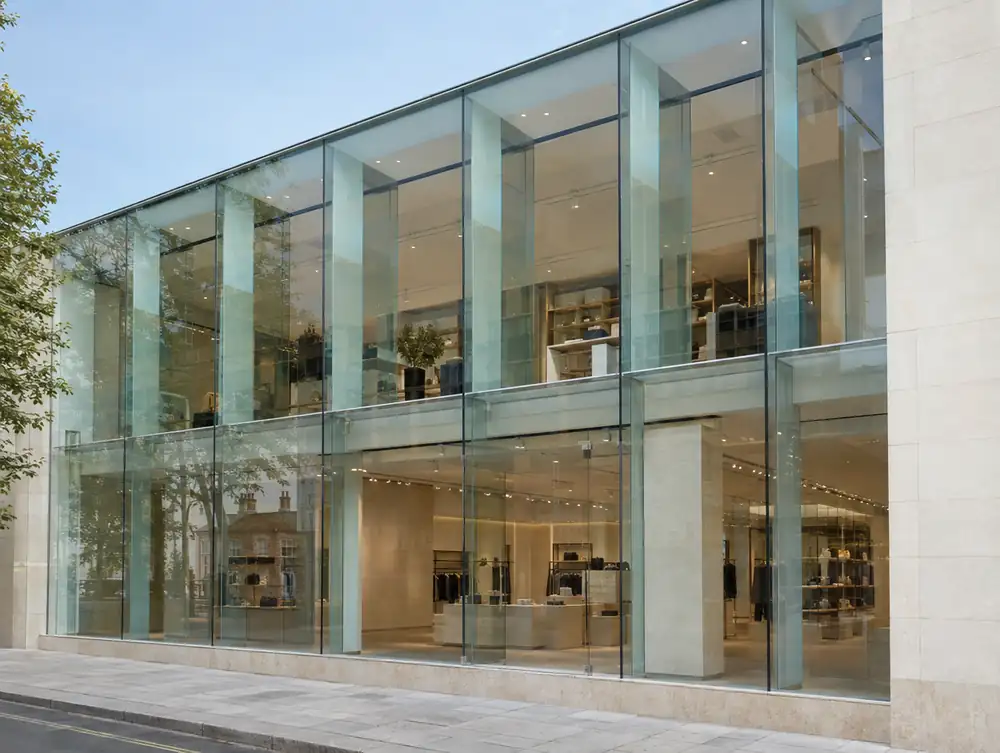
What makes structural glazing work well for premises in County Fermanagh?
Narrow streets call for a different grid. Where premises around Enniskillen open onto a tight street, one big pane can become two smaller ones with a fin on the joint, trading a little purity for a lift that can happen safely.
A flagship entrance often has a fixed opening date. Where a new unit in County Fermanagh is working to one, we plan back from it and leave room for a windy lifting day or a damaged pane.
What consents apply to structural glazing in County Fermanagh?
Shutters in Northern Ireland are treated like the rest of the frontage: as no permitted development route appears to exist, they usually fall to the appearance test. Building work that materially affects the external appearance needs planning permission, for structural glazing at premises in the County Fermanagh area as for anything else on the frontage, while a true like-for-like usually doesn't. Ask the council where a particular job stands.
How much does structural glazing cost in County Fermanagh?
Our guide band is £950 to £1,850 plus VAT per m². Scope is the biggest lever, so a tighter brief for structural glazing brings the figure down faster than any change of detail.
| Area | County Fermanagh |
|---|---|
| Nation | Northern Ireland |
| Towns covered | 1 |
| Main town | Enniskillen |
| Planning regime | Northern Ireland: Planning Act 2011 and the 2015 Advertisement Regulations |
| Building approval | Building Control (Technical Booklets) |
| Survey | Free for new work, from our Great Barr base |
Does Fermanagh and Omagh District Council publish shopfront guidance?
Yes, Shop Front Design, Supplementary Planning Guidance. It tells applicants what the council expects from new and altered shopfronts. A few of the things it asks for:
- Stallrisers should not exceed the pilaster base or fascia depth, whichever is less, with depths up to 600mm generally acceptable.
- Fascia depths up to 600mm are generally acceptable, one fascia should not span two buildings, and box fascia signs should be avoided.
- External solid roller shutters are not acceptable, with security glass, internal lattice shutters or demountable mesh grilles preferred.
Questions about structural glazing in County Fermanagh
What happens if a large pane breaks on premises in County Fermanagh?
A laminated pane normally stays in place until it can be replaced. We would make the opening safe, then schedule the new pane and the lift, which typically takes some weeks because large glass is made to order.
Can structural glazing be fitted while a business around Enniskillen stays open?
Often, with a carefully agreed sequence. Lifts usually happen when the street is quiet, and closed-day or out-of-hours installation can be arranged. A temporary screen keeps the interior secure and dry until the glass is in.
Can large glass reach premises on a narrow street in County Fermanagh?
Often, yes, though pane size may need to change. We measure the street, the kerb and any overhead obstructions at survey, then size the glass around what a lifter can reach.
Does a shop sign in the County Fermanagh area need advertisement consent?
Not always. Under Northern Ireland's 2015 Regulations, an unlit sign within Class 5 generally needs no application, with a 5m top height and 0.3m letters, and neither does a lit sign within Class 4(2). That lit class isn't available in conservation areas, Areas of Outstanding Natural Beauty or National Parks, so ask first.
Who decides listed building consent for a shopfront in the County Fermanagh area?
The council decides, under section 85 of the Planning Act (Northern Ireland) 2011. The Department for Communities' Historic Environment Division is a statutory consultee on applications. Unauthorised works are a criminal offence, so ask before anything is removed.