Seen a frontage you admire? Bring the picture to our first talk about timber shopfronts in County Tyrone, and we will work out what makes it succeed, from fascia depth to glass line, and what that means for your building.
Access gets as much attention as appearance at survey. Where a vehicle can stop, how long sections reach the opening and how the pavement stays safe for the public all shape the programme for timber shopfronts in County Tyrone.
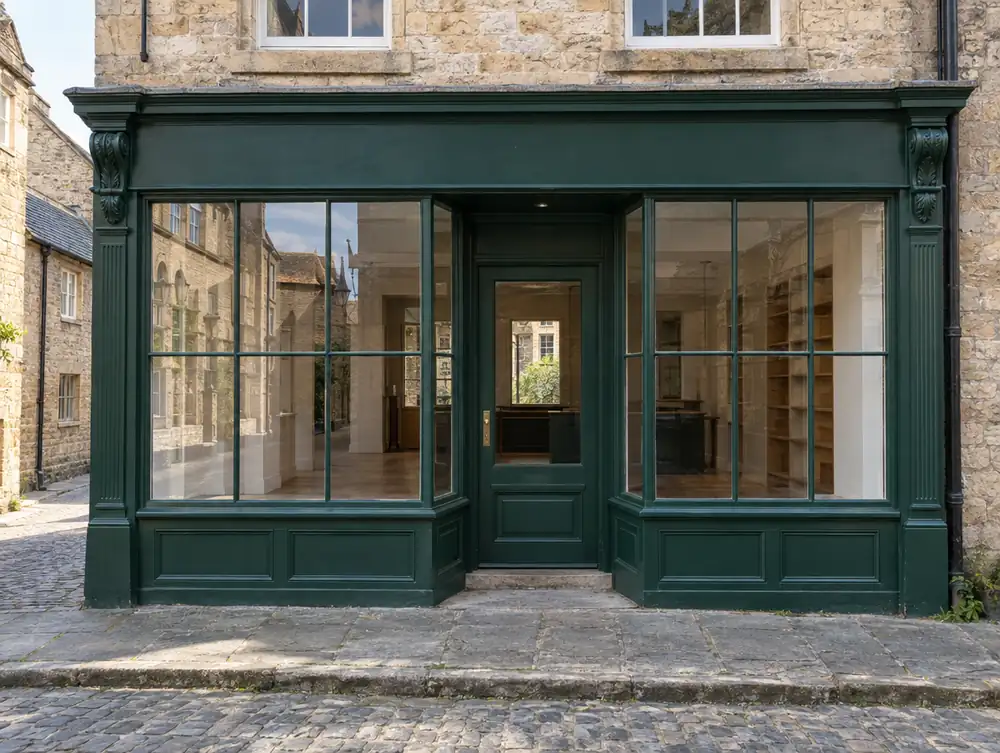
How do we handle timber shopfronts for premises in County Tyrone?
Colour does a lot of the work on timber. For premises across County Tyrone we test samples on the actual frontage in morning and evening light, because a deep green or navy can read as black at dusk, and the sign then has to carry more contrast.
A timber front has to sit comfortably with what's around it. If your premises in County Tyrone share a terrace, we draw the mouldings at a scale that suits the neighbours, so the new work looks settled from the day it goes in.
What consents apply to timber shopfronts in County Tyrone?
Shutters in Northern Ireland are treated like the rest of the frontage: as no permitted development route appears to exist, they usually fall to the appearance test. Building work that materially affects the external appearance needs planning permission, for timber shopfronts at premises in the County Tyrone area as for anything else on the frontage, while a true like-for-like usually doesn't. Ask the council where a particular job stands.
How much do timber shopfronts cost in County Tyrone?
Until the survey is done, plan on £3,995 to £13,995 plus VAT for a typical frontage. Unusual sizes, fine detail and phased working push the figure up, while a simple brief and clear access keep it toward the lower end.
| Area | County Tyrone |
|---|---|
| Nation | Northern Ireland |
| Towns covered | 4 |
| Main town | Omagh |
| Planning regime | Northern Ireland: Planning Act 2011 and the 2015 Advertisement Regulations |
| Building approval | Building Control (Technical Booklets) |
| Survey | Free for new work, from our Great Barr base |
Does Fermanagh and Omagh District Council publish shopfront guidance?
Yes, Shop Front Design, Supplementary Planning Guidance. It tells applicants what the council expects from new and altered shopfronts. A few of the things it asks for:
- Stallrisers should not exceed the pilaster base or fascia depth, whichever is less, with depths up to 600mm generally acceptable.
- Fascia depths up to 600mm are generally acceptable, one fascia should not span two buildings, and box fascia signs should be avoided.
- External solid roller shutters are not acceptable, with security glass, internal lattice shutters or demountable mesh grilles preferred.
Questions about timber shopfronts in County Tyrone
Do you make timber shopfronts for premises in County Tyrone?
Yes. Each front is drawn and made to a measured survey, and we travel from Great Barr to fit it, with one named contact throughout.
Who looks after a timber shopfront in County Tyrone once it is fitted?
Any good decorator can, working to the paint reference on your drawings. Keep a note of each repaint, as it makes future work far easier to plan.
Can you match other timber shopfronts in Omagh?
Yes, if we can see and measure the original. Mouldings can be copied from a surviving piece, and paint colours can be matched from a sample.
Does a shop sign in the County Tyrone area need advertisement consent?
Not always. Under Northern Ireland's 2015 Regulations, an unlit sign within Class 5 generally needs no application, with a 5m top height and 0.3m letters, and neither does a lit sign within Class 4(2). That lit class isn't available in conservation areas, Areas of Outstanding Natural Beauty or National Parks, so ask first.
Does the Disability Discrimination Act apply to a shop entrance in the County Tyrone area?
Yes. The Disability Discrimination Act 1995 applies in Northern Ireland, and section 21 deals with physical features that make a service hard for disabled people to use. Regulations made in 2007 (SR 2007/473) add detail on features, third-party consent and design standards.