Run a multi-site rollout by surveying a sample of sites, turning the brand into a kit of parts with rules for each type of unit, and testing it on a pilot before repeating it. Consents, leases and access are then handled site by site, with one contact and one programme across the estate. Pricing is set per estate after the sample sites have been surveyed.
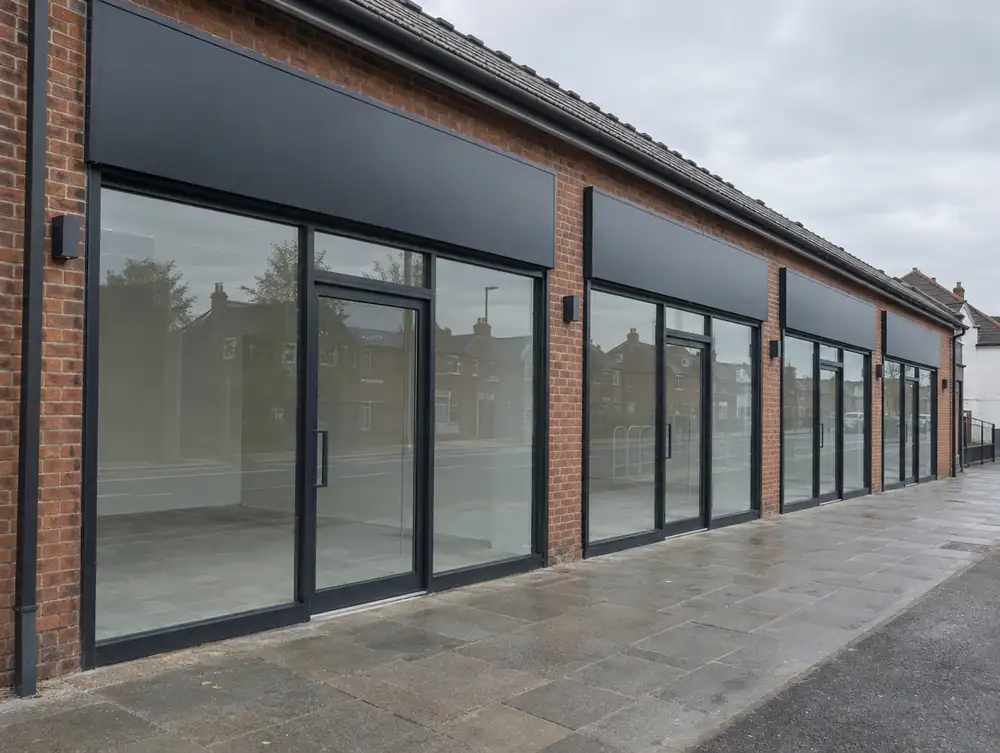
How do you run a multi-site shopfront rollout?
Treat it as one design problem solved once, then a logistics problem solved many times. The brand decides what the frontage should feel like, and the estate decides how much of that can be repeated. A rollout goes wrong when a single flagship drawing gets sent to every site, because no two openings are the same.
The steps below follow a sensible order, though a live estate will need some of them to overlap. Each stage feeds the next: the sample survey shapes the kit of parts, the pilot corrects it, and the corrected version is the one that goes out across the rest of the sites.
- Audit the estate from leases, photographs and any old drawings
- Group sites by type and survey a sample of each
- Design a kit of parts and the rules for using it
- Build a pilot and correct the kit
- Run consents and landlord approvals site by site
- Programme in waves, then hand over a pack for each site
How many sites should be surveyed first?
Survey enough sites to cover every type in the estate, not a set percentage. A chain with parade shops, shopping centre units and a handful of listed buildings has three problems, however many doors it has, and a retail park unit tells you nothing about a Georgian terrace.
Start with a desk audit. Pull lease dates, landlord details, floor plans and current street photographs into one sheet, and flag anything listed, in a conservation area or outside England. Those flags usually identify your hard sites long before anyone visits.
Each sample survey should capture the opening sizes, fascia depth, stallriser, door position and threshold, along with what the structure seems to be doing. Note access too: parking, loading times and any shopping centre rules. Take the same set of photographs at each site, from the same angles, so that sites can be compared side by side back at a desk.
What is a kit of parts?
A kit of parts is a controlled set of components and rules that lets one brand fit many openings. It might fix the frame colour, door set, handle, glass make-up and stallriser treatment, while offering a small range of sign sizes to suit different fascia depths.
The rules matter as much as the parts. Say what happens when a fascia is only 350mm deep, when a door has to sit to the left, or when a landlord won't allow a projecting sign. Good kits have an answer for the awkward site, so that a fitter on a pavement isn't left to invent one.
Colour needs watching. Powder coat from different batches can vary slightly, so hold a master sample and agree a tolerance before the first order. A difference nobody notices across two towns becomes very obvious when a replacement door goes next to an original frame.
How do consents work across an estate?
Every site needs its own check, because a brand's standard frontage can be fine in one council and refused in the next. The legal limits differ by nation, and councils apply their own design policies on top. Assume nothing carries across, even between neighbouring sites.
Signs cause the most trouble. Northern Ireland's deemed consent letter limit is 0.3m, so a logo that fits within the 0.75m limit in England may need an application there. Lit classes are unavailable in conservation areas across the UK, so the brand needs a proper unlit version from the start. Scotland's lit class is worded differently again.
Budget for fees by nation using the figures below, which are the closest categories at their stated dates, and the council confirms each amount. Allow a typical 4 to 8 weeks per application, and run landlord approvals in parallel, as they can take longer.
| Nation | Advertisement | Alteration | From |
|---|---|---|---|
| England | £174 | £309 | 1 April 2026 |
| Wales | £248 | £383 | 1 December 2025 |
| Scotland | £371 | £371 | 1 April 2026 |
| Northern Ireland | £231 | £220 | 1 April 2025 |
How should a rollout programme be sequenced?
Sequence it in waves, grouped by geography, lease events and trading calendar. Clustering nearby sites keeps travel down and lets a team build a rhythm, while a site with a lease break or a planned refit can pick up its frontage work at the same time.
Keep clear of each sector's peak. A retailer won't want a frontage out in the run-up to Christmas, and a restaurant group may care more about summer terraces. Order long-lead items by wave, and hold a small stock of spares such as glass for odd sizes, handles and sign letters.
CDM applies across the work. In Great Britain, a project is notified to HSE on form F10 if it lasts over 30 working days with more than 20 workers at once, or exceeds 500 worker days, and in Northern Ireland the client submits form NI10 to HSENI. Ask your principal designer how a phased programme should be treated.
How do you keep quality consistent across sites?
Use one drawing set, one specification and one sign-off sheet, and inspect the first site in every wave. Inspecting early finds a repeating mistake before it is repeated twenty times. A short photographic checklist at handover, taken from fixed positions, lets someone at head office compare sites without travelling.
One named contact should hold the whole programme, and any change to the kit should be logged and issued as a numbered revision. Keep a handover pack for each site with as-built dimensions, pane schedule, coating reference and door paperwork, because estates teams change and those files outlast them.
How is a multi-site rollout priced?
A rollout is priced per estate, because the mix of sites decides the cost. After sample surveys, a schedule of rates by unit type can be drawn up, with allowances for known unknowns such as strip-out findings and out-of-hours working. Each site is still confirmed by its own measure-up, since every price comes from a measured survey.
Common questions
Can a rollout mix full frontages and sign-only sites?
Yes, and most estates need that. Tiers such as full replacement, partial refresh and sign-only let the budget go where it shows, while the kit of parts keeps them looking related.
What happens if the brand changes mid-rollout?
Issue the change as a numbered revision and agree which wave it starts from. Decide early whether finished sites will be updated, because a mixed estate tends to last longer than anyone plans.
Who is the contract with?
The contract is with S&K Glazing Limited, company 14088194, which trades as Shopfront Specialists. One contract and one named contact can cover the glass, frame, sign and shutter at each site.
Can sites keep trading during a rollout?
Most can, with closed-day or out-of-hours fitting arranged to suit. Each site's method is settled during its survey, as hours and access vary from one landlord to the next.