A salon needs daylight at the mirrors, privacy in the treatment rooms and a front that still feels welcoming. The street should see a cared-for room without seeing anyone mid-treatment.
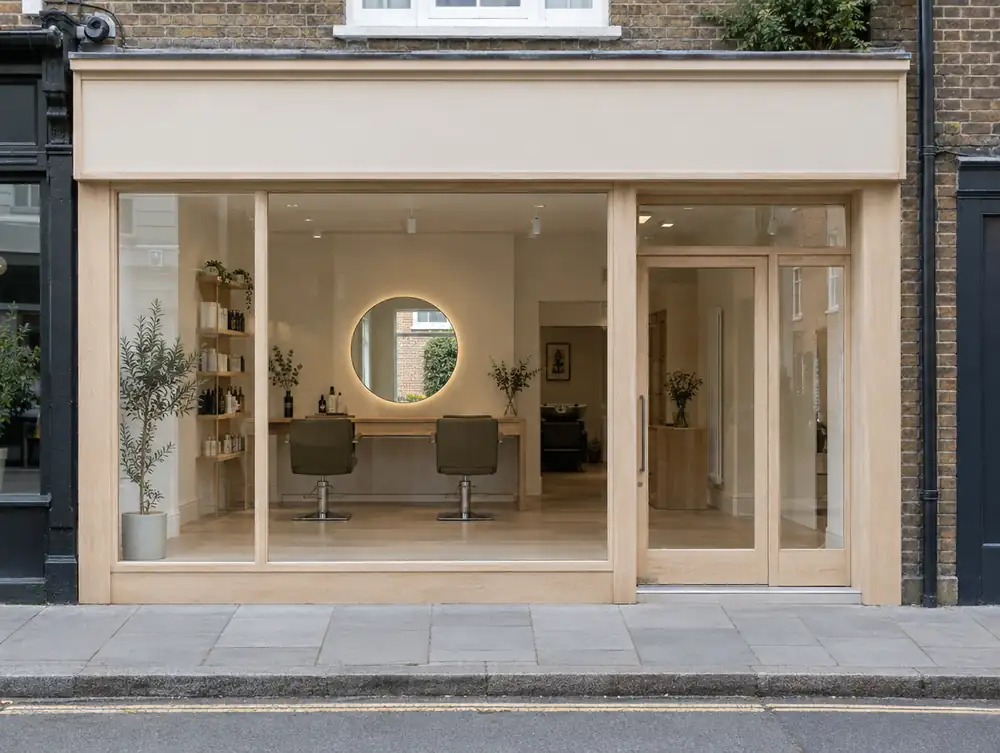
How much of a salon should the street see?
The cutting floor can be on show, but treatment rooms and basins can't. Most salons therefore need two glass conditions in one frontage.
Set any obscured band from a seated client's eye line, which sits far lower than a passer-by's. That lets you screen the chairs and keep clear glass above for daylight. Etched glass ages better than film here, because film edges lift in a humid room.
Evening appointments change the picture. Once it is dark outside, clear glass hides nothing, so a client under bright lights at 7pm is more exposed than one at noon.
How do you stop salon windows steaming up?
Use double-glazed units and a thermally broken frame, then deal with the moisture itself.
Dryers, steamers and wet hair keep a salon warm and humid, and that air condenses on any cold surface. Single glazing can fog by mid-morning in winter, hiding the very room you're paying to show. Colour and nail products add fumes too, so ask your ventilation engineer whether a louvre belongs in the fascia, and draw it in now.
Where should the mirrors go in a salon window?
At right angles to the glass where you can, because side daylight falls evenly across a client's face. A mirror facing the window throws glare at the stylist, and a client facing it will squint.
Stations set against the glass show their backs to the street, so finish those backs properly. Raw board and loose cables will sit in your shop window for years.
What sign suits a salon?
Built-up letters on a slim fascia, paired with a small projecting sign, suit most salons. People approach along the pavement and see a fascia edge-on first, so the projecting sign earns its place.
Late appointments make lighting worthwhile. Lit signs lose their deemed consent route in conservation areas in all four UK nations, though, so a lit sign there means an application. Put opening hours and the booking number on the door glass, because that is what people read when the salon is shut.
Does a salon need a level entrance?
Level is the aim, and guidance in all four nations puts the threshold limit at 15mm.
Where a step already exists, the duty is to take reasonable steps on physical features: the Equality Act 2010 in Great Britain, and the Disability Discrimination Act 1995 in Northern Ireland. We look first at whether the step can go, because a shallow internal slope often costs less than people expect and takes less floor than they fear.
Door width counts as well. A new public entrance is drawn with 1000mm clear in England, Wales and Northern Ireland, or 800mm in Scotland.
Common questions
Is window film good enough for privacy?
For a short lease, often yes. Etched or back-painted glass lasts longer and won't peel in a humid room.
Should a salon have a shutter?
Only if the risk justifies it. A solid shutter makes a late-opening salon look shut, so laminated glass or a perforated shutter usually sits better.
Can we change only the sign?
Yes, signs are a job on their own. Advertisement rules still apply, so we check the size and lighting against your nation's limits.
How do you fit around a full appointment book?
Closed-day or out-of-hours installation can be arranged. Tell us your quietest day, and we'll plan the disruptive stages around it.