A pharmacy, a showroom and a food shop each ask something different of a door. For King's Cross premises, we size the opening and set the sensors around how your customers arrive.
It helps if you can be there when we visit King's Cross, since five minutes walking the frontage together answers more than a long email.
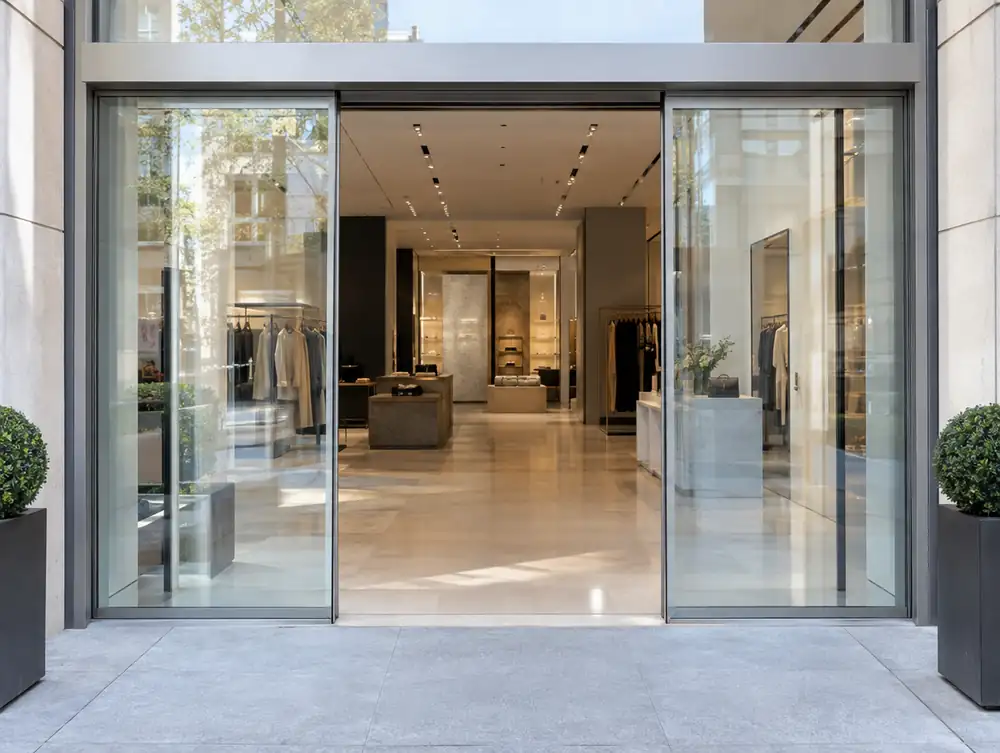
What goes into getting automatic sliding doors right in King's Cross?
In a parade in King's Cross with a narrow pavement, the sensor set-up is the first job. We'd angle the radar so people walking past don't trigger the door, and keep the leaves in line with the neighbouring frontage.
A corner unit in King's Cross can often move its entrance to the angle, where two directions of footfall meet. We'd look at a curved or canted door set, and check the wind on both streets before fixing the position.
Where the footway outside your King's Cross premises is narrow, a recessed entrance earns its keep. It gives people a dry place to pause out of the walkway, and it adds a longer run of display glass either side of the door.
Which applications might automatic sliding doors in King's Cross involve?
A true like-for-like replacement usually needs no planning permission in England, because the external appearance isn't materially affected. New materials, a different glass line or altered proportions usually do count as material, so for automatic sliding doors at premises in the King's Cross area, an application is then likely. The council confirms which side of that line a job falls on.
For King's Cross, the usual route for planning and advert applications is through London Borough of Camden, and we confirm that when we visit.
How much could automatic sliding doors in King's Cross cost you?
As a working budget, use £3,895 to £11,995 plus VAT per entrance. Your place inside that range for automatic sliding doors depends mostly on how much of the existing frontage can stay and how much has to be put right first.
| Town | King's Cross |
|---|---|
| Area | Greater London |
| Postcode districts | N1C |
| Planning authority | London Borough of Camden |
| Building approval | Building Regulations (Approved Documents) |
| Distance from Great Barr | About 104 miles |
| Survey | Free for new work |
Does London Borough of Camden publish shopfront guidance?
Yes, Camden Planning Guidance: Design (Chapter 6: Shopfronts) (2021). It tells applicants what the council expects from new and altered shopfronts. A few of the things it asks for:
- Existing stall risers should be kept, and new ones should be at least 300mm high or reach the top of the pilaster base or door panel.
- Solid shutters are only acceptable in exceptional circumstances, and internal security measures are strongly encouraged.
- Uncoated shutters, galvanised steel, milled finishes and anodised aluminium are not acceptable finishes.
Questions about automatic sliding doors in King's Cross
Can you match the door to my existing front in Greater London?
Yes. Frames come in any RAL colour, and we'd line up the leaves with your existing mullions so the door doesn't look like an add-on.
What will people on the street see at my King's Cross entrance?
Ideally, very little. The drive sits behind the fascia, the leaves line up with the screens beside them, and the frame colour matches the rest of your front.
Can an automatic door work with my King's Cross shop's alarm and locks?
Yes. The door can lock at closing, and it can link to your alarm or access control where the systems allow, with a manual key position as a fallback.
Do I need planning permission to change a shopfront in the King's Cross area?
Usually yes, if the work materially affects the building's external appearance. England's shop permitted development rights exclude creating, altering or replacing a shopfront, so there is no shortcut. A true like-for-like replacement usually needs no application, and the council confirms the position.
Do roller shutters need planning permission in the King's Cross area?
Usually yes. Installing or replacing a security grill or shutter on a shopfront is expressly outside England's shop permitted development rights, so the only way to avoid an application is work that doesn't materially affect the appearance. Ask the council before ordering.