We measure, draw and fit aluminium fronts for King's Cross premises under one contract. You deal with one named contact from the first survey to handover.
Expect us to measure the opening, photograph the existing front and check how materials will reach it on the day, at a time you have agreed.
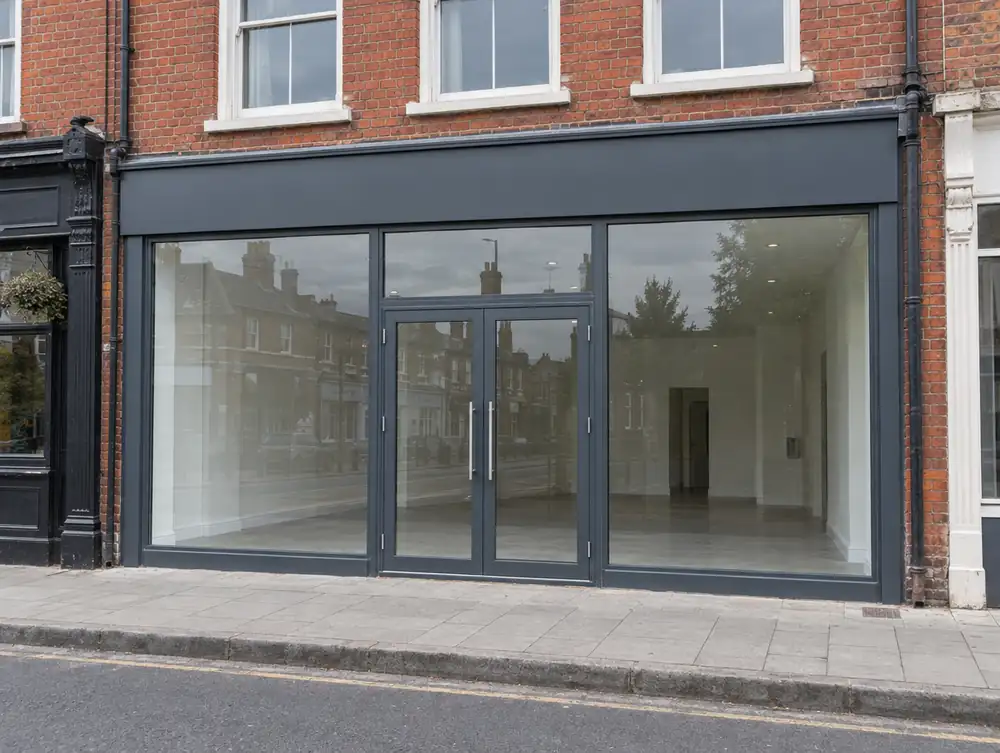
What should you think about before commissioning aluminium shopfronts in King's Cross?
Some King's Cross landlords issue a shopfront specification, and we'd draw to it from the start. Where your brand needs something different, we mark each departure on the drawing so the landlord can approve the front without a round of guesswork.
If your unit sits in a parade in King's Cross, we'd start with the neighbours: the fascia line, cill height and pier rhythm of the row. Holding those lines lets a slimmer section stand out for the right reasons, rather than fighting everything beside it.
A corner unit has two fronts to think about, and the return elevation often does as much selling as the main one. If that is your layout in King's Cross, carry the fascia and glass line round the corner and treat both faces as one composition.
Who approves aluminium shopfronts in King's Cross?
For aluminium shopfronts at premises in the King's Cross area, the deciding question in England is whether the building work materially affects the external appearance. If it does, planning permission is needed, while a true like-for-like replacement usually needs none. The council confirms the position for each site.
Expect planning and advert applications here to go to London Borough of Camden in the normal way. We check what that means for your building when we survey it in King's Cross.
What is a realistic budget for aluminium shopfronts in King's Cross?
A sensible starting budget is £2,495 to £11,995 plus VAT for a typical 3 to 7 m frontage. What shifts the figure is whatever can't be seen yet, such as the condition behind the old frontage or the services running through it.
| Town | King's Cross |
|---|---|
| Area | Greater London |
| Postcode districts | N1C |
| Planning authority | London Borough of Camden |
| Building approval | Building Regulations (Approved Documents) |
| Distance from Great Barr | About 104 miles |
| Survey | Free for new work |
Does London Borough of Camden publish shopfront guidance?
Yes, Camden Planning Guidance: Design (Chapter 6: Shopfronts) (2021). It tells applicants what the council expects from new and altered shopfronts. A few of the things it asks for:
- Existing stall risers should be kept, and new ones should be at least 300mm high or reach the top of the pilaster base or door panel.
- Solid shutters are only acceptable in exceptional circumstances, and internal security measures are strongly encouraged.
- Uncoated shutters, galvanised steel, milled finishes and anodised aluminium are not acceptable finishes.
Questions about aluminium shopfronts in King's Cross
Can you match a shopfront I like elsewhere in Greater London?
Usually, yes. Send the photo and address, and we'll work out the section, colour and proportions behind it, then adapt them to your King's Cross opening.
Can a sign and shutter be fitted with the frame in King's Cross?
Yes, and it's usually the neater way to do it. One contract covers the frontage, so the shutter box, fascia and sign fixings are drawn together and nobody is left waiting for another trade.
Who carries out the work in King's Cross?
Vetted teams working under S&K Glazing carry it out, with one named contact from survey to handover. The contract is with S&K Glazing Limited, and we travel to King's Cross from Great Barr.
Do roller shutters need planning permission in the King's Cross area?
Usually yes. Installing or replacing a security grill or shutter on a shopfront is expressly outside England's shop permitted development rights, so the only way to avoid an application is work that doesn't materially affect the appearance. Ask the council before ordering.
Does a new shopfront in the King's Cross area need Building Regulations approval?
Assume yes until building control says otherwise. England has no like-for-like exemption, though registered installers can self-certify replacement windows and doors in non-dwellings. That route doesn't cover structural glass, curtain walling or revolving doors.