Colour is where an aluminium front in Holborn earns its keep. We choose it against your actual brick, stone or render, then carry it through the frame, door, capping and fascia so the whole elevation reads as one.
Surveys for Holborn are booked with you directly. Tell us your quieter days and we'll work around them.
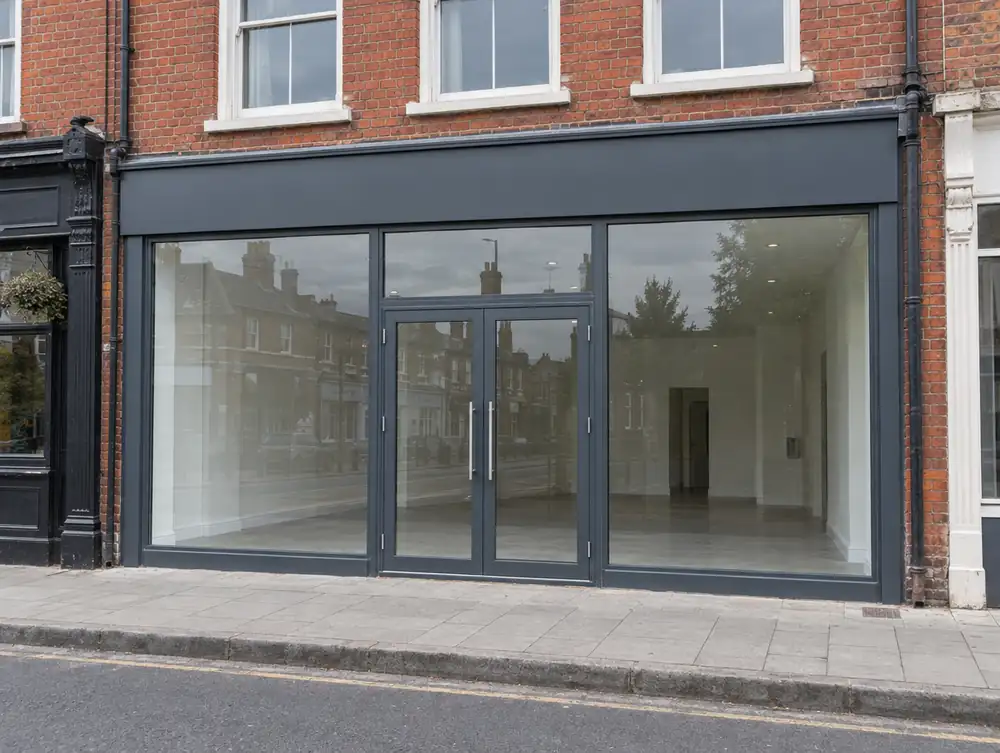
What should you think about before commissioning aluminium shopfronts in Holborn?
If your Holborn branch is one stop in a wider rollout, we'd adapt your standard details to this opening instead of forcing the opening to fit them. Section, colour and fixings stay the same as the rest of the estate, while mullion spacing and fascia depth answer to the building.
A narrow Holborn unit gains from fewer parts. Under about 4m wide, we'd offset the door and use one large pane rather than a central door with two slivers of glass either side, which makes the front feel wider than it measures.
Where the footway outside your Holborn premises is narrow, a recessed entrance earns its keep. It gives people a dry place to pause out of the walkway, and it adds a longer run of display glass either side of the door.
Who approves aluminium shopfronts in Holborn?
A true like-for-like replacement usually needs no planning permission in England, because the external appearance isn't materially affected. New materials, a different glass line or altered proportions usually do count as material, so for aluminium shopfronts at premises in the Holborn area, an application is then likely. The council confirms which side of that line a job falls on.
At survey we check how things stand for your building, although applications for planning permission or advertisement consent here normally go to London Borough of Camden.
What is a realistic budget for aluminium shopfronts in Holborn?
The guide for aluminium shopfronts is £2,495 to £11,995 plus VAT for a typical 3 to 7 m frontage. Expect the lower end for simple work with clear access, and the upper end where detail, finish or awkward conditions add hours.
| Town | Holborn |
|---|---|
| Area | Greater London |
| Postcode districts | WC1A, WC1R, WC1V, WC2B |
| Planning authority | London Borough of Camden |
| Building approval | Building Regulations (Approved Documents) |
| Distance from Great Barr | About 104 miles |
| Survey | Free for new work |
Does London Borough of Camden publish shopfront guidance?
Yes, Camden Planning Guidance: Design (Chapter 6: Shopfronts) (2021). It tells applicants what the council expects from new and altered shopfronts. A few of the things it asks for:
- Existing stall risers should be kept, and new ones should be at least 300mm high or reach the top of the pilaster base or door panel.
- Solid shutters are only acceptable in exceptional circumstances, and internal security measures are strongly encouraged.
- Uncoated shutters, galvanised steel, milled finishes and anodised aluminium are not acceptable finishes.
Questions about aluminium shopfronts in Holborn
What do you need before surveying a unit in Holborn?
An address, a few photos and a rough idea of what you have in mind are enough to book the survey. If you have a lease, a landlord's specification or brand guidelines, send those too, because they shape the drawing.
Can you match a shopfront I like elsewhere in Greater London?
Usually, yes. Send the photo and address, and we'll work out the section, colour and proportions behind it, then adapt them to your Holborn opening.
How does pricing work for Holborn premises?
Every price comes from a measure-up, never a photograph. You get an itemised written quotation that holds for 90 days, and nothing is ordered until you accept it.
Do roller shutters need planning permission in the Holborn area?
Usually yes. Installing or replacing a security grill or shutter on a shopfront is expressly outside England's shop permitted development rights, so the only way to avoid an application is work that doesn't materially affect the appearance. Ask the council before ordering.
Do I need listed building consent for a shopfront in the Holborn area?
Usually yes, if the building is listed. In England the local planning authority decides, and Historic England is notified of Grade I and II* works and specified Grade II works. Like-for-like repair may not need consent, so ask the council before work starts.