Your brand and your building both have a say in a new frontage. On premises in King's Cross we start with what the structure allows, then bring in the name, colours and materials.
Surveys for King's Cross are booked with you directly. Tell us your quieter days and we'll work around them.
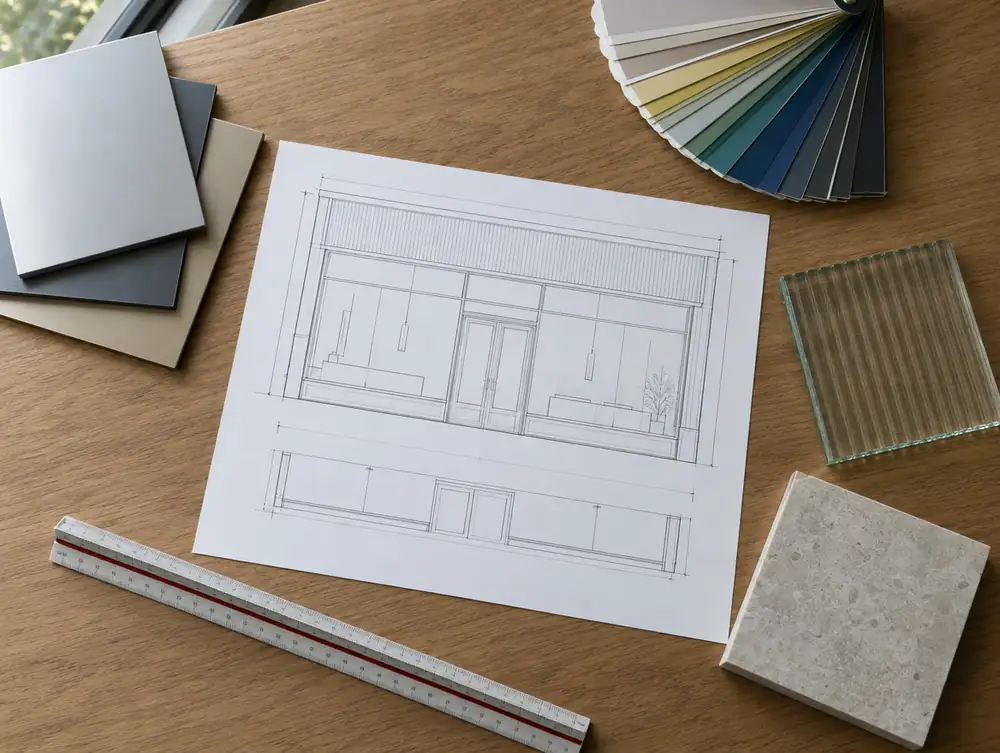
How would we approach shopfront design for your King's Cross premises?
Where an existing shopfront has good bones, the design may keep the frame and change only the glass, fascia and colour. We would show that option next to a new frontage, with the cost of each.
Should several trades be involved in your fit-out, we coordinate the frontage with the shopfitter's drawings. Ceiling lines, display depths and shutter boxes then agree with each other before work starts.
If there are storeys above the shop, the frontage should feel like the base of the building and not a sign stuck on it. Lining up mullions with the windows overhead is a small move that settles the whole elevation at King's Cross premises.
What should you budget for shopfront design in King's Cross?
Our guide band is £495 to £2,495 plus VAT per frontage. Scope is the biggest lever, so a tighter brief for shopfront design brings the figure down faster than any change of detail.
What consents could affect shopfront design in King's Cross?
A true like-for-like replacement usually needs no planning permission in England, because the external appearance isn't materially affected. New materials, a different glass line or altered proportions usually do count as material, so for shopfront work at premises in the King's Cross area, an application is then likely. The council confirms which side of that line a job falls on.
We confirm the position at survey, because a boundary or a special designation can change who handles the file, but applications from King's Cross premises normally go to London Borough of Camden.
| Town | King's Cross |
|---|---|
| Area | Greater London |
| Postcode districts | N1C |
| Planning authority | London Borough of Camden |
| Building approval | Building Regulations (Approved Documents) |
| Distance from Great Barr | About 104 miles |
| Survey | Free for new work |
Does London Borough of Camden publish shopfront guidance?
Yes, Camden Planning Guidance: Design (Chapter 6: Shopfronts) (2021). It tells applicants what the council expects from new and altered shopfronts. A few of the things it asks for:
- Existing stall risers should be kept, and new ones should be at least 300mm high or reach the top of the pilaster base or door panel.
- Solid shutters are only acceptable in exceptional circumstances, and internal security measures are strongly encouraged.
- Uncoated shutters, galvanised steel, milled finishes and anodised aluminium are not acceptable finishes.
Questions about shopfront design in King's Cross
How many options will I see for my King's Cross premises?
Usually two or three directions at concept stage, then one developed design. If you already know what you want, we can go straight to the developed drawings.
Can the work on my King's Cross frontage be designed in phases?
Yes. We can draw the complete frontage first, then split it into stages, so a new sign and paint now will still suit a new shopfront later.
Will you work with my shopfitter or architect in King's Cross?
Yes. We share drawings and coordinate the frontage with their ceiling, lighting and display plans. Your named contact stays the route for questions on the frontage.
Does a shop sign in the King's Cross area need advertisement consent?
Not always. In England, an unlit sign within Class 5 of the 2007 Advertisement Regulations generally needs no application, and neither does a lit sign within Class 4B. Anything outside those classes needs consent, and Class 4B isn't available in conservation areas, so check before ordering.
Does a new shopfront in the King's Cross area need Building Regulations approval?
Assume yes until building control says otherwise. England has no like-for-like exemption, though registered installers can self-certify replacement windows and doors in non-dwellings. That route doesn't cover structural glass, curtain walling or revolving doors.