Thinking about opening up your Kew frontage? Start with where the stack will sit, because that one decision shapes the panel count, the track and the seating plan behind it.
A survey in Kew usually starts outside, looking at the whole elevation before any tape comes out, because the frontage has to answer the building above it.
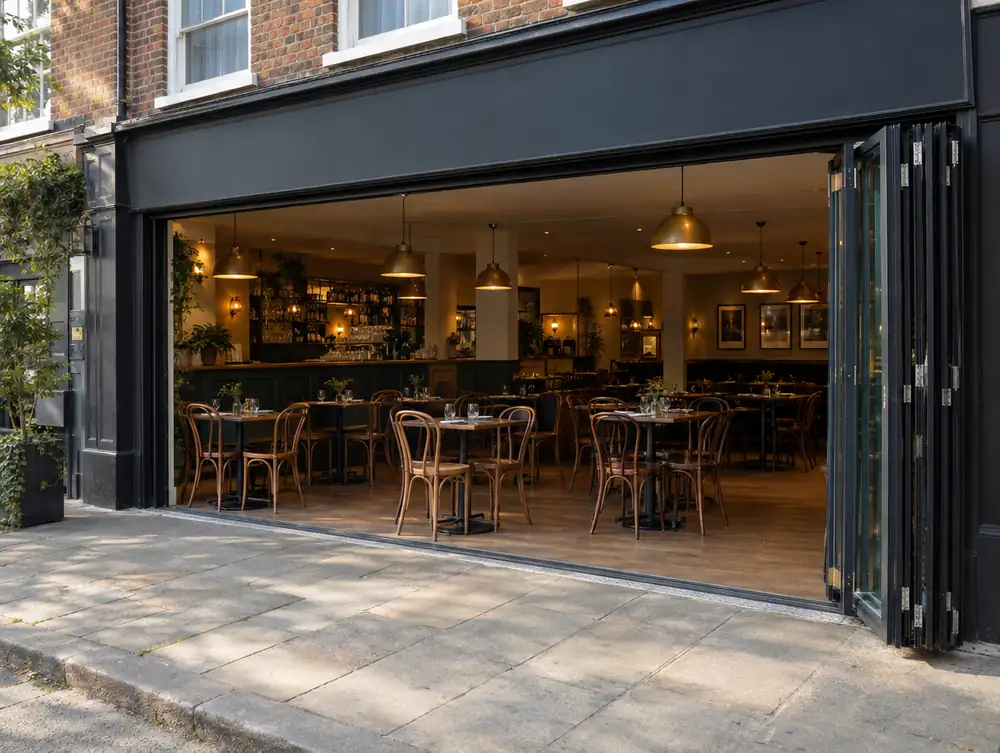
Where should you begin with bi-folding shopfronts in Kew?
In a parade in Kew, a bi-fold has to sit politely when closed. We'd match the fascia line and keep a short fixed return at one end, so the set reads as part of the row instead of a gap in it.
If your Kew frontage faces the sun, a bi-fold doubles as ventilation. We'd pair it with an awning so the room stays usable at midday, and look at solar control glass for the days the set stays closed.
Where the footway outside your Kew premises is narrow, a recessed entrance earns its keep. It gives people a dry place to pause out of the walkway, and it adds a longer run of display glass either side of the door.
What sign-off might you need for bi-folding shopfronts in Kew?
Security grilles and shutters are named in England's rules: installing or replacing one on a shopfront sits outside the shop permitted development rights. The frontage itself is treated the same way, so for bi-folding shopfronts at premises in the Kew area, building work that materially affects the appearance needs planning permission. Confirm the position with the council before anything is ordered.
For Kew, the usual route for planning and advert applications is through London Borough of Richmond upon Thames, and we confirm that when we visit.
What price should you expect for bi-folding shopfronts in Kew?
Allow £5,195 to £13,995 plus VAT for a typical opening. Size and specification set most of that figure for bi-folding shopfronts, and the rest depends on what the survey finds on site.
| Town | Kew |
|---|---|
| Area | Greater London |
| Postcode districts | SW14, TW8, TW9, W4 |
| Planning authority | London Borough of Richmond upon Thames |
| Building approval | Building Regulations (Approved Documents) |
| Distance from Great Barr | About 101 miles |
| Survey | Free for new work |
Does London Borough of Richmond upon Thames publish shopfront guidance?
Yes, Shopfronts: Supplementary Planning Document (2010). It tells applicants what the council expects from new and altered shopfronts. A few of the things it asks for:
- The fascia should be no deeper than the cornice and architrave combined, and no more than one-fifth of total shopfront height.
- External roller shutters are unlikely to be permitted, and internal grilles are the only acceptable security form in conservation areas and on listed buildings.
- Internally lit box fascia signs will usually be resisted, with externally lit fascias generally preferred.
Questions about bi-folding shopfronts in Kew
Who do I speak to about a bi-fold in Kew?
Your named contact stays the same from the first visit to the final adjustment. Fitting is carried out by vetted teams working under S&K Glazing, travelling from Great Barr.
Can the threshold be level at my Kew premises?
It can be close to level, depending on the floor and drainage. We'd check the levels at survey, because a track sitting flush with the pavement still needs somewhere for water to go.
How many panels would my Kew opening need?
It depends on the width and how you want the set to open. Most openings divide into leaves under 1m wide, and an odd number gives you a daily door, so we draw the options after the measure-up.
Does a shop sign in the Kew area need advertisement consent?
Not always. In England, an unlit sign within Class 5 of the 2007 Advertisement Regulations generally needs no application, and neither does a lit sign within Class 4B. Anything outside those classes needs consent, and Class 4B isn't available in conservation areas, so check before ordering.
Do I need planning permission to change a shopfront in the Kew area?
Usually yes, if the work materially affects the building's external appearance. England's shop permitted development rights exclude creating, altering or replacing a shopfront, so there is no shortcut. A true like-for-like replacement usually needs no application, and the council confirms the position.