Security after hours is rarely a simple choice between a heavy shutter and nothing. We look at your stock, your glass and your Kew premises together, then specify what the risk calls for.
We measure your Kew opening in person, at a time agreed with you first, so the visit fits around your trading.
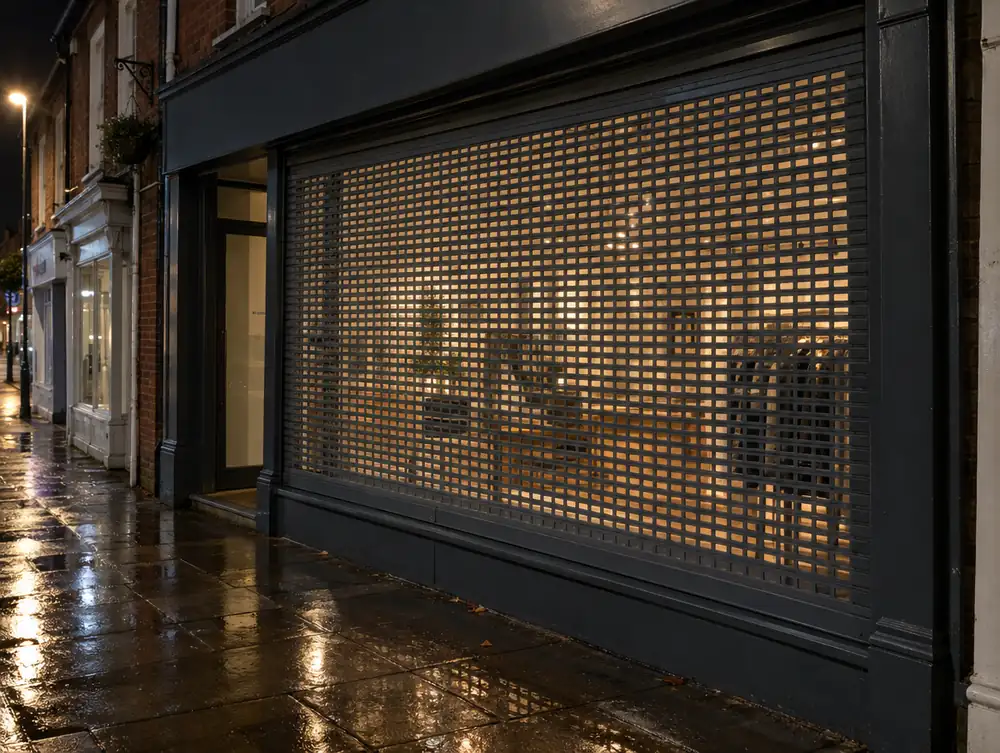
What goes into getting perforated roller shutters right in Kew?
Where the frame is slim aluminium, guides need fixing back to something solid. We may add a concealed post or a stiffer jamb, so the lower corners cannot be levered out.
If the shutter has to run past a door or a side window, we check how the curtain lands on the threshold. A neat bottom rail and floor lock keep the entrance flush when the shutter is up.
If your Kew unit sits in a Victorian parade, the old pilasters usually set the rhythm, so a new front should land on them and not run past them. Keep that line and even a modern frame looks as though it belongs.
Which applications might perforated roller shutters in Kew involve?
A true like-for-like replacement usually needs no planning permission in England, because the external appearance isn't materially affected. New materials, a different glass line or altered proportions usually do count as material, so for perforated roller shutters at premises in the Kew area, an application is then likely. The council confirms which side of that line a job falls on.
For Kew, the usual route for planning and advert applications is through London Borough of Richmond upon Thames, and we confirm that when we visit.
How much could perforated roller shutters in Kew cost you?
Allow £1,695 to £4,495 plus VAT per shutter. Size and specification set most of that figure for perforated roller shutters, and the rest depends on what the survey finds on site.
| Town | Kew |
|---|---|
| Area | Greater London |
| Postcode districts | SW14, TW8, TW9, W4 |
| Planning authority | London Borough of Richmond upon Thames |
| Building approval | Building Regulations (Approved Documents) |
| Distance from Great Barr | About 101 miles |
| Survey | Free for new work |
Does London Borough of Richmond upon Thames publish shopfront guidance?
Yes, Shopfronts: Supplementary Planning Document (2010). It tells applicants what the council expects from new and altered shopfronts. A few of the things it asks for:
- The fascia should be no deeper than the cornice and architrave combined, and no more than one-fifth of total shopfront height.
- External roller shutters are unlikely to be permitted, and internal grilles are the only acceptable security form in conservation areas and on listed buildings.
- Internally lit box fascia signs will usually be resisted, with externally lit fascias generally preferred.
Questions about perforated roller shutters in Kew
Can a perforated shutter match my other sites in Greater London?
Yes. Send us the colour reference and curtain type from an existing site, and we match them on the new one. The box and guides may differ, because each frontage has its own structure.
Can I keep my window display lit behind a shutter in Kew?
Yes, and we recommend it. A low-level light on a timer costs very little and lets the display read through the perforations overnight.
Can you fit an internal shutter on my Kew premises?
Usually, yes. We check for ceiling space, a clear path behind the window and a solid fixing for the guides. Where space is tight, a slim box or a smaller display can make it work.
What rules apply to a fire exit door through a shopfront in the Kew area?
It must open in the direction of escape and can't be locked against immediate use, and a dedicated fire exit can't be a sliding or revolving door. In England that comes from article 14(2) of the Regulatory Reform (Fire Safety) Order 2005, and the duty sits with the responsible person, normally the employer or whoever controls the premises for a business, otherwise the owner. An outward door can clash with section 153 of the Highways Act 1980 where it opens onto the footway, so raise it early.
Does the Equality Act apply to a shop entrance in the Kew area?
Yes. The Equality Act 2010 applies in England, as across Great Britain, and it requires reasonable steps to remove, alter or avoid physical features that disadvantage disabled people. The duty is anticipatory, so it looks at disabled people generally, and a new Services Code replaced the 2011 Code on 5 August 2026.