Folding glass is a simple idea that rewards careful detailing. For Stamford premises, we check the head, floor and drainage before the panels are ordered.
It helps if you can be there when we visit Stamford, since five minutes walking the frontage together answers more than a long email.
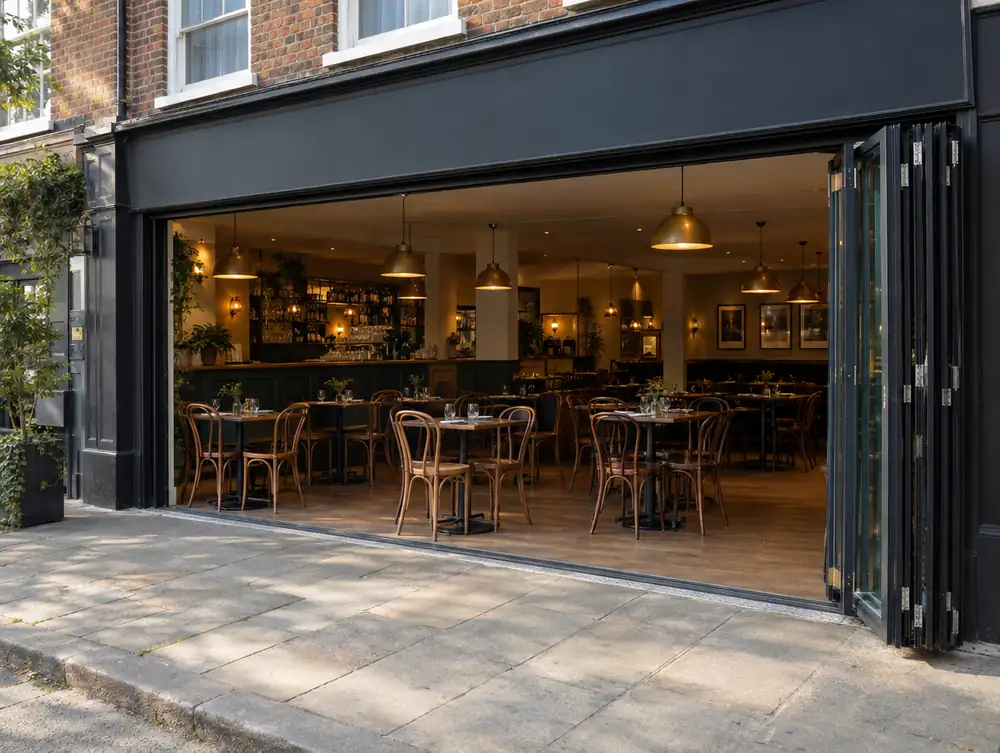
What should you think about before commissioning bi-folding shopfronts in Stamford?
A deep recess can host a bi-fold set back from the street, which keeps the panels clear of passers-by and creates a sheltered pocket by the door. At Stamford premises with that depth, it's often the neatest layout.
On a narrow Stamford unit, the stack can swallow the opening. We'd limit the set to three panels, or look at a single sliding leaf, so the opening you gain outweighs the width lost to parked frames.
If you trade after dark in Stamford, the view in matters more than the sign. A warm, evenly lit interior with light on the back wall will usually do more than a brighter fascia, because it gives the eye somewhere to go.
Who approves bi-folding shopfronts in Stamford?
A true like-for-like replacement usually needs no planning permission in England, because the external appearance isn't materially affected. New materials, a different glass line or altered proportions usually do count as material, so for bi-folding shopfronts at premises in the Stamford area, an application is then likely. The council confirms which side of that line a job falls on.
Planning and advert applications for Stamford premises normally go to South Kesteven District Council. We check the position for your address at survey.
What is a realistic budget for bi-folding shopfronts in Stamford?
As a working budget, use £5,195 to £13,995 plus VAT for a typical opening. Your place inside that range for bi-folding shopfronts depends mostly on how much of the existing frontage can stay and how much has to be put right first.
| Town | Stamford |
|---|---|
| Area | Lincolnshire |
| Postcode districts | PE9 |
| Planning authority | South Kesteven District Council |
| Building approval | Building Regulations (Approved Documents) |
| Distance from Great Barr | About 60 miles |
| Survey | Free for new work |
Does South Kesteven District Council publish shopfront guidance?
Yes, South Kesteven Shopfront Design Guide (2024). It tells applicants what the council expects from new and altered shopfronts. A few of the things it asks for:
- Retractable shutters should sit inside the building hidden behind the fascia, and external roller shutters are not acceptable on listed buildings.
- Fascias that are boxed in or project excessively are unsuitable, and signs should not be built out on an extra box or board.
- External illumination is the only acceptable option for traditional shopfronts, using static single-colour LED where lighting is accepted.
Questions about bi-folding shopfronts in Stamford
Can I have a timber bi-fold on my Stamford frontage?
Yes. Painted hardwood sets suit older premises across Lincolnshire, though the panels are heavier and need a stiffer head than aluminium.
How secure is a folding front in Stamford overnight?
Very, if it is specified for the job. Each leaf locks top and bottom with concealed bolts, and laminated glass adds a second line of defence.
Who do I speak to about a bi-fold in Stamford?
Your named contact stays the same from the first visit to the final adjustment. Fitting is carried out by vetted teams working under S&K Glazing, travelling from Great Barr.
Does the Equality Act apply to a shop entrance in the Stamford area?
Yes. The Equality Act 2010 applies in England, as across Great Britain, and it requires reasonable steps to remove, alter or avoid physical features that disadvantage disabled people. The duty is anticipatory, so it looks at disabled people generally, and a new Services Code replaced the 2011 Code on 5 August 2026.
Do I need listed building consent for a shopfront in the Stamford area?
Usually yes, if the building is listed. In England the local planning authority decides, and Historic England is notified of Grade I and II* works and specified Grade II works. Like-for-like repair may not need consent, so ask the council before work starts.