A double-height entrance in Stamford deserves more than a stretched shopfront. Deeper aluminium sections carry the span, with sightlines kept as slim as the wind load allows.
We measure your Stamford opening in person, at a time agreed with you first, so the visit fits around your trading.
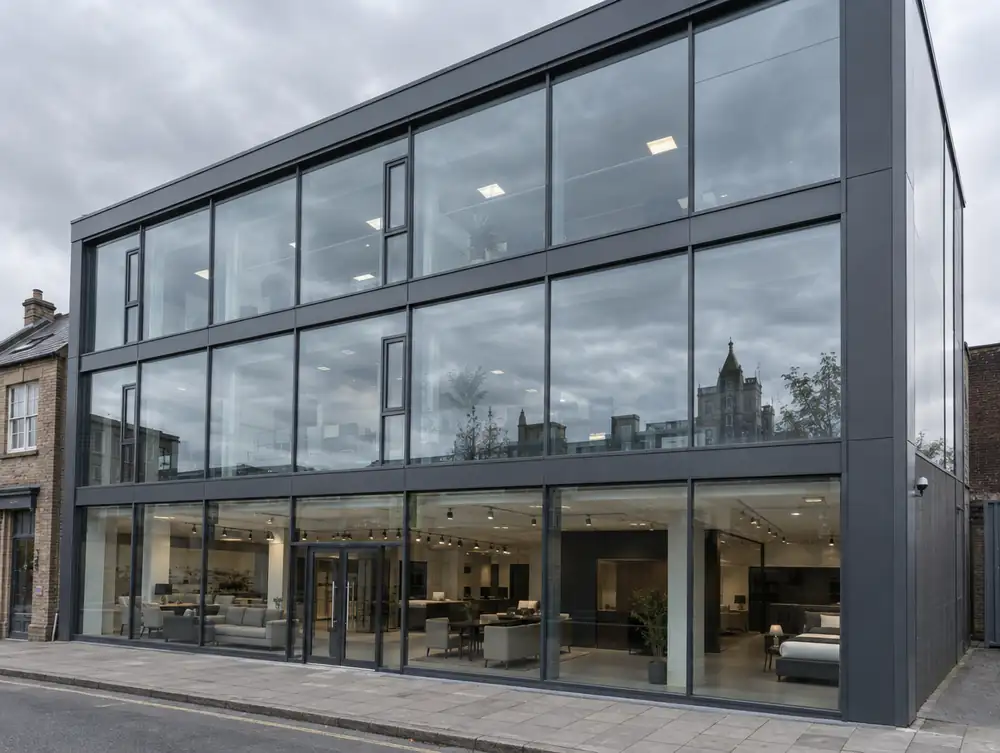
How do you design around the building when planning curtain walling in Stamford?
If the ground floor of your Stamford premises is a shop, we carry the curtain wall grid down into the shopfront below. Door heads, fascia line and transoms then line up by design.
If the frontage joins a neighbouring building in Stamford, we draw that junction in full at design stage. The last mullion, the flashing and the movement joint are details people notice from the pavement.
If your Stamford unit is narrow, a central door can split a small window into two weak ones. Moving the door to one side gives you a single confident pane, provided the layout inside still works.
What permissions should you check for curtain walling in Stamford?
England has no permitted development route for changing a shopfront. Part 7 Class A of the General Permitted Development Order 2015 excludes creating, altering or replacing one, and it allows no alterations at all on article 2(3) land. That leaves two outcomes for curtain walling at premises in the Stamford area: a planning application, or work that doesn't materially affect the external appearance.
Expect planning and advert applications here to go to South Kesteven District Council in the normal way. We check what that means for your building when we survey it in Stamford.
What might curtain walling cost in Stamford?
As a working budget, use £550 to £1,250 plus VAT per m². Your place inside that range for curtain walling depends mostly on how much of the existing frontage can stay and how much has to be put right first.
| Town | Stamford |
|---|---|
| Area | Lincolnshire |
| Postcode districts | PE9 |
| Planning authority | South Kesteven District Council |
| Building approval | Building Regulations (Approved Documents) |
| Distance from Great Barr | About 60 miles |
| Survey | Free for new work |
Does South Kesteven District Council publish shopfront guidance?
Yes, South Kesteven Shopfront Design Guide (2024). It tells applicants what the council expects from new and altered shopfronts. A few of the things it asks for:
- Retractable shutters should sit inside the building hidden behind the fascia, and external roller shutters are not acceptable on listed buildings.
- Fascias that are boxed in or project excessively are unsuitable, and signs should not be built out on an extra box or board.
- External illumination is the only acceptable option for traditional shopfronts, using static single-colour LED where lighting is accepted.
Questions about curtain walling in Stamford
Can part of an elevation in Stamford be done first?
Yes, provided the break falls at a sensible mullion. Phasing can spread cost and disruption, although two visits usually cost more than one. We would draw the whole elevation first so the second phase matches.
Will you coordinate with my architect or main contractor in Stamford?
Yes. We can work to their drawings and programme, and we supply shop drawings for their review before anything is made. Your named contact stays the single route for questions on our package.
How disruptive is curtain walling for neighbours in Stamford?
Most disruption comes from access equipment and deliveries, not from noisy work. We plan unloading and any scaffold around nearby premises, and we keep the working area screened and tidy at the end of each shift.
Does a new shopfront in the Stamford area need Building Regulations approval?
Assume yes until building control says otherwise. England has no like-for-like exemption, though registered installers can self-certify replacement windows and doors in non-dwellings. That route doesn't cover structural glass, curtain walling or revolving doors.
Do roller shutters need planning permission in the Stamford area?
Usually yes. Installing or replacing a security grill or shutter on a shopfront is expressly outside England's shop permitted development rights, so the only way to avoid an application is work that doesn't materially affect the appearance. Ask the council before ordering.