Drawn well, a frontage in Stamford can be priced accurately and built without guesswork. The design pack covers elevation, section and specification.
Measuring the opening is the easy part of a survey in Stamford. We also look at the beam above, the pavement fall and any meters or drains nearby.
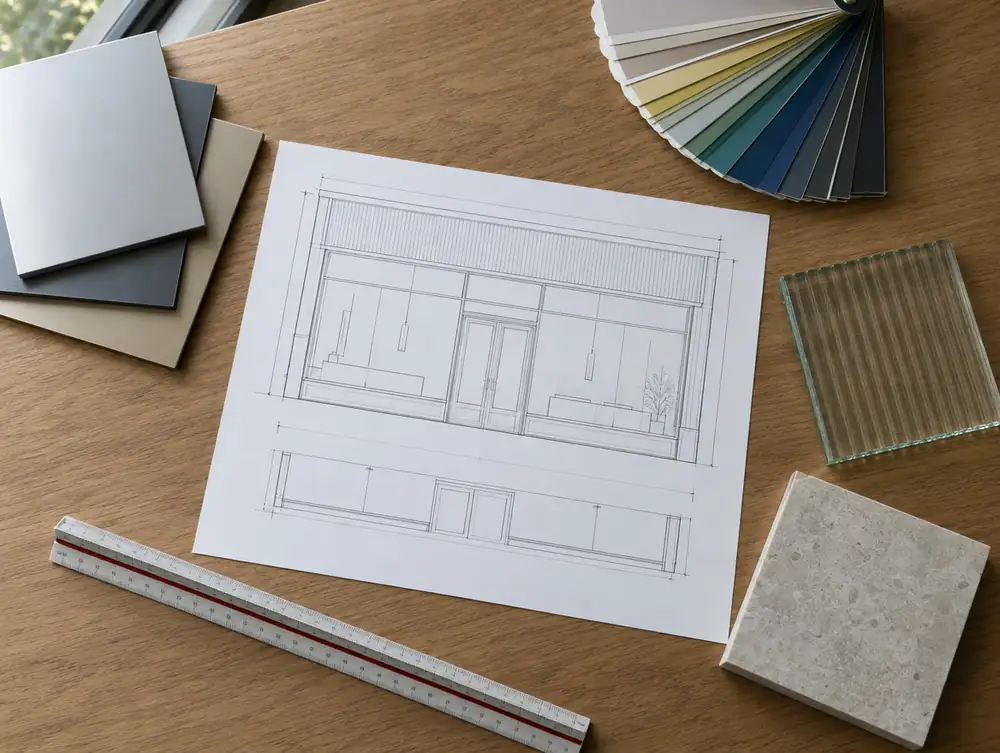
What goes into getting shopfront design right in Stamford?
If your brand is new to Stamford, we look at how far the guidelines need adapting to this building. A logo may need a different size or layout on a shallow fascia, and that is worth settling early.
If the pavement falls along your frontage, we survey the levels before drawing a line. Door threshold, stallriser and sill are then set from the real ground, which is where designs drawn from photographs tend to fail.
If your premises were once two shops, decide early whether the front should read as one or as two. One continuous fascia with a repeated bay width usually settles the elevation better than two mismatched halves, which is worth testing on any Stamford unit of that kind.
How much could shopfront design in Stamford cost you?
Our guide band is £495 to £2,495 plus VAT per frontage. Scope is the biggest lever, so a tighter brief for shopfront design brings the figure down faster than any change of detail.
Which applications might shopfront design in Stamford involve?
For shopfront work at premises in the Stamford area, the deciding question in England is whether the building work materially affects the external appearance. If it does, planning permission is needed, while a true like-for-like replacement usually needs none. The council confirms the position for each site.
At survey we check how things stand for your building, although applications for planning permission or advertisement consent here normally go to South Kesteven District Council.
| Town | Stamford |
|---|---|
| Area | Lincolnshire |
| Postcode districts | PE9 |
| Planning authority | South Kesteven District Council |
| Building approval | Building Regulations (Approved Documents) |
| Distance from Great Barr | About 60 miles |
| Survey | Free for new work |
Does South Kesteven District Council publish shopfront guidance?
Yes, South Kesteven Shopfront Design Guide (2024). It tells applicants what the council expects from new and altered shopfronts. A few of the things it asks for:
- Retractable shutters should sit inside the building hidden behind the fascia, and external roller shutters are not acceptable on listed buildings.
- Fascias that are boxed in or project excessively are unsuitable, and signs should not be built out on an extra box or board.
- External illumination is the only acceptable option for traditional shopfronts, using static single-colour LED where lighting is accepted.
Questions about shopfront design in Stamford
Can a design for Stamford premises follow my brand guidelines?
Yes. Send them over with your logo files, and we apply them to your elevation. Where a rule does not fit the building, we explain why and suggest an adjustment.
Can the work on my Stamford frontage be designed in phases?
Yes. We can draw the complete frontage first, then split it into stages, so a new sign and paint now will still suit a new shopfront later.
Will you work with my shopfitter or architect in Stamford?
Yes. We share drawings and coordinate the frontage with their ceiling, lighting and display plans. Your named contact stays the route for questions on the frontage.
Does the Equality Act apply to a shop entrance in the Stamford area?
Yes. The Equality Act 2010 applies in England, as across Great Britain, and it requires reasonable steps to remove, alter or avoid physical features that disadvantage disabled people. The duty is anticipatory, so it looks at disabled people generally, and a new Services Code replaced the 2011 Code on 5 August 2026.
Does a new shopfront in the Stamford area need Building Regulations approval?
Assume yes until building control says otherwise. England has no like-for-like exemption, though registered installers can self-certify replacement windows and doors in non-dwellings. That route doesn't cover structural glass, curtain walling or revolving doors.