From measured survey to handover, awnings and canopies across Little Venice and Greater London sit under one contract, alongside any sign or shopfront work on the same frontage. Your named contact treats the fabric, the frame and the fixing as one job.
We measure your Little Venice opening in person, at a time agreed with you first, so the visit fits around your trading.
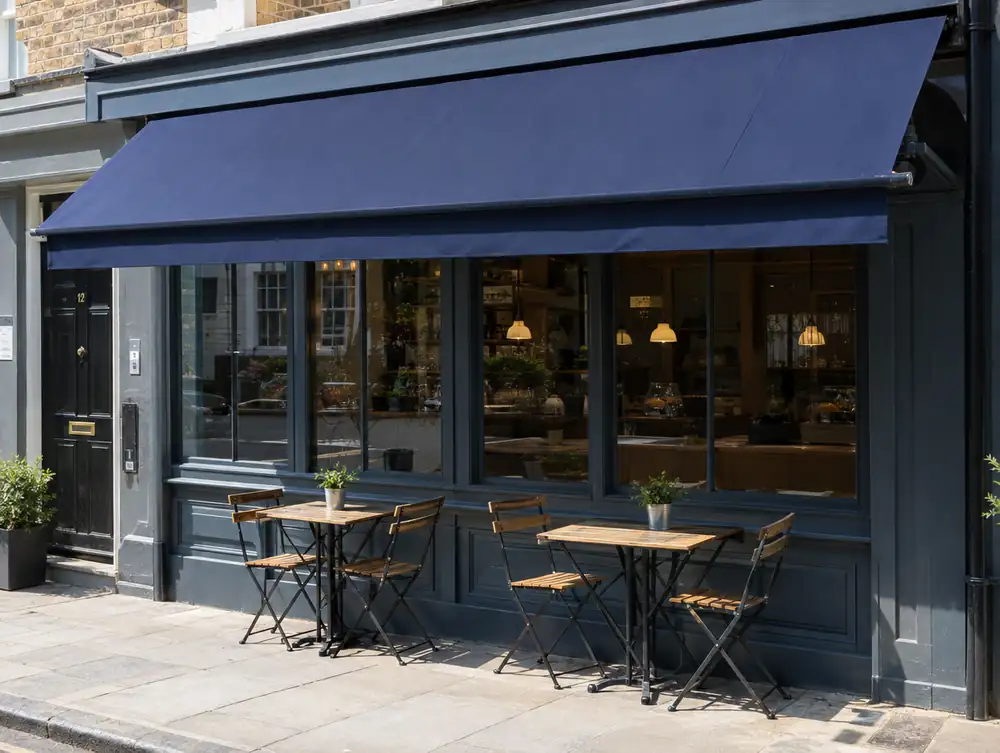
What makes canopies and awnings work well on Little Venice premises?
If the wall is rendered or cavity-built, we check what lies behind it before designing brackets. Long anchors or a spreader plate can take the load where a standard fixing would pull out.
Should your frontage still have an old blind box, we open it up at survey. A sound box can take a new roller and cover, and it keeps a detail worth having.
A corner unit has two fronts to think about, and the return elevation often does as much selling as the main one. If that is your layout in Little Venice, carry the fascia and glass line round the corner and treat both faces as one composition.
How much should you set aside for canopies and awnings in Little Venice?
A sensible starting budget is £1,495 to £9,995 plus VAT per canopy or awning. What shifts the figure is whatever can't be seen yet, such as the condition behind the old frontage or the services running through it.
Could canopies and awnings in Little Venice need planning permission?
Security grilles and shutters are named in England's rules: installing or replacing one on a shopfront sits outside the shop permitted development rights. The frontage itself is treated the same way, so for canopies and awnings at premises in the Little Venice area, building work that materially affects the appearance needs planning permission. Confirm the position with the council before anything is ordered.
A lit projecting sign at premises in the Little Venice area has firm limits under Class 4B in England: 0.75m² per surface and 1m high. It can project 1m, or two-thirds of the footway if that is less, and it can't sit over the carriageway. A larger sign needs advertisement consent, and so does a lit one in a conservation area.
For Little Venice, the usual route for planning and advert applications is through Westminster City Council, and we confirm that when we visit.
| Town | Little Venice |
|---|---|
| Area | Greater London |
| Postcode districts | NW8, W1H, W2, W9 |
| Planning authority | Westminster City Council |
| Building approval | Building Regulations (Approved Documents) |
| Distance from Great Barr | About 102 miles |
| Survey | Free for new work |
Does Westminster City Council publish shopfront guidance?
Yes, Shopfronts, Blinds and Signs - A Guide to their Design (1993). It tells applicants what the council expects from new and altered shopfronts. A few of the things it asks for:
- Roller shutters will not normally be given consent, and internally fitted brick-bond grilles are the preferred solution.
- Large internally lit box signs are generally inappropriate, while externally lit fascias and back-lit or halo-lit letters are accepted.
- Projecting signs need at least 2.6m clearance above the pavement and should sit at fascia level, centred on a pilaster.
Questions about canopies and awnings in Little Venice
Which awning suits a cafe in Little Venice?
A folding arm awning with a motor usually suits a cafe, because it covers a wide area with no posts. If tables sit close to the kerb or the site is windy, a shorter projection or fixed canopy may suit better.
Can the awning match other premises I run in Greater London?
Yes. Send a photograph and any fabric reference, and we match the cloth, valance and lettering as closely as current ranges allow. Fabric lines change over time, so we show you a sample first.
Can an awning in Little Venice be motorised?
Yes, most can. A tubular motor sits inside the roller, with a remote or wall switch, and a wind sensor can be added. You will need a power supply near the box, which we check at survey.
What rules apply to a fire exit door through a shopfront in the Little Venice area?
It must open in the direction of escape and can't be locked against immediate use, and a dedicated fire exit can't be a sliding or revolving door. In England that comes from article 14(2) of the Regulatory Reform (Fire Safety) Order 2005, and the duty sits with the responsible person, normally the employer or whoever controls the premises for a business, otherwise the owner. An outward door can clash with section 153 of the Highways Act 1980 where it opens onto the footway, so raise it early.
Do I need planning permission to change a shopfront in the Little Venice area?
Usually yes, if the work materially affects the building's external appearance. England's shop permitted development rights exclude creating, altering or replacing a shopfront, so there is no shortcut. A true like-for-like replacement usually needs no application, and the council confirms the position.