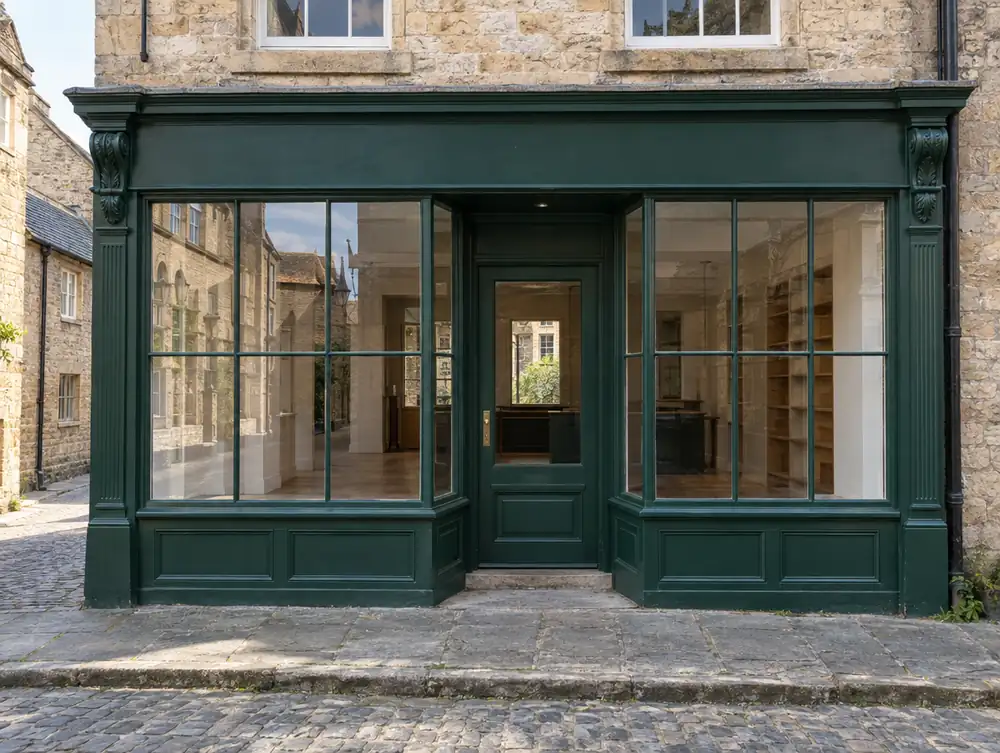
Timber gives a shopfront in Little Venice something metal can't: real depth, cast shadows and mouldings you can run your hand along. We draw each front to the measured opening and make it to those signed-off dimensions.
Expect us to measure the opening, photograph the existing front and check how materials will reach it on the day, at a time you have agreed.
What goes into getting timber shopfronts right in Little Venice?
Where a landlord in Little Venice has set rules for materials or colour, timber is usually an easy conversation. We'd prepare a drawing and paint reference for approval, and adjust the mouldings if the terms ask for something plainer.
In a parade of mixed fronts in Little Venice, painted timber can lift a unit without shouting. We'd take the height of the neighbouring cills and fascias, then let the depth of the mouldings and a considered colour do the talking.
Where units share one long run of fascia, breaking the height makes you stand out for the wrong reason. If that describes your Little Venice parade, keep the line and win attention with lettering, lighting and what's in the window.
How much could timber shopfronts in Little Venice cost you?
A sensible starting budget is £3,995 to £13,995 plus VAT for a typical frontage. What shifts the figure is whatever can't be seen yet, such as the condition behind the old frontage or the services running through it.
Which applications might timber shopfronts in Little Venice involve?
For timber shopfronts at premises in the Little Venice area, the deciding question in England is whether the building work materially affects the external appearance. If it does, planning permission is needed, while a true like-for-like replacement usually needs none. The council confirms the position for each site.
Expect planning and advert applications here to go to Westminster City Council in the normal way. We check what that means for your building when we survey it in Little Venice.
| Town | Little Venice |
|---|---|
| Area | Greater London |
| Postcode districts | NW8, W1H, W2, W9 |
| Planning authority | Westminster City Council |
| Building approval | Building Regulations (Approved Documents) |
| Distance from Great Barr | About 102 miles |
| Survey | Free for new work |
Does Westminster City Council publish shopfront guidance?
Yes, Shopfronts, Blinds and Signs - A Guide to their Design (1993). It tells applicants what the council expects from new and altered shopfronts. A few of the things it asks for:
- Roller shutters will not normally be given consent, and internally fitted brick-bond grilles are the preferred solution.
- Large internally lit box signs are generally inappropriate, while externally lit fascias and back-lit or halo-lit letters are accepted.
- Projecting signs need at least 2.6m clearance above the pavement and should sit at fascia level, centred on a pilaster.
Questions about timber shopfronts in Little Venice
How much disruption will a timber front cause in my Little Venice shop?
Expect more time on site than an aluminium front, typically 3 to 7 days with the painting. Closed-day or out-of-hours fitting can be arranged, and the opening stays boarded and secure between stages.
Can a timber front take a modern sign in Little Venice?
Yes. Hand-painted letters suit a timber fascia well, and raised letters or a concealed trough light work too. We draw the sign and the joinery together, so the fixings don't cut through a moulding.
Can you fit a timber front around existing tiles in Little Venice?
Often, yes, and it's usually worth trying. If your stallriser or entrance has good original tile, we'd measure it carefully and scribe the new joinery to it.
What rules apply to a fire exit door through a shopfront in the Little Venice area?
It must open in the direction of escape and can't be locked against immediate use, and a dedicated fire exit can't be a sliding or revolving door. In England that comes from article 14(2) of the Regulatory Reform (Fire Safety) Order 2005, and the duty sits with the responsible person, normally the employer or whoever controls the premises for a business, otherwise the owner. An outward door can clash with section 153 of the Highways Act 1980 where it opens onto the footway, so raise it early.
Does a new shopfront in the Little Venice area need Building Regulations approval?
Assume yes until building control says otherwise. England has no like-for-like exemption, though registered installers can self-certify replacement windows and doors in non-dwellings. That route doesn't cover structural glass, curtain walling or revolving doors.